当前位置:网站首页>Implementation of depth first and breadth first traversal of binary tree
Implementation of depth first and breadth first traversal of binary tree
2022-07-25 08:17:00 【A new dawn on the horizon】
The realization of depth first and breadth first traversal of binary tree
What is a binary tree
Binary tree is a tree storage structure , A tree that meets the following two conditions is a binary tree .
- It's an ordered tree .
- The degree of each node cannot exceed 2
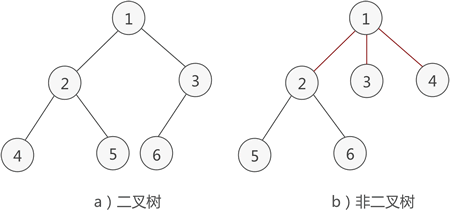
The degree of a tree refers to the node subtree , That is to say, the subtree of each node of a binary tree cannot be more than 2.
Java Implementation of binary tree structure in
class TreeNode {

     int val;
     TreeNode left;
     TreeNode right;
     TreeNode() {
    }
     TreeNode(int val) {
     this.val = val; }
     TreeNode(int val, TreeNode left, TreeNode right) {

         this.val = val;
         this.left = left;
         this.right = right;
     }
}
Each node of the binary tree saves its own data and child nodes , In fact, it is a recursive structure , Therefore, it is very simple to use recursive method to obtain the data of binary tree . The traversal of binary trees is mainly divided into two kinds , Depth-first traversal (Depth First Search) And breadth first traversal (Breadth First Search).
Depth first traversal of binary tree
Depth first traversal of a binary tree is to access the binary tree from a certain layer according to a certain order , After accessing all nodes of the current layer, enter the next layer , According to the order of the root node in the traversal process , Depth first traversal is divided into preorder traversal , Middle order traversal and post order traversal .
- The first sequence traversal
Preorder traversal is to visit the root node first , Then visit the left and right nodes respectively to traverse the binary tree .
For a binary tree in the figure above , Its preorder traversal order is A,B,D,E,F,G,C,H, First visit A node , Then access its left node B, Again because B It is also the root node of its subtree , So visit its left node , This is the order above .
use Java There are mainly two ways to realize preorder traversal: stack and recursion , The following middle sequence and post sequence will also be implemented in these two ways .
Java Recursive way to achieve preorder traversal :
public void firstSearch(TreeNode root){

        if(root!=null){

            System.out.println(root.val);
            firstSearch(root.left);
            firstSearch(root.right);
        }
    }
Very simple code , There's no need to explain
Java Stack way to achieve preorder traversal :
public void firstSearch2(TreeNode root){

        Stack<TreeNode> stack=new Stack<>();
        while(root!=null||stack.size()>0){

            if(root!=null){

                System.out.println(root.val);
                stack.push(root);
                root=root.left;
            }else{

                TreeNode pop = stack.pop();
                root=pop.right;
            }

        }
    }
First create a stack , Then access the data of the root node , Finally, push it onto the stack and take out its left child node as the value of the next cycle , If the current root node is found to be null, It means that the left node of the previous node is null, Then pop it from the stack and take its right child node as the value of the next cycle , Until there are no elements in the stack .
- In the sequence traversal
The middle order traversal of a binary tree is to traverse first left, then root, and finally right nodes .
For the binary tree in the figure above , Its middle order traversal method is E,D,F,B,G,A,C,H.
Java Recursive way to achieve sequence traversal :
public void firstSearch3(TreeNode root){

        if(root!=null){

            firstSearch3(root.left);
            System.out.println(root.val);
            firstSearch3(root.right);
        }
    }
It's still very simple , Just change the execution order of the code , It turns into traversing the left node first , Then output the root node , Finally, output the right node .
Java Stack way to achieve sequence traversal :
public void firstSearch4(TreeNode root){

        Stack<TreeNode> stack =new Stack<>();
        while(root!=null||stack.size()>0){

            if(root!=null){

                stack.push(root);
                root=root.left;
            }else{

                TreeNode pop = stack.pop();
                System.out.println(pop.val);
                root=pop.right;
            }
        }
    }
It is no different from the method of preorder traversal , Just like recursion, it's just the code order of exchange , When all the left child nodes are pushed into the stack , Pop up traversal again , and
3. After the sequence traversal
The middle order traversal of binary tree is to traverse the root node from left to right .
This is also the binary tree , According to the way of post order traversal, the result is ,E,F,D,G,B,H,C,A.
Java Recursive way to achieve subsequent traversal
public void firstSearch5(TreeNode root){

        if(root!=null){

            firstSearch5(root.left);
            firstSearch5(root.right);
            System.out.println(root.val);
        }
    }
Java Stack to achieve subsequent traversal
public void firstSearch7(TreeNode root){

            Stack<TreeNode> stack = new Stack<TreeNode>();
            TreeNode pre = null;
            stack.push(root);
            while(!stack.isEmpty()){

                TreeNode curr = stack.peek();
                if((curr.left == null && curr.right == null) ||
                        (pre != null && (pre == curr.left || pre == curr.right))){

                    // If the left and right child nodes of the current node are empty or the last accessed node is the child node of the current node , The current node is out of the stack
                    System.out.println(curr.val);
                    pre = curr;
                    stack.pop();
                }else{

                    if(curr.right != null) stack.push(curr.right); // First press the right node on the stack
                    if(curr.left != null) stack.push(curr.left);   // Then put the left node on the stack
                }
            }
    }
The implementation of post order traversal stack is more complex than the first two , Because it requires us to pop the root node out of the stack and not access it when it has a right node , Finally, visit it . In the first half of the code, it is the same idea as the middle order traversal , First find the leftmost child node , The difference is , When we play the stack, we judge every time , Whether its right node is empty and whether its right node was accessed last time , If this condition is not met, we will store it in the stack , Take its right node as the next node , Access it after accessing its left and right nodes .
Traversing a binary tree first
The breadth first traversal of binary tree is from top to bottom , Traverse the binary tree layer by layer ,
For the binary tree in the above figure , Its breadth first traversal result is A,B,C,D,G,H,E,F.
Java Queue way to achieve the breadth first traversal of binary tree :
public void firstSearch8(TreeNode root){

        Queue<TreeNode> queue=new LinkedList<>();
        if(root!=null){

            queue.add(root);
        }
        while(!queue.isEmpty()){

            TreeNode remove = queue.remove();
            System.out.println(remove.val);
            if(remove.left!=null){

                queue.add(remove.left);
            }
            if(remove.right!=null){

                queue.add(remove.right);
            }
        }
    }
It's simple , Using the idea of queue first in first out , After accessing the root node, put its next child node at the end of the queue , After traversing this layer in this way , Then you can visit the next level node .
Then the main ways of traversing binary trees are introduced , In error , Welcome to point out
边栏推荐
- 7.24模拟赛总结
- Introduction and installation of mongodb
- Raspberry pie 3b ffmpeg RTMP streaming
- mysql 如何获取两个集合的交集/差集/并集
- R language error
- Test the mock data method of knowing and knowing
- ArcGIS Pro scripting tool (10) -- generate.Stylx style symbols from layers
- Raspberrypico serial communication
- Learn no when playing 8 | the enterprise saves hundreds of thousands in an instant, just because it uses it
- 016 fundamentals of machine learning mathematics: Introduction
猜你喜欢

公寓报修系统(IDEA,SSM,MySQL)
![[audio and video] picture YUV data format](/img/f6/922ff1f8bbbeff83a095a3ad5e797f.png)
[audio and video] picture YUV data format
![[dark horse programmer] redis learning notes 003: redis transactions](/img/c4/a7fcb3bc65d4013b3817c6115ce061.png)
[dark horse programmer] redis learning notes 003: redis transactions

Raspberry connects EC20 for PPP dialing

Redis best practices

CM4 development cross compilation tool chain production

Chapter 3 business function development (modifying clues, data echo and modifying data)

Science: listening to music can really relieve pain. Chinese scientists reveal the neural mechanism behind it

475-82(230、43、78、79、213、198、1143)

Numpy learning
随机推荐
Idea2021 failed to start. Could not find main class com/intellij/idea/main
文献学习(part101)--CONVEX BICLUSTERING
Advanced C language (XII) - dynamic memory management
Dijkstra序列(暑假每日一题 5)
[dark horse programmer] redis learning notes 005: enterprise level solutions
Dirty data and memory leakage of ThreadLocal
File details
Learn when playing No 6 | the magic of document library lies in
RTOS series (13): assembly LDR instruction, LDR pseudo instruction, [rn] register indirect reference detailed analysis
Learn when playing No 1 | can live classroom still be like this? Come and unlock "new posture"!
Install MySQL 8.0 using docker
People who lose weight should cry: it's no good not eating food, because your brain will be inflamed
Some easy-to-use plug-ins and settings installed in vscode
Chapter 3 business function development (query clues)
Vscode remote connection server, switch to go version
Introduction to machine learning (I): understanding maximum likelihood estimation in supervised learning
Rk3399 development board i2c4 attaching EEPROM instance
475-82(230、43、78、79、213、198、1143)
Sun Tzu's art of war
Uiautomator2 common commands