当前位置:网站首页>Classical synchronization problem
Classical synchronization problem
2022-06-26 16:46:00 【Uncertainty!!】
Classic synchronization problem
1. Classic synchronization problem
Process synchronization : This enables concurrent processes to advance in an orderly manner , Solve the uncertainty caused by disordered promotion in asynchrony ( There is a sequence of execution )
Processes are mutually exclusive : When a process accesses or operates on a resource , Other processes cannot operate on this resource ( I operate you cannot )
1.1 producer - Consumer issues
There is a queue ( buffer ), The producer is at the head of the queue , The consumer is at the end of the queue , Producers put things at the head of the team ( data ), Consumers take things from the end of the line ( data )
The following figure comes from 《 Half an hour cartoon computer 》
If the queue is empty , Consumers have to wait , Wait until the producer puts in something before telling the consumer to take it ( Queue is not full , Producers produce )
If the queue is full , The producer has to wait , Wait until the consumer takes something away before telling the producer to put it away ( The queue is empty , Consumer consumption )
There is a sequence between putting data and fetching data , That is, there is synchronization
Be careful :
1. Because buffers are critical resources , Both cannot operate queues at the same time , So you need a mutex (mutex clock)
2. The thread also has to notify another thread when the above conditions are met
The mutex : A thread attempts to lock a resource before operating on it , Operate the resource after locking successfully , Unlock after operation , That is, only one thread can hold the lock at a time
The following figure comes from 《 Half an hour cartoon computer 》

A producer , A consumer
semaphore muxtex=1;		// Mutex semaphore
semaphore empty=n;		// Synchronous semaphore , The initial state is n Empty buffer units
semaphore full=0;		// Synchronous semaphore , The initial state is 0 Full buffer units
producer(){
    		// Producer process
	while(1){

		produce data;
		P(empty);	// Request an empty buffer unit
		P(mutex);	// Enter the mutex on the critical area
		add data into buffer;	// Fill the buffer with data , The buffer unit becomes a full buffer unit
		V(mutex);	// Exit the critical area and release the mutex
		V(full);	// Release the full buffer unit
	}
}
consumer(){
    		// Consumer process
	while(1){

		P(full);	// Request a full buffer unit
		P(mutex);	// Enter the mutex on the critical area
		remove data from buffer;	// Fetch data from buffer , The buffer unit becomes an empty buffer unit
		V(mutex);	// Exit the critical area and release the mutex
		V(empty);	// Release the empty buffer unit
	}
}
Suppose a situation : Buffer is full (empty=0,full=n), If you exchange two in the production function P Sequence of operations , Then there will be a deadlock
P(mutex);	// Top mutex
P(empty);	// Request empty buffer unit , But there are no empty buffer units , So the process will wait here , You cannot release the mutex , Caused a deadlock problem
So we need Sync first , Post mutual exclusion To avoid the deadlock problem in this case
1.2 readers - Write the questions
Readers can only read data , Can't modify data
The writer can read the data , Data can be modified 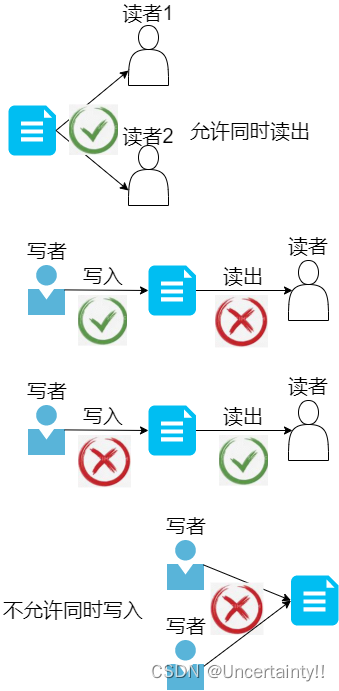
semaphore rw=1;	// Realize mutually exclusive access to shared files
writer(){
    	// Writer process
	while(1){

		P(rw);	// Request operation share file
		write(); // Writing documents
		V(rw);	// Release shared files
	}
}
reader1(){
    	// The reader process 1
	while(1){

		P(rw);	// Request access to shared files
		read(); // Reading documents
		V(rw);	// Release shared files
	}
reader2(){
    	// The reader process 2
	while(1){

		P(rw);	// Request access to shared files
		read(); // Reading documents
		V(rw);	// Release shared files
	}
}
In the above case , If there are multiple readers calling at the same time reader To read the file , First of all, such behavior is allowed , But it was locked before reading , Multiple readers are mutually exclusive , Therefore, multiple readers cannot read files at the same time , So how can multiple readers read files at the same time ? We introduce a variable count Record the number of readers reading the file , And introduce mutually exclusive semaphores countmutex To make processes mutually exclusive count Variable
semaphore rw=1;	// Realize mutually exclusive access to shared files
int count=0;	// Number of processes currently accessing shared files , The initial value is 0
semaphore countmutex=1;	// Guarantee right count Mutually exclusive access to variables
writer(){
    	// Writer process
	while(1){

		P(rw);	// Request operation share file
		write(); // Writing documents
		V(rw);	// Release shared files
	}
}
reader1(){
    	// The reader process 1
	while(1){

		P(countmutex);
		//if(count==0) You can determine whether the current read process is the first read process or the last read process
		if(count == 0)	// A reader process calls reader, Check count by 0, Indicates that no process is currently accessing the shared file
			P(rw);	// Request access to shared files
		count++;	// The previous process has requested to read the file , Therefore, the current number of processes accessing shared files is increased by 1
		V(countmutex);
		read();	 	// The process reads the file
		P(countmutex);
		count--;	// The previous process has finished reading , Therefore, the current number of processes accessing shared files decreases 1
		if(count == 0)	// Determine whether there are still processes reading files , If meet , It means there is no , You can release the lock
			V(rw);	// Release the lock to access the shared file
		V(countmutex);
	}
reader2(){
    	// The reader process 2
	while(1){

		P(countmutex);
		//if(count==0) You can determine whether the current read process is the first read process or the last read process
		if(count == 0)	// A reader process calls reader, Check count by 0, Indicates that no process is currently accessing the shared file
			P(rw);	// Request access to shared files
		count++;	// The previous process has requested to read the file , Therefore, the current number of processes accessing shared files is increased by 1
		V(countmutex);
		read();	 	// The process reads the file
		P(countmutex);
		count--;	// The previous process has finished reading , Therefore, the current number of processes accessing shared files decreases 1
		if(count == 0)	// Determine whether there are still processes reading files , If meet , It means there is no , You can release the lock
			V(rw);	// Release the lock to access the shared file
		V(countmutex);
	}
}
Although the above implements the operation of reading shared files by multiple readers at the same time , However, there is a hidden danger in this situation, that is, if multiple readers have been reading the shared files , At this time, the writer process has been blocking and waiting , This may cause the writer process to starve , In order to solve the problem that the writing process may starve , We need to implement write first
We introduce mutually exclusive semaphores w To achieve write first
( In fact, it is not really write first , A read-write fairness policy is required to achieve true write first )
semaphore rw=1;	// Ensure that readers and writers are mutually exclusive to access files
int count =0;	// Number of processes reading files , Initially, no process was reading file
semaphore mutex=1;	// The process is right count Variables for mutually exclusive access
semaphore w=1;	// Used to implement write first . Prevent multiple reading processes from reading files , The writer process starved to death due to blocking and waiting too long
writer(){
    	// Writer process 1
	while(1){

		P(w);	// Lock the write process
		P(rw);	// Lock the write file
		 Writing documents
		V(rw);	// Unlock write file
		V(w);	// Unlock the write process
	}
}
reader1(){
    	// The reader process 1
	while(1){

		P(w);
		P(mutex);	// The variable count Lock
		if(count==0)	// Check that no process is currently reading the file
			P(rw);		// If there is a writer , Block the writer
		count++;		// Number of processes currently reading files +1
		V(mutex);	// The variable count Unlock
		V(w);
		 Reading documents
		P(mutex);	// The variable count Lock
		count--;	// Last process read completed , Number of processes currently reading files -1
		if(count==0)	// Check that no process is currently reading the file
			V(rw);		// Unlock the read file
		V(mutex);	// The variable count Unlock
	}
reader2(){
    	// The reader process 2
	while(1){

		P(w);
		P(mutex);	// The variable count Lock
		if(count==0)	// Check that no process is currently reading the file
			P(rw);		// If there is a writer , Block the writer
		count++;		// Number of processes currently reading files +1
		V(mutex);	// The variable count Unlock
		V(w);
		 Reading documents
		P(mutex);	// The variable count Lock
		count--;	// Last process read completed , Number of processes currently reading files -1
		if(count==0)	// Check that no process is currently reading the file
			V(rw);		// Unlock the read file
		V(mutex);	// The variable count Unlock
	}
}
Hypothetical reader 1, Writer 1, readers 2 Concurrent execution
Writer 1 In the reader 2 Pre execution , Realize write first , It avoids the starvation of the writing process 
1.3 The question of philosophers eating
There is... On one table 5 A philosopher (5 A process ),5 Chopsticks (5 A critical resource ), Only when philosophers pick up their left and right chopsticks at the same time can they eat ( Access critical resources ), If you can't get it at the same time 2 Chopsticks , Then philosophers think ( Process blocking wait )
The following figure is from the Wangdao postgraduate entrance examination operating system 
hypothesis 5 Two philosophers picked up their left chopsticks at the same time , Every philosopher is waiting for the philosopher on the right to put down his chopsticks , And will not take the initiative to put down the chopsticks in their hands , So there's a deadlock 
How to solve the deadlock problem ?
Scheme 1 : 4 Two philosophers picked up the chopsticks on the left side at the same time ,3 No. 1 also picked up the chopsticks on the right , After eating , put down 2 Chopsticks ,2 No. pick up 3 Put down the chopsticks to eat
stay 3 While the No. 1 philosopher was eating ,0 Number ,1 Number ,2 Number is occupied 1 Resources are blocking and waiting at the same time ( Some waste resources )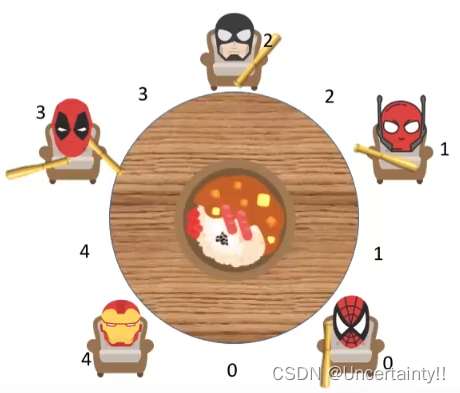
semaphore chopstick[5]={
    1,1,1,1,1}; // Semaphore ( Critical resource quantity ,1 Chopsticks stand for 1 A critical resource )
Pi(){
    	// The first i A philosopher process
	do{

		P(chopstick[i]);	// Take the left chopsticks
		P(chopstick[(i+1)%5]);	// Take the right chopsticks
		eat;
		V(chopstick[i]);	// Put back the left chopsticks
		V(chopstick[(i+1)%5]);	// Put back the right chopsticks
		think;
	}while(1);
}
Option two : Odd numbered philosophers take the chopsticks on the left first , Then take the chopsticks on the right , Even numbered philosophers take the chopsticks on the right first , Then take the chopsticks on the left
If two philosophers vie for one of the chopsticks , Surely one of the philosophers will vie for it , Another philosopher would be empty handed ( Do not use resources to block and wait )
Option three : Only when the chopsticks on the left and right sides of the philosopher are available , Just grab two chopsticks to eat
Consider whether you can pick it up at once 2 Chopsticks , Then make a decision , This will avoid deadlock , This is the essence of the dining problem of philosophers

semaphore chopstick[5]={
    1,1,1,1,1};	// Semaphore ( Critical resource quantity ,1 Chopsticks stand for 1 A critical resource )
semaphore mutex = 1;	// Mutex semaphore , Mutually exclusive chopsticks
Pi(){
    	// The first i A philosopher process
	do{

		P(mutex);	// locked
		P(chopstick[i]);	// Take the left chopsticks
		P(chopstick[(i+1)%5]);	// Take the right chopsticks
		V(mutex);	// Unlock
		eat;
		V(chopstick[i]);	// Put back the left chopsticks
		V(chopstick[(i+1)%5]);	// Put back the right chopsticks
		think;
	}while(1);
}
1.4 Smoker problem
Essential for : Single producer — The problem of multiple consumers
The supplier provides three materials without limit : paper 、 glue 、 Tobacco , And only two of them are provided at a time
Smokers have only one material in their hands , Only when there are two other materials , Then you can roll out cigarettes , And smoke , Tell the supplier after smoking , The supplier continues to supply materials and puts them on the table
Mutual exclusion :
Three smoker processes are mutually exclusive to access the table ( Capacity of 1 The buffer )
Synchronous relationship :
There are combinations on the table 1, Then the first smoker takes away
There are combinations on the table 2, Then the second smoker takes away
There are combinations on the table 3, Then the third smoker takes away
A smoker sends a signal to the supplier after smoking , Then the supplier continues to supply materials and puts them on the table
The following figure is from the Wangdao postgraduate entrance examination operating system 
The following figure is from the Wangdao postgraduate entrance examination operating system 
int num=0;		// It is used to realize that three smokers smoke in turn
semaphore offer1=0;
semaphore offer2=0;
semaphore offer3=0;
semaphore finish=0;
provider(){

	while(1){

		num++;
		num=num%3;	// Make smokers 0,1,2 Take turns getting materials
		if(num==0)
			V(offer1);	// Release the combination 1 material : paper + glue
		else if(num==1)
			V(offer2);	// Release the combination 2 material : Tobacco + glue
		else
			V(offer3);	// Release the combination 3 material : Tobacco + paper
	 Put the material on the table
	P(finish);	// Receive completion signals from smokers
	}
}

smoker1(){

	while(1){

		P(offer1);	// smoker 1 Take away the combination 1 material
		 Smoke after making cigarettes with three materials
		V(finish);	// Notify the supplier , Smoking completed
	}
}

smoker2(){

	while(1){

		P(offer2);	// smoker 2 Take away the combination 2 material
		 Smoke after making cigarettes with three materials
		V(finish);	// Notify the supplier , Smoking completed
	}
}

smoker3(){

	while(1){

		P(offer3);	// smoker 3 Take away the combination 3 material
		 Smoke after making cigarettes with three materials
		V(finish);	// Notify the supplier , Smoking completed
	}
}
边栏推荐
- [graduation season] a word for graduates: the sky is high enough for birds to fly, and the sea is wide enough for fish to leap
- Memory partition model
- Redis migration (recommended operation process)
- 建立自己的网站(16)
- Teach you to learn dapr - 2 Must know concept
- Arduino uno + DS1302 simple time acquisition and serial port printing
- 电路中缓存的几种形式
- The first open source MySQL HTAP database in China will be released soon, and the three highlights will be notified in advance
- [understanding of opportunity -31]: Guiguzi - Daoyu [x ī] Crisis is the coexistence of danger and opportunity
- Teach you to learn dapr - 1 The era of net developers
猜你喜欢

牛客编程题--必刷101之动态规划(一文彻底了解动态规划)

C语言 头哥习题答案截图
Cloud platform monitoring system based on stm32+ Huawei cloud IOT design
Web3去中心化存储生态图景

Kubernetes essential tools: 2021

Stm32h7b0 replaces the h750 program, causing the MCU to hang up and unable to burn the program

Teach you to learn dapr - 8 binding
用Attention和微调BERT进行自然语言推断-PyTorch

The first open source MySQL HTAP database in China will be released soon, and the three highlights will be notified in advance

建立自己的网站(16)
随机推荐
【从删库到跑路】MySQL基础 完结篇(入个门先跑路了。。)
How to implement interface current limiting?
《软件工程》期末重点复习笔记
JS tutorial - printing stickers / labels using the electronjs desktop application
Failed to upload hyperf framework using alicloud OSS
Use the array to calculate the average of N numbers, and output the numbers greater than the average
Stm32h7b0 replaces the h750 program, causing the MCU to hang up and unable to burn the program
Cloud platform monitoring system based on stm32+ Huawei cloud IOT design
GUI+SQLServer考试系统
最小二乘系统辨识课 中篇:递归最小二乘
基於Kubebuilder開發Operator(入門使用)
C language -- legal identifier and integer
Mono 的一些实例方法
我把它当副业月入3万多,新手月入过万的干货分享!
[Li Kou brush question] monotone stack: 84 The largest rectangle in the histogram
Detailed explanation of cookies and sessions
对NFT市场前景的7个看法
JS tutorial electron JS is a good tool for designing powerful multi platform desktop applications
经典同步问题
[207] several possible causes of Apache crash