当前位置:网站首页>Performance Optimization: how to solve the slow loading speed of the first screen of spa single page application?
Performance Optimization: how to solve the slow loading speed of the first screen of spa single page application?
2022-07-25 05:06:00 【rananie】
List of articles
- SPA How to solve the slow loading speed of the first screen of a single page application ?
- What is the first screen time
- How to calculate the first screen loading time
- Why is the loading speed of the first screen slow , What is the cause ? How to solve the problem of slow speed ?
- Road load by lazy - Reduce the size of the entry file √
- Image loading optimization
- Use CDN Static resource caching +webpack:externals - Improve the response speed of the first request for resources / Reduce the size of the entry file √
- Static resource local cache /HTTP cache - Improve the response speed of secondary requests √
- Avoid repeated packaging of components -webpack:CommonsChunkPlugin The plug-in reduces the volume of the entry file
- webpack Packaging volume optimization
- Turn on GZip Compress -- Reduce the transmission time in the network √
- HTTP2
SPA How to solve the slow loading speed of the first screen of a single page application ?
What is the first screen time
The first screen loading time refers to The time from the corresponding user entering the URL to the completion of the first screen content rendering , The entire website does not need to be fully loaded , But you need to show the content in the current visual window .
White screen time (First Paint): The URL that the user enters from the browser is the address , By the time the browser starts displaying content .
White screen time = The time when the page starts to show - The time to start the request
First screen time (First Contentful Paint): It means that the browser inputs the network address from the response user , By the time the first screen content rendering is completed .
First screen time = First screen content rendering end time point - The time to start the request
How to calculate the first screen loading time
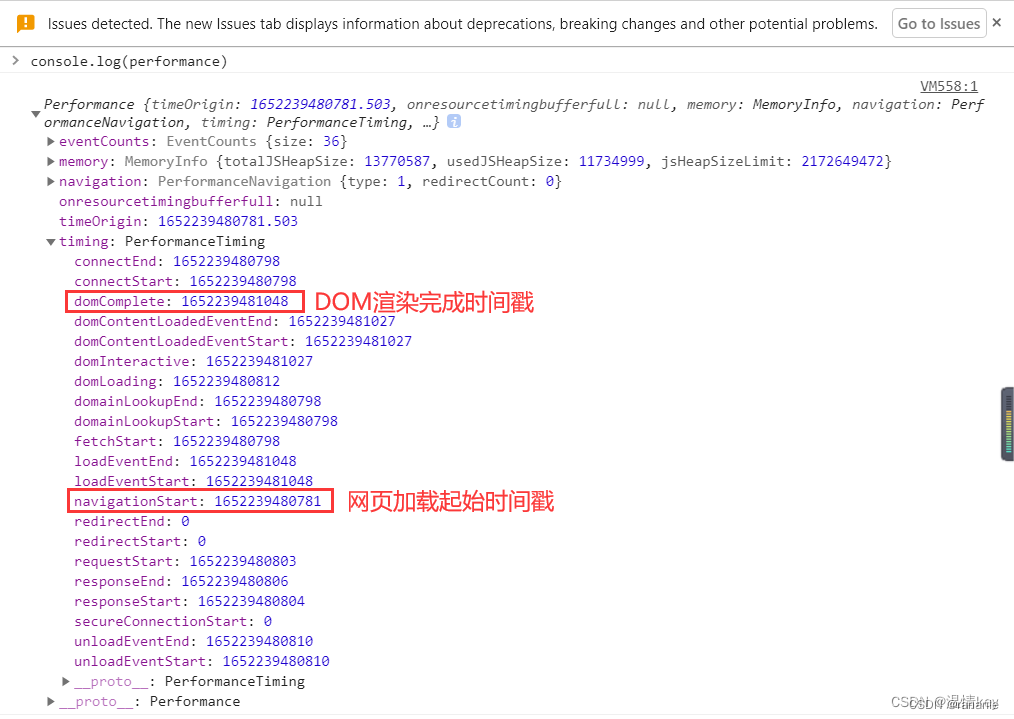
In the console load Display the loading time of the first screen

adopt
window.performanceObject can get the performance related information of the current page
//  Calculate the loading time of the first screen (s)
let awiatTime = (performance.timing.domComplete - performance.timing.navigationStart) / 1000;
Why is the loading speed of the first screen slow , What is the cause ? How to solve the problem of slow speed ?
- Network delay
- Too large file size : Load on demand 、 Compress 、 cache
- Road load by lazy : Pack the routing files separately , Only when a given route is parsed can the corresponding route component be loaded .
- Static resource local cache : Rational use of the front end localStorage,sessionStorage And so on . use HTTP cache , Set up Cache-Control,Last-Modified,Etag Equal response head .
- UI Libraries are loaded on demand : We are introducing elementUI perhaps antdesign etc. UI When the component , There is no need to introduce... Completely at one time , Just introduce the components we need . √
- Image loading optimization ( Use compressible pictures , With lazy loading and preloading )
- GZip Compress : A kind of http Request optimization , Increase loading speed by reducing file size .html、js、css Documents even json Data can be compressed with it , Can reduce 60% The volume above . The front-end configuration gzip Compress , And the server uses nginx Turn on gzip, Used to reduce the traffic size of network transmission .
- Packing volume (webpack Optimize ,tree-sharking And loading plug-ins on demand , as well as css Merge )
- Use CDN Caching static resources
- Use SSR Server rendering
- Repeated requests : Through anti shake throttling , Reduce duplicate requests
Road load by lazy - Reduce the size of the entry file √
note :https://blog.csdn.net/qq_41370833/article/details/125299151?csdn_share_tail=%7B%22type%22%3A%22blog%22%2C%22rType%22%3A%22article%22%2C%22rId%22%3A%22125299151%22%2C%22source%22%3A%22qq_41370833%22%7D&ctrtid=9odkn
Image loading optimization
Picture compression -webpack:file-loader+image-webpack-loader
First use image-webpack-loader Compressed pictures can be reused file-loader Copy the output to the packed static resource directory
//  The official sample
rules: [{

  test: /\.(gif|png|jpe?g|svg)$/i,
  use: [
    'file-loader',
    {

      loader: 'image-webpack-loader',
      options: {

        bypassOnDebug: true, // [email protected]
        disable: true, // [email protected] and newer
      },
    },
  ]
}]
Picture lazy loading √
note :https://blog.csdn.net/qq_41370833/article/details/125284975?csdn_share_tail=%7B%22type%22%3A%22blog%22%2C%22rType%22%3A%22article%22%2C%22rId%22%3A%22125284975%22%2C%22source%22%3A%22qq_41370833%22%7D&ctrtid=wL4FF
Use CDN Static resource caching +webpack:externals - Improve the response speed of the first request for resources / Reduce the size of the entry file √
adopt import Third party dependency package for syntax import , It will eventually be packaged and merged into the same file , This leads to the success of packaging , The volume of single file is too large .
To solve this problem , Can load external CDN resources , adopt webpack Of externals attribute , To configure it so that it is not packaged
Case study
introduce vue and element-ui
  <script src="https://cdn.jsdelivr.net/npm/[email protected]"></script>
  <!--  Introducing styles  -->
  <link rel="stylesheet" href="https://unpkg.com/element-ui/lib/theme-chalk/index.css">
  <!--  Import component library  -->
  <script src="https://unpkg.com/element-ui/lib/index.js"></script>
  //console.log(window) Will find CDN Way to introduce vue、element-ui The exposed global variable is named Vue、ELEMENT
To configure externals
module.exports = {

  externals: {

    'vue': 'Vue',
    'element-ui': 'ELEMENT',
  }
}
CDN Learning notes :https://editor.csdn.net/md/?articleId=125171191
Static resource local cache /HTTP cache - Improve the response speed of secondary requests √
note :https://editor.csdn.net/md/?articleId=125171191
Avoid repeated packaging of components -webpack:CommonsChunkPlugin The plug-in reduces the volume of the entry file
hypothesis A.js File is a common library , Now there are multiple routes in use A.js file , This causes repeated loading CommonsChunkPlugin plug-in unit : By removing the common module , The final composite file can be loaded once at the beginning , It's stored in the cache for later use .
webpack Packaging volume optimization
tree shaking Remove unused code , Reduce code size
Tree shaking The essence of is to eliminate useless JavaScript Code .
tree shaking Premise of use
- Use ES6 Write module code according to the specification ES6 The module dependency of is certain , It has nothing to do with the runtime state
- In the production environment
Load modules on demand code split The code segment
1. Can be node_modules The code is packaged separately into a chunk Output
2. It will automatically analyze multiple entries chunk in , Are there any public documents , If so, it will be packaged into a separate one chunk No repeated packaging
3. Multi entry page
4.- import Dynamic reference module
Turn on GZip Compress -- Reduce the transmission time in the network √
After unpacking , We'll use gzip Do some compression
gizp Compression is a kind of http Request optimization , Increase loading speed by reducing file size .
html、js、css Documents even json Data can be compressed with it , Can reduce 60% The volume above .
compression-webpack-plugin plug-in unit
const CompressionPlugin = require('compression-webpack-plugin')

configureWebpack: config => {

    if (process.env.NODE_ENV === 'production') {

        return {

            plugins: [new CompressionPlugin({

                test: /\.js$|\.html$|\.css/,
                threshold: 10240,
                deleteOriginalAssets: false
            })]
        }
    }
}
We also need to make corresponding configuration on the server If the browser that sent the request supports gzip, Just send it gzip File format , My server uses express It's framed Just install it compression Can use
HTTP2
todo
边栏推荐
- 2022-7-13 summary
- Introduction to fundamentals of operations research [1]
- Introduction to kubernetes
- Information System Project Manager --- Chapter IX examination questions of project human resource management over the years
- I will write some Q & A blogs recently, mainly focusing on the points that are easy to have doubts.
- 深入掌握Pod
- Tiny-emitter.js: a small event subscription and Publishing Library
- Luogu p4281 [ahoi2008] emergency gathering / gathering solution
- Implementation principle of epoll
- Harbor installation
猜你喜欢

QT download installation tutorial

Xiaohongshu joins hands with HMS core to enjoy HD vision and grow grass for a better life
![[literature notes] pointmlp](/img/8f/654dc6e2f4770b7f12aab49098d3d7.png)
[literature notes] pointmlp

Openworm project compilation

基于云原生的私有化 PaaS 平台交付实践

Burpsuite爆破之token值替换

Web: compiling big refactoring from 10 to 1

5年经验的大厂测试/开发程序员,怎样突破技术瓶颈?大厂通病......
中创算力荣获「2022年科技型中小企业」认定

Wechat official account all article download links to get
随机推荐
Permanent magnet synchronous motor 36 question (1) -- what is the difference between salient pole motor and salient pole motor?
The market is right
How to test data in the process of data warehouse migration?
Idea2021 installation
Mit.js: small event publishing and subscription library
It we media shows off its wealth in a high profile, and is targeted by hacker organizations. It is bound to be imprisoned
Seven suggestions for Server Protection
[sht30 temperature and humidity display based on STM32F103]
When image component in wechat applet is used as background picture
QT download installation tutorial
Set up private CA server
Li Kou 731. My schedule II
Openworm project compilation
rhcsa暑假第二天
[analysis of GPIO register (crl/crh) configuration of STM32]
Matter's Unified Smart Home connection standard enables local automatic interaction between smart devices
Solve the problem that uni app applet obtains routes and route parameters
Teach you how to locate unreasonable SQL? And optimize it
Now the operator wants to check the answer details of all user questions from Zhejiang University. Please take out the corresponding data
DOM processing in ahooks