当前位置:网站首页>Pymoo learning (3): use multi-objective optimization to find the set of optimal solutions
Pymoo learning (3): use multi-objective optimization to find the set of optimal solutions
2022-07-23 17:21:00 【Inji】
List of articles
1 Bi objective optimization
It is shown as follows :
min f 1 ( x ) = 100 ( x 1 2 + x 2 2 ) max f 2 ( x ) = − ( x 1 − 1 ) 2 − x 2 2 s.t. g 1 ( x ) = 2 ( x 1 − 0.1 ) ( x 1 − 0.9 ) ≤ 0 g 2 ( x ) = 20 ( x 1 − 0.4 ) ( x 1 − 0.6 ) ≥ 0 − 2 ≤ x 1 ≤ 2 − 2 ≤ x 2 ≤ 2 x ∈ R \begin{aligned} \min & f_{1}(x)=100\left(x_{1}^{2}+x_{2}^{2}\right) \\ \max & f_{2}(x)=-\left(x_{1}-1\right)^{2}-x_{2}^{2} \\ \text { s.t. } & g_{1}(x)=2\left(x_{1}-0.1\right)\left(x_{1}-0.9\right) \leq 0 \\ & g_{2}(x)=20\left(x_{1}-0.4\right)\left(x_{1}-0.6\right) \geq 0 \\ &-2 \leq x_{1} \leq 2 \\ &-2 \leq x_{2} \leq 2 \\ & x \in \mathbb{R} \end{aligned} minmax s.t. f1(x)=100(x12+x22)f2(x)=−(x1−1)2−x22g1(x)=2(x1−0.1)(x1−0.9)≤0g2(x)=20(x1−0.4)(x1−0.6)≥0−2≤x1≤2−2≤x2≤2x∈R First, it needs to be transformed into the standard form of optimization problem :
1) − f 2 ( x ) -f_2(x) −f2(x) Replace f 2 ( x ) f_2(x) f2(x);
2) Inequality constraints are converted to ≤ 0 \leq0 ≤0 In the form of , namely − g 2 ( x ) ≤ 0 -g_2(x)\leq0 −g2(x)≤0;
3) Normalized variable , Make it equal in importance , namely g 1 ( x ) / ( 2 ∗ ( − 0.1 ) ∗ ( − 0.9 ) ) g_1(x)/(2*(-0.1)*(-0.9)) g1(x)/(2∗(−0.1)∗(−0.9)), g 2 ( x ) / ( 20 ∗ ( − 0.4 ) ∗ ( − 0.6 ) ) g_2(x)/(20*(-0.4)*(-0.6)) g2(x)/(20∗(−0.4)∗(−0.6)). The conversion result is as follows :
min f 1 ( x ) = 100 ( x 1 2 + x 2 2 ) min f 2 ( x ) = ( x 1 − 1 ) 2 + x 2 2 s.t. g 1 ( x ) = 2 ( x 1 − 0.1 ) ( x 1 − 0.9 ) / 0.18 ≤ 0 g 2 ( x ) = − 20 ( x 1 − 0.4 ) ( x 1 − 0.6 ) / 4.8 ≤ 0 − 2 ≤ x 1 ≤ 2 − 2 ≤ x 2 ≤ 2 x ∈ R \begin{aligned} \min & f_{1}(x)=100\left(x_{1}^{2}+x_{2}^{2}\right) \\ \min & f_{2}(x)=\left(x_{1}-1\right)^{2}+x_{2}^{2} \\ \text { s.t. } & g_{1}(x)=2\left(x_{1}-0.1\right)\left(x_{1}-0.9\right)/0.18 \leq 0 \\ & g_{2}(x)=-20\left(x_{1}-0.4\right)\left(x_{1}-0.6\right)/4.8 \leq 0 \\ &-2 \leq x_{1} \leq 2 \\ &-2 \leq x_{2} \leq 2 \\ & x \in \mathbb{R} \end{aligned} minmin s.t. f1(x)=100(x12+x22)f2(x)=(x1−1)2+x22g1(x)=2(x1−0.1)(x1−0.9)/0.18≤0g2(x)=−20(x1−0.4)(x1−0.6)/4.8≤0−2≤x1≤2−2≤x2≤2x∈R
2 Python solve
This section uses element-wise solve , It is one of the three solutions :
import numpy as np
from pymoo.core.problem import ElementwiseProblem


class MyProblem(ElementwiseProblem):

    def __init__(self):
        super(MyProblem, self).__init__(
            n_var=2,  #  Number of variables
            n_obj=2,  #  Number of optimization objectives
            n_constr=2,  #  Number of constraints
            xl=np.array([-2, -2]),  #  Lower bound of variable
            xu=np.array([2, 2])  #  The upper limit of the variable
        )

    def _evaluate(self, x, out, *args, **kwargs):
        """ :param x: 1D vector , The length is n_var :param out: :param args: :param kwargs: :return: """
        #  Objective function
        f1 = 100 * (x[0]**2 + x[1]**2)
        f2 = (x[0] - 1)**2 + x[1]**2

        #  constraint condition
        g1 = 2 * (x[0] - 0.1) * (x[0] - 0.9) / 0.18
        g2 = - 20 * (x[0] - 0.4) * (x[0] - 0.6) / 4.8

        #  Store the target value and constraint value
        out["F"] = [f1, f2]
        out["G"] = [g1, g2]
notes : The three ways to solve the problem are as follows :
1)element-wise: Every time x x x call _evaluate;
2)vectorized: x x x Represents a set of solutions ;
3)functional: Provide each goal and constraint as a function .
2.1 initialization
The optimization problem in the diagram is very simple , There are only two goals and two constraints , The following is the famous multi-objective Algorithm NSGA-II The initialization :
from pymoo.algorithms.moo.nsga2 import NSGA2
from pymoo.factory import get_sampling, get_crossover, get_mutation


algorithm = NSGA2(
    pop_size=40,  #  Population number
    n_offsprings=10,  #  The number of offspring
    sampling=get_sampling("real_random"),  #  The way of sampling , Such as random sampling
    crossover=get_crossover("real_sbx", prob=0.9, eta=15),  #  mating system  , Such as analog binary
    mutation=get_mutation("real_pm", eta=20),  #  The way of variation , Polynomial variation
    eliminate_duplicates=True   #  Ensure that the target values of future generations are different
)
2.2 Termination conditions
Before optimization, you need to define Termination conditions . Common methods include :
1) Limit the total number of function evaluations ;
2) Limit the number of iterations of the algorithm ;
3) customized : Some algorithms implement their own termination conditions , For example, when simplex degenerates Nelder-Mead Or use supplier library CMA-ES.
Because this example is relatively simple , Use 40 Iterations as the termination condition :
from pymoo.factory import get_termination

termination = get_termination("n_gen", 40)
2.3 Optimize
The minimization method is as follows :
from pymoo.optimize import minimize

res = minimize(
    problem=MyProblem(),
    algorithm=algorithm,
    termination=termination,
    seed=1,
    save_history=True,
    verbose=True    #  Output control variables
)

#  Store feasible solutions
X = res.X
#  Store the target value
F = res.F
Output is as follows , Each column represents :
1) The number of iterations ;
2) Number of evaluations ;
3) Overall minimum constraint violation ;
4) Overall average constraint violation ;
5) The number of non dominant solutions ;
6) and 7) Search for motion related indicators in space .
=====================================================================================
n_gen |  n_eval |   cv (min)   |   cv (avg)   |  n_nds  |     eps      |  indicator
=====================================================================================
    1 |      40 |  0.00000E+00 |  2.36399E+01 |       1 |            - |            -
    2 |      50 |  0.00000E+00 |  1.15486E+01 |       1 |  0.00000E+00 |            f
    3 |      60 |  0.00000E+00 |  5.277918607 |       1 |  0.00000E+00 |            f
    4 |      70 |  0.00000E+00 |  2.406068542 |       2 |  1.000000000 |        ideal
    5 |      80 |  0.00000E+00 |  0.908316880 |       3 |  0.869706146 |        ideal
    6 |      90 |  0.00000E+00 |  0.264746300 |       3 |  0.00000E+00 |            f
    7 |     100 |  0.00000E+00 |  0.054063822 |       4 |  0.023775686 |        ideal
    8 |     110 |  0.00000E+00 |  0.003060876 |       5 |  0.127815454 |        ideal
    9 |     120 |  0.00000E+00 |  0.00000E+00 |       6 |  0.085921728 |        ideal
   10 |     130 |  0.00000E+00 |  0.00000E+00 |       7 |  0.015715204 |            f
   11 |     140 |  0.00000E+00 |  0.00000E+00 |       8 |  0.015076323 |            f
   12 |     150 |  0.00000E+00 |  0.00000E+00 |       7 |  0.026135665 |            f
   13 |     160 |  0.00000E+00 |  0.00000E+00 |      10 |  0.010026699 |            f
   14 |     170 |  0.00000E+00 |  0.00000E+00 |      11 |  0.011833783 |            f
   15 |     180 |  0.00000E+00 |  0.00000E+00 |      12 |  0.008294035 |            f
   16 |     190 |  0.00000E+00 |  0.00000E+00 |      14 |  0.006095993 |        ideal
   17 |     200 |  0.00000E+00 |  0.00000E+00 |      17 |  0.002510398 |        ideal
   18 |     210 |  0.00000E+00 |  0.00000E+00 |      20 |  0.003652660 |            f
   19 |     220 |  0.00000E+00 |  0.00000E+00 |      20 |  0.010131820 |        nadir
   20 |     230 |  0.00000E+00 |  0.00000E+00 |      21 |  0.005676014 |            f
   21 |     240 |  0.00000E+00 |  0.00000E+00 |      25 |  0.010464402 |            f
   22 |     250 |  0.00000E+00 |  0.00000E+00 |      25 |  0.000547515 |            f
   23 |     260 |  0.00000E+00 |  0.00000E+00 |      28 |  0.001050255 |            f
   24 |     270 |  0.00000E+00 |  0.00000E+00 |      33 |  0.003841298 |            f
   25 |     280 |  0.00000E+00 |  0.00000E+00 |      37 |  0.006664377 |        nadir
   26 |     290 |  0.00000E+00 |  0.00000E+00 |      40 |  0.000963164 |            f
   27 |     300 |  0.00000E+00 |  0.00000E+00 |      40 |  0.000678243 |            f
   28 |     310 |  0.00000E+00 |  0.00000E+00 |      40 |  0.000815766 |            f
   29 |     320 |  0.00000E+00 |  0.00000E+00 |      40 |  0.001500814 |            f
   30 |     330 |  0.00000E+00 |  0.00000E+00 |      40 |  0.014706442 |        nadir
   31 |     340 |  0.00000E+00 |  0.00000E+00 |      40 |  0.003554320 |        ideal
   32 |     350 |  0.00000E+00 |  0.00000E+00 |      40 |  0.000624123 |            f
   33 |     360 |  0.00000E+00 |  0.00000E+00 |      40 |  0.000203925 |            f
   34 |     370 |  0.00000E+00 |  0.00000E+00 |      40 |  0.001048509 |            f
   35 |     380 |  0.00000E+00 |  0.00000E+00 |      40 |  0.001121103 |            f
   36 |     390 |  0.00000E+00 |  0.00000E+00 |      40 |  0.000664461 |            f
   37 |     400 |  0.00000E+00 |  0.00000E+00 |      40 |  0.000761066 |            f
   38 |     410 |  0.00000E+00 |  0.00000E+00 |      40 |  0.000521906 |            f
   39 |     420 |  0.00000E+00 |  0.00000E+00 |      40 |  0.004652095 |        nadir
   40 |     430 |  0.00000E+00 |  0.00000E+00 |      40 |  0.000287847 |            f
2.4 visualization
Visualization to better show the solution results :
import matplotlib.pyplot as plt
problem = MyProblem()
xl, xu = problem.bounds()
plt.figure(figsize=(7, 5))
plt.scatter(X[:, 0], X[:, 1], s=30, facecolors='none', edgecolors='r')
plt.xlim(xl[0], xu[0])
plt.ylim(xl[1], xu[1])
plt.title("Search space")
plt.show()

plt.figure(figsize=(7, 5))
plt.scatter(F[:, 0], F[:, 1], s=30, facecolors='none', edgecolors='blue')
plt.title("Objective Space")
plt.show()
Output is as follows :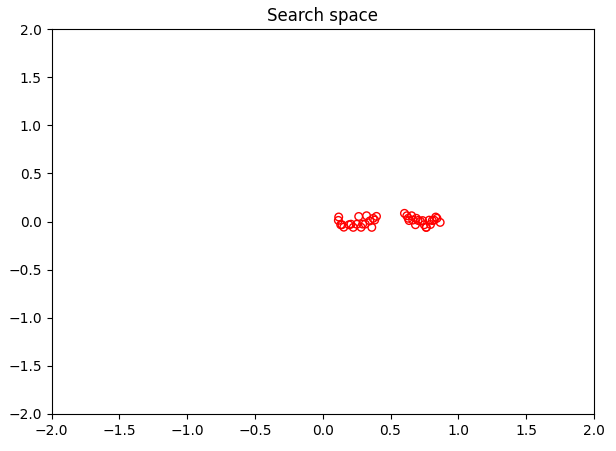

3 Complete code
import numpy as np
from pymoo.core.problem import ElementwiseProblem
from pymoo.algorithms.moo.nsga2 import NSGA2
from pymoo.factory import get_sampling, get_crossover, get_mutation
from pymoo.factory import get_termination
from pymoo.optimize import minimize


class MyProblem(ElementwiseProblem):

    def __init__(self):
        super(MyProblem, self).__init__(
            n_var=2,  #  Number of variables
            n_obj=2,  #  Number of optimization objectives
            n_constr=2,  #  Number of constraints
            xl=np.array([-2, -2]),  #  Lower bound of variable
            xu=np.array([2, 2])  #  The upper limit of the variable
        )

    def _evaluate(self, x, out, *args, **kwargs):
        """ :param x: 1D vector , The length is n_var :param out: :param args: :param kwargs: :return: """
        #  Objective function
        f1 = 100 * (x[0]**2 + x[1]**2)
        f2 = (x[0] - 1)**2 + x[1]**2

        #  constraint condition
        g1 = 2 * (x[0] - 0.1) * (x[0] - 0.9) / 0.18
        g2 = - 20 * (x[0] - 0.4) * (x[0] - 0.6) / 4.8

        #  Store the target value and constraint value
        out["F"] = [f1, f2]
        out["G"] = [g1, g2]


algorithm = NSGA2(
    pop_size=40,  #  Population number
    n_offsprings=10,  #  The number of offspring
    sampling=get_sampling("real_random"),  #  The way of sampling , Such as random sampling
    crossover=get_crossover("real_sbx", prob=0.9, eta=15),  #  mating system  , Such as analog binary
    mutation=get_mutation("real_pm", eta=20),  #  The way of variation , Polynomial variation
    eliminate_duplicates=True   #  Ensure that the goals of future generations are different
)

termination = get_termination("n_gen", 40)

res = minimize(
    problem=MyProblem(),
    algorithm=algorithm,
    termination=termination,
    seed=1,
    save_history=True,
    verbose=True    #  Output control variables
)

#  Store feasible solutions
X = res.X
#  Store the target value
F = res.F

import matplotlib.pyplot as plt
problem = MyProblem()
xl, xu = problem.bounds()
plt.figure(figsize=(7, 5))
plt.scatter(X[:, 0], X[:, 1], s=30, facecolors='none', edgecolors='r')
plt.xlim(xl[0], xu[0])
plt.ylim(xl[1], xu[1])
plt.title("Search space")
plt.show()

plt.figure(figsize=(7, 5))
plt.scatter(F[:, 0], F[:, 1], s=30, facecolors='none', edgecolors='blue')
plt.title("Objective Space")
plt.show()
边栏推荐
猜你喜欢


![[web vulnerability exploration] SQL injection vulnerability](/img/48/660ef6fcfc368283c8c97720c4e77c)

随机推荐
Closure of JS
Pymoo学习 (1):基本概念
[MySQL]一、MySQL起步
Sprintf and cv:: puttext
树
Is it safe for online account managers to open accounts when choosing securities companies in flush
Compose canvas pie chart effect drawing
SQL bool盲注和时间盲注详解
小程序商城如何精细化运营?
使用 Preparedstatement 选择和显示记录的 JDBC 程序
quota命令详细拓展使用方法,RHEL 7中quota命令搭载方法!磁盘容量配额!
排序-介绍,代码思路,使用建议,代码实现-1
Opencv finding the intersection of two regions
Agile testing practice in large-scale teams
wsus可以打mysql中间件补丁_加入WSUS补丁服务器并下载补丁
[31. Maze walking (BFS)]
在 Kotlin 中使用 Flow Builder 创建流
ROS2自学笔记:Rviz可视化工具
Browser homology policy
oracle 数据库 11C 之后版本使用 memory_target 自动内存管理