当前位置:网站首页>Convolutional neural network model -- googlenet network structure and code implementation
Convolutional neural network model -- googlenet network structure and code implementation
2022-07-25 13:08:00 【1 + 1= Wang】
List of articles
GoogLeNet Network profile
GoogLeNet Original address :Going Deeper with Convolutions:https://www.cv-foundation.org/openaccess/content_cvpr_2015/papers/Szegedy_Going_Deeper_With_2015_CVPR_paper.pdf
GoogLeNet stay 2014 Year by year Christian Szegedy Put forward , It is a new deep learning structure .
GoogLeNet The main innovation of the network is :
Put forward Inception The structure is convoluted and repolymerized simultaneously on multiple sizes ;

Use 1X1 The convolution of is used for dimension reduction and mapping ;
Add two auxiliary classifiers to help train ;
Auxiliary classifier is to use the output of a certain middle layer as a classification , And add a smaller weight to the final classification result .Use the average pool layer instead of the full connection layer , Greatly reduced the number of parameters .
GoogLeNet Network structure
GoogLeNet The complete network structure of is as follows :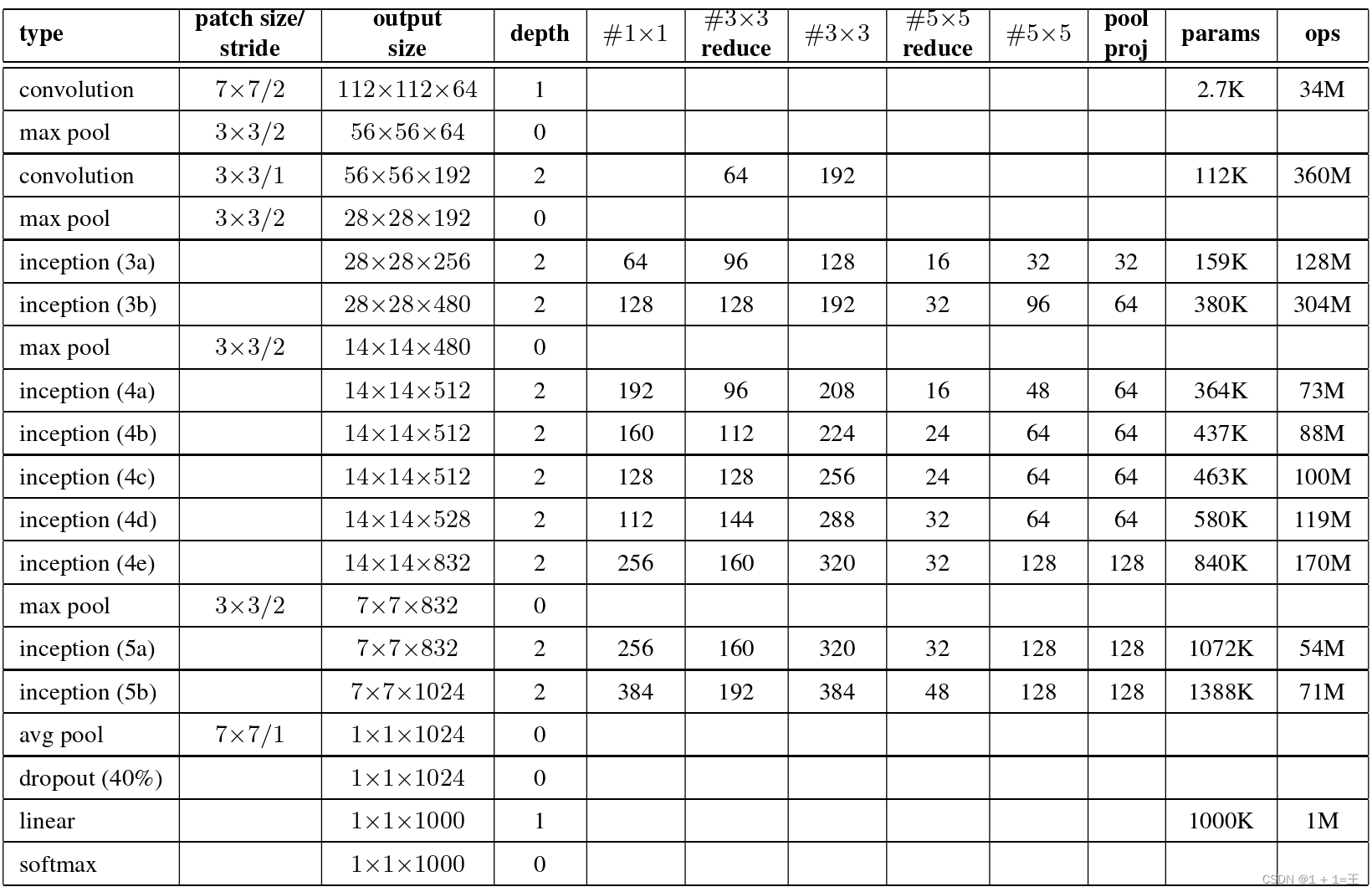
Next, we will explain it layer by layer and combine it with code analysis
Inception Previous layers
When entering Inception Before the structure ,GoogLeNet The network first stacks two convolutions ( But in fact 3 individual , There is one 1X1 Convolution of ) And two maximum pooling layers .

# input(3,224,224)
self.front = nn.Sequential(
    nn.Conv2d(3, 64, kernel_size=7, stride=2, padding=3),   # output(64,112,112)
    nn.ReLU(inplace=True),

    nn.MaxPool2d(kernel_size=3,stride=2,ceil_mode=True),    # output(64,56,56)

    nn.Conv2d(64,64,kernel_size=1),
    nn.Conv2d(64,192,kernel_size=3,stride=1,padding=1),     # output(192,56,56)
    nn.ReLU(inplace=True),

    nn.MaxPool2d(kernel_size=3,stride=2,ceil_mode=True),    # output(192,28,28)
)
Inception structure

Inception The module will only change the number of channels of the characteristic graph , Without changing the size .
Inception The structure is relatively complex , We recreate a class to build this structure , The number of channels in each layer is controlled by different parameters .
class Inception(nn.Module):
    ''' in_channels:  Enter the number of channels  out1x1: Branch 1 Number of output channels  in3x3: Branch 2 Of 3x3 Number of input channels for convolution  out3x3: Branch 2 Of 3x3 The number of output channels of convolution  in5x5: Branch 3 Of 5x5 Number of input channels for convolution  out5x5: Branch 3 Of 5x5 The number of output channels of convolution  pool_proj: Branch 4 Maximum number of pooled layer output channels  '''
    def __init__(self,in_channels,out1x1,in3x3,out3x3,in5x5,out5x5,pool_proj):
        super(Inception, self).__init__()

        self.branch1 = nn.Sequential(
            nn.Conv2d(in_channels, out1x1, kernel_size=1),
            nn.ReLU(inplace=True)
        )
        self.branch2 = nn.Sequential(
            nn.Conv2d(in_channels,in3x3,kernel_size=1),
            nn.ReLU(inplace=True),
            nn.Conv2d(in3x3,out3x3,kernel_size=3,padding=1),
            nn.ReLU(inplace=True)
        )
        self.branch3 = nn.Sequential(
            nn.Conv2d(in_channels, in5x5, kernel_size=1),
            nn.ReLU(inplace=True),
            nn.Conv2d(in5x5, out5x5, kernel_size=5, padding=2),
            nn.ReLU(inplace=True)
        )

        self.branch4 = nn.Sequential(
            nn.MaxPool2d(kernel_size=3,stride=1,padding=1),
            nn.Conv2d(in_channels,pool_proj,kernel_size=1),
            nn.ReLU(inplace=True)
        )

    def forward(self,x):
        branch1 = self.branch1(x)
        branch2 = self.branch2(x)
        branch3 = self.branch3(x)
        branch4 = self.branch4(x)

        outputs = [branch1,branch2,branch3,branch4]
        return torch.cat(outputs,1)	#  Stack by channel number
Inception3a modular

# input(192,28,28)
self.inception3a = Inception(192, 64, 96, 128, 16, 32, 32)		# output(256,28,28)
Inception3b + MaxPool

# input(256,28,28)
self.inception3b = Inception(256, 128, 128, 192, 32, 96, 64)		# output(480,28,28)
self.maxpool3 = nn.MaxPool2d(3, stride=2, ceil_mode=True)			# output(480,14,14)
Inception4a

# input(480,14,14)
self.inception4a = Inception(480, 192, 96, 208, 16, 48, 64)		# output(512,14,14)
Inception4b

# input(512,14,14)
self.inception4b = Inception(512, 160, 112, 224, 24, 64, 64)		# output(512,14,14)
Inception4c

# input(512,14,14)
self.inception4c = Inception(512, 160, 112, 224, 24, 64, 64)		# output(512,14,14)
Inception4d

# input(512,14,14)
self.inception4d = Inception(512, 112, 144, 288, 32, 64, 64)		# output(528,14,14)
Inception4e+MaxPool
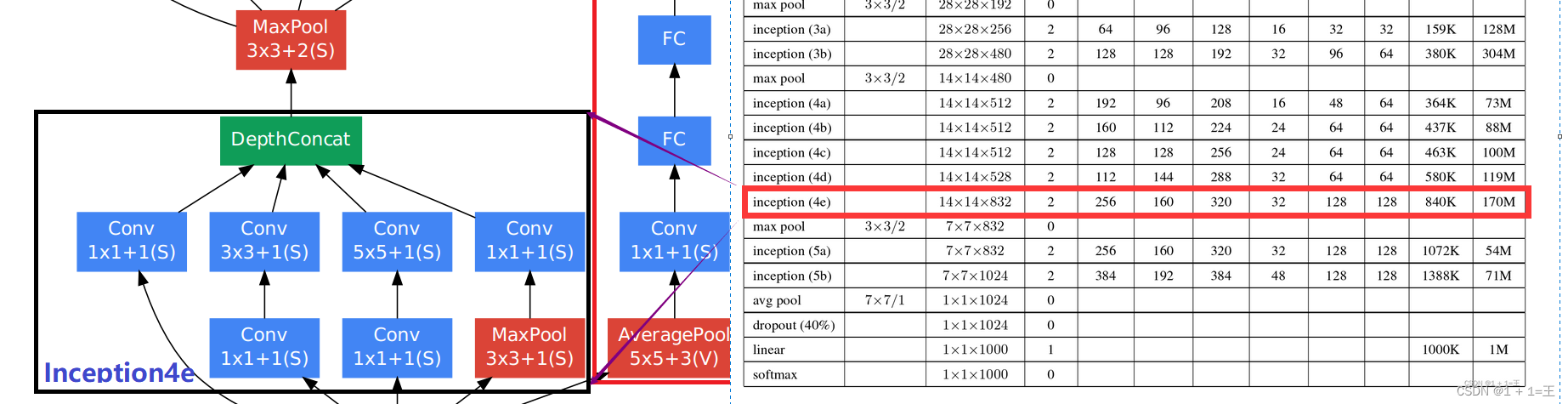
# input(528,14,14)
self.inception4e = Inception(528, 256, 160, 320, 32, 128, 128)	# output(832,14,14)
self.maxpool4 = nn.MaxPool2d(3, stride=2, ceil_mode=True)		# output(832,7,7)
Inception5a

# input(832,7,7)
self.inception5a = Inception(832, 256, 160, 320, 32, 128, 128)		# output(832,7,7)
Inception5b
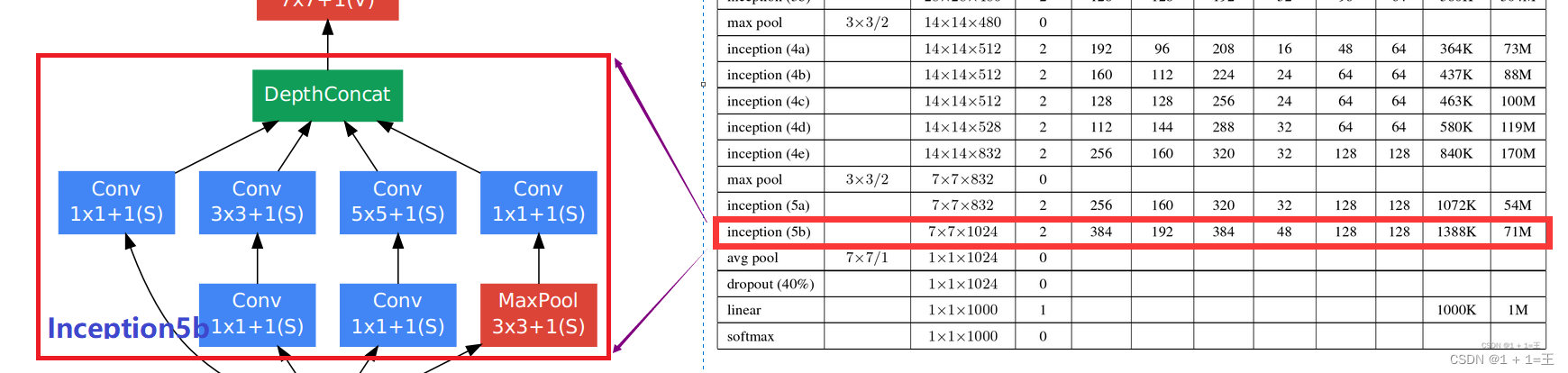
# input(832,7,7)
self.inception5b = Inception(832, 384, 192, 384, 48, 128, 128)		# output(1024,7,7)
Inception The next several layers

Auxiliary classification module
In addition to the above backbone network structure ,GoogLeNet It also provides two auxiliary classification modules , Used to use the output of an intermediate layer as a classification , And press a smaller weight (0.3) Add to the final classification result .
And Inception The modules are the same , We also re create a class to build the auxiliary classification module structure .
class AccClassify(nn.Module):
	# in_channels:  Input channel
	# num_classes:  Number of categories
    def __init__(self,in_channels,num_classes):
        self.avgpool = nn.AvgPool2d(kernel_size=5, stride=3)
        self.conv = nn.MaxPool2d(in_channels, 128, kernel_size=1)  # output[batch, 128, 4, 4]
        self.relu = nn.ReLU(inplace=True)

        self.fc1 = nn.Linear(2048, 1024)
        self.fc2 = nn.Linear(1024, num_classes)

    def forward(self,x):
        x = self.avgpool(x)
        x = self.conv(x)
        x = self.relu(x)
        x = torch.flatten(x, 1)
        x = F.dropout(x, 0.5, training=self.training)
        x = F.relu(self.fc1(x), inplace=True)
        x = F.dropout(x, 0.5, training=self.training)
        x = self.fc2(x)

        return x
Auxiliary classification module 1
The first m-server output is located at Inception4a after , take Inception4a The output of is average pooled ,1X1 After convolution and full connection, wait until the classification result .
self.acc_classify1 = AccClassify(512,num_classes)
Auxiliary classification module 2
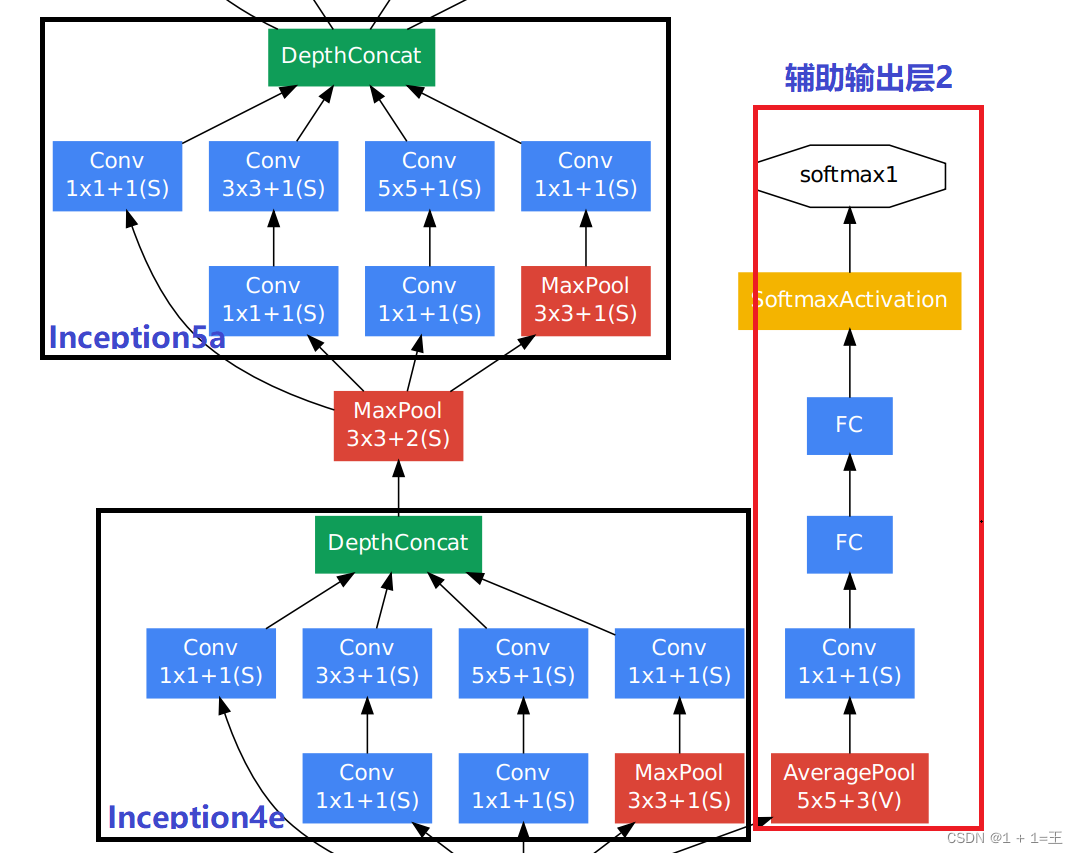
self.acc_classify2 = AccClassify(528,num_classes)
Overall network structure
pytorch Build complete code
""" #-*-coding:utf-8-*- # @author: wangyu a beginner programmer, striving to be the strongest. # @date: 2022/7/5 18:37 """
import torch.nn as nn
import torch
import torch.nn.functional as F


class GoogLeNet(nn.Module):
    def __init__(self,num_classes=1000,aux_logits=True):
        super(GoogLeNet, self).__init__()
        self.aux_logits = aux_logits

        # input(3,224,224)
        self.front = nn.Sequential(
            nn.Conv2d(3, 64, kernel_size=7, stride=2, padding=3),   # output(64,112,112)
            nn.ReLU(inplace=True),

            nn.MaxPool2d(kernel_size=3,stride=2,ceil_mode=True),    # output(64,56,56)

            nn.Conv2d(64,64,kernel_size=1),
            nn.Conv2d(64,192,kernel_size=3,stride=1,padding=1),     # output(192,56,56)
            nn.ReLU(inplace=True),

            nn.MaxPool2d(kernel_size=3,stride=2,ceil_mode=True),    # output(192,28,28)
        )

        # input(192,28,28)
        self.inception3a = Inception(192, 64, 96, 128, 16, 32, 32)  # output(64+128+32+32=256,28,28)
        self.inception3b = Inception(256, 128, 128, 192, 32, 96, 64)  # output(480,28,28)
        self.maxpool3 = nn.MaxPool2d(3, stride=2, ceil_mode=True)  # output(480,14,14)

        self.inception4a = Inception(480, 192, 96, 208, 16, 48, 64)  # output(512,14,14)
        self.inception4b = Inception(512, 160, 112, 224, 24, 64, 64)  # output(512,14,14)
        self.inception4c = Inception(512, 128, 128, 256, 24, 64, 64)  # output(512,14,14)
        self.inception4d = Inception(512, 112, 144, 288, 32, 64, 64)  # output(528,14,14)
        self.inception4e = Inception(528, 256, 160, 320, 32, 128, 128)  # output(832,14,14)
        self.maxpool4 = nn.MaxPool2d(3, stride=2, ceil_mode=True)  # output(832,7,7)

        self.inception5a = Inception(832, 256, 160, 320, 32, 128, 128)  # output(832,7,7)
        self.inception5b = Inception(832, 384, 192, 384, 48, 128, 128)  # output(1024,7,7)

        if self.training and self.aux_logits:
            self.acc_classify1 = AccClassify(512,num_classes)
            self.acc_classify2 = AccClassify(528,num_classes)

        self.avgpool = nn.AdaptiveAvgPool2d((1,1))        # output(1024,1,1)
        self.dropout = nn.Dropout(0.4)
        self.fc = nn.Linear(1024,num_classes)


    def forward(self,x):
        # input(3,224,224)
        x = self.front(x)       # output(192,28,28)

        x= self.inception3a(x)  # output(256,28,28)
        x = self.inception3b(x)
        x = self.maxpool3(x)

        x = self.inception4a(x)

        if self.training and self.aux_logits:
            classify1 = self.acc_classify1(x)

        x = self.inception4b(x)
        x = self.inception4c(x)
        x = self.inception4d(x)

        if self.training and self.aux_logits:
            classify2 = self.acc_classify2(x)

        x = self.inception4e(x)
        x = self.maxpool4(x)

        x = self.inception5a(x)
        x = self.inception5b(x)

        x = self.avgpool(x)
        x = torch.flatten(x,dims=1)
        x = self.dropout(x)
        x= self.fc(x)

        if self.training and self.aux_logits:
            return x,classify1,classify2

        return x


class Inception(nn.Module):
    ''' in_channels:  Enter the number of channels  out1x1: Branch 1 Number of output channels  in3x3: Branch 2 Of 3x3 Number of input channels for convolution  out3x3: Branch 2 Of 3x3 The number of output channels of convolution  in5x5: Branch 3 Of 5x5 Number of input channels for convolution  out5x5: Branch 3 Of 5x5 The number of output channels of convolution  pool_proj: Branch 4 Maximum number of pooled layer output channels  '''
    def __init__(self,in_channels,out1x1,in3x3,out3x3,in5x5,out5x5,pool_proj):
        super(Inception, self).__init__()

        # input(192,28,28)
        self.branch1 = nn.Sequential(
            nn.Conv2d(in_channels, out1x1, kernel_size=1),
            nn.ReLU(inplace=True)
        )
        self.branch2 = nn.Sequential(
            nn.Conv2d(in_channels,in3x3,kernel_size=1),
            nn.ReLU(inplace=True),
            nn.Conv2d(in3x3,out3x3,kernel_size=3,padding=1),
            nn.ReLU(inplace=True)
        )
        self.branch3 = nn.Sequential(
            nn.Conv2d(in_channels, in5x5, kernel_size=1),
            nn.ReLU(inplace=True),
            nn.Conv2d(in5x5, out5x5, kernel_size=5, padding=2),
            nn.ReLU(inplace=True)
        )

        self.branch4 = nn.Sequential(
            nn.MaxPool2d(kernel_size=3,stride=1,padding=1),
            nn.Conv2d(in_channels,pool_proj,kernel_size=1),
            nn.ReLU(inplace=True)
        )

    def forward(self,x):
        branch1 = self.branch1(x)
        branch2 = self.branch2(x)
        branch3 = self.branch3(x)
        branch4 = self.branch4(x)

        outputs = [branch1,branch2,branch3,branch4]
        return torch.cat(outputs,1)


class AccClassify(nn.Module):
    def __init__(self,in_channels,num_classes):
        self.avgpool = nn.AvgPool2d(kernel_size=5, stride=3)
        self.conv = nn.MaxPool2d(in_channels, 128, kernel_size=1)  # output[batch, 128, 4, 4]
        self.relu = nn.ReLU(inplace=True)

        self.fc1 = nn.Linear(2048, 1024)
        self.fc2 = nn.Linear(1024, num_classes)

    def forward(self,x):
        x = self.avgpool(x)
        x = self.conv(x)
        x = self.relu(x)
        x = torch.flatten(x, 1)
        x = F.dropout(x, 0.5, training=self.training)
        x = F.relu(self.fc1(x), inplace=True)
        x = F.dropout(x, 0.5, training=self.training)
        x = self.fc2(x)

        return x

# print(GoogLeNet())
chart

边栏推荐
- Atcoder beginer contest 261e / / bitwise thinking + DP
- B树和B+树
- Shell Basics (exit control, input and output, etc.)
- EMQX Cloud 更新:日志分析增加更多参数,监控运维更省心
- Chapter5 : Deep Learning and Computational Chemistry
- AtCoder Beginner Contest 261 F // 树状数组
- Zero basic learning canoe panel (16) -- clock control/panel control/start stop control/tab control
- 力扣 83双周赛T4 6131.不可能得到的最短骰子序列、303 周赛T4 6127.优质数对的数目
- A hard journey
- 卷积神经网络模型之——AlexNet网络结构与代码实现
猜你喜欢

【AI4Code】《GraphCodeBERT: Pre-Training Code Representations With DataFlow》 ICLR 2021

卷积神经网络模型之——LeNet网络结构与代码实现

【AI4Code】《InferCode: Self-Supervised Learning of Code Representations by Predicting Subtrees》ICSE‘21

yum和vim须掌握的常用操作
ECCV2022 | TransGrasp类级别抓取姿态迁移
Clickhouse notes 03-- grafana accesses Clickhouse
Mlx90640 infrared thermal imager temperature sensor module development notes (V)

Introduction to web security UDP testing and defense

2022.07.24 (lc_6124_the first letter that appears twice)

Redis可视化工具RDM安装包分享
随机推荐
Shell common script: judge whether the file of the remote host exists
Azure Devops(十四) 使用Azure的私有Nuget仓库
AtCoder Beginner Contest 261 F // 树状数组
web安全入门-UDP测试与防御
AtCoder Beginner Contest 261E // 按位思考 + dp
7行代码让B站崩溃3小时,竟因“一个诡计多端的0”
公安部:国际社会普遍认为中国是世界上最安全的国家之一
Redis可视化工具RDM安装包分享
massCode 一款优秀的开源代码片段管理器
【OpenCV 例程 300篇】239. Harris 角点检测之精确定位(cornerSubPix)
艰辛的旅程
Zero basic learning canoe panel (14) -- led control and LCD control
Force deduction 83 biweekly T4 6131. The shortest dice sequence impossible to get, 303 weeks T4 6127. The number of high-quality pairs
Memory layout of program
【AI4Code】《InferCode: Self-Supervised Learning of Code Representations by Predicting Subtrees》ICSE‘21
手写一个博客平台~第一天
Use vsftpd service to transfer files (anonymous user authentication, local user authentication, virtual user authentication)
【AI4Code】《CoSQA: 20,000+ Web Queries for Code Search and Question Answering》 ACL 2021
The programmer's father made his own AI breast feeding detector to predict that the baby is hungry and not let the crying affect his wife's sleep
Substance designer 2021 software installation package download and installation tutorial