当前位置:网站首页>[advanced binary tree] AVLTree - balanced binary search tree
[advanced binary tree] AVLTree - balanced binary search tree
2022-06-23 04:18:00 【CodeWinter】
List of articles
- Preface
- One 、AVL Trees
- 1.1 AVL The concept of tree
- 1.2 AVL Definition of tree node
- 1.3 AVL Trees - Insert node
- 1.3.1 Insert new node
- 1.3.2 Update the balance factor of the tree
- 1.3.3 According to the updated BF The situation of , Perform balancing operation
- ① Right single spin - The new node is inserted into the leftmost part of the higher left subtree
- ② Left spin - The new node is inserted into the rightmost part of the higher right subtree
- ③ Double left and right - The new node is inserted to the right of the higher left subtree
- ④ Right left double rotation - The new node is inserted to the left of the higher right subtree
- 1.4 AVL Verification of trees
- 1.5 AVL Trees - Delete node ( understand )
- 1.6 AVL Tree performance
Preface
The insertion and deletion operations of binary search tree must first find , Search efficiency Represents the binary search tree Efficiency of each operation .
But binary search tree has its own defects , If The elements inserted into the tree are orderly or nearly orderly , The binary search tree will degenerate into a single branch tree , The time complexity is O(N), therefore map、set The underlying structure of equal correlation container is to balance the binary tree , The balanced binary search tree is used to realize .
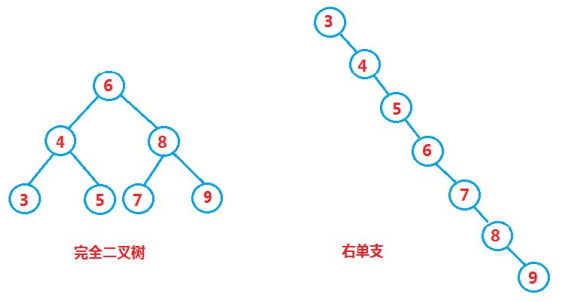
In the best case , Yes n A binary search tree of nodes is a complete binary tree , The search efficiency is :O(log2N)
In the worst case , Yes n A binary search tree of nodes degenerates into a single branch tree , The search efficiency is :O(N)
One 、AVL Trees
1.1 AVL The concept of tree
Balanced binary search trees (Self-balancing binary search tree), also called AVL Trees
Although binary search tree can shorten the search efficiency , but The search tree will degenerate into a single ordered tree or a binary tree , Finding elements is equivalent to searching for elements in the sequence table , inefficiency . therefore , Two Russian mathematicians G.M.Adelson-Velskii and E.M.Landis stay 1962 In, he invented a method to solve the above problems : When a new node is inserted into the binary search tree , If we can ensure that the absolute value of the height difference between the left and right subtrees of each node does not exceed 1( exceed 1 You need to adjust the nodes in the tree ), You can reduce the height of the tree , This reduces the average search length .
A tree AVL Trees , Or it's an empty tree , Or it is a binary search tree with the following properties :
The height difference between the left and right subtrees of each node ( It's called equilibrium factor Balance Factor) The absolute value of is not more than 1 (-1/0/1)
Balance factor = The height of the right subtree - The height of the left subtree : Used to judge whether balance operation is required
Each subtree is a balanced binary search tree

If a binary search tree is highly balanced , It is AVL Trees .
Yes n Of nodes AVL Trees , The height can be maintained at log2n, Its search time complexity O(log2n).
reflection : Why is the height difference between the left and right subtrees not specified as 0 Well ?
Because in 2、4 When the number of nodes is equal , It is impossible to achieve the same height on the left and right
1.2 AVL Definition of tree node
AVL The tree node is a trident chain structure , Except for the pointers to the left and right children , And a pointer to his father , Data fields are key value pairs , namely pair object , The equilibrium factor is also introduced , Used to judge whether balance operation is required .
// AVL Definition of tree node (KV Model )
template<class K, class V>
struct AVLTreeNode
{

	pair<K, V> _kv;  //  Key value pair
	int _bf;         //  Balance factor (balance factor) =  Height of right subtree  -  Height of left subtree
	AVLTreeNode<K, V>* _left;
	AVLTreeNode<K, V>* _right;
	AVLTreeNode<K, V>* _parent; //  Parental pointer

	//  Constructors
	AVLTreeNode(const pair<K, V>& kv)
		:_kv(kv)
		,_bf(0)
		,_left(nullptr)
		,_right(nullptr)
		,_parent(nullptr)
	{
    }
};

// AVL The definition of a tree (KV Model )
template<class K, class V>
class AVLTree
{

	typedef AVLTreeNode<K, V> Node;

private:
	Node* _root;

public:
	//  Member functions
}
1.3 AVL Trees - Insert node
AVL The tree is based on the binary search tree and introduces the balance factor , therefore AVL The tree can also be regarded as a binary search tree . that AVL The process of inserting a tree can be divided into 3 Step :
- Insert new node
- Update the balance factor of the tree
- According to the balance factor of the updated tree , To control the balance of the tree ( Rotation operation )
1.3.1 Insert new node
The insertion method is the same as that of binary search tree , To find the first , Insert again .
//  Insert node
bool AVLTree::Insert(const pair<K, V>& kv)
{

    //  If the tree is empty , Insert the node directly
    if (_root == nullptr)
    {

        _root = new Node(kv);
        return true;
    }

    //  If the tree is not empty , Find an empty location suitable for inserting nodes
    Node* parent = nullptr;  //  Record the parent of the current node
    Node* cur = _root;       //  Record current node
    while (cur)
    {

        if(kv.first > cur->_kv.first) //  Insert node key values k Greater than the current node
        {

            parent = cur;
            cur = cur->_right;
        }
        else if(kv.first < cur->_kv.first) //  Insert node key values k Less than the current node
        {

            parent = cur;
            cur = cur->_left;
        }
        else //  Insert node key values k Equal to the current node
        {

            return false;
        }
    }
    // while The loop ends , It indicates that an empty location suitable for inserting nodes has been found

    //  Insert new node
    cur = new Node(kv); //  Apply for a new node
    //  Determine whether the current node is the father's left child or right child
    if (cur->_kv.first > parent->_kv.first)
    {

        parent->_right = cur;
        cur->_parent = parent;

    }
    else
    {

        parent->_left = cur;
        cur->_parent = parent;
    }

    //...................................
    //  These write update balance factors , And control the balance of the tree
    //...................................

    //  Insert the success
    return true;
}
1.3.2 Update the balance factor of the tree
Insert 「 New node 」, From this node to all nodes on the branch through which the root passes ( Ancestor node ) The equilibrium factors of all are likely to be affected , According to different situations , Update their balance factor :
- If inserted in 「 New node father 」 To the right of , Father's balance factor ++(
_bf++)- If inserted in 「 New node father 」 Left side , Father's balance factor –(
_bf--)
「 New node father 」 After the balance factor is updated , It can be divided into 3 In this case :
1、 If after the update , The equilibrium factor is 1 perhaps -1( It must have been 0), It means that the height of father's subtree has changed , Need to continue to update up .( The worst : Up to the root node )
2、 If after the update , The equilibrium factor is 0( It must have been 1 perhaps -1), It means that the height of the father's subtree has not changed ( Because the short side was filled ), There is no need to continue to update up .
3、 If after the update , Balance factor yes 2 perhaps -2, It shows that the subtree of the father is unbalanced , Need to rotate , Let it balance .


The code is as follows :
while (parent) //  The worst : Update to the root node
{

    //  Update the balance factor of the new node's parent

    if (cur == parent->_left) //  The new node is inserted to the left of the father
    {

        parent->_bf--;
    }
    else //  The new node is inserted to the right of the parent
    {

        parent->_bf++;
    }

    //  Check the balance factor of the new node's parent

    // 1、 The height of father's subtree has changed , Need to continue to update up
    if (parent->_bf == 1 || parent->_bf == -1)
    {

        cur = parent;
        parent = cur->_parent;
    }
    // 2、 The height of father's subtree has not changed , No need to continue updating
    else if (parent->_bf == 0)
    {

        break;
    }
    // 3、 Father's subtree is unbalanced , Need to rotate
    else if (parent->_bf == 2 || parent->_bf == -2)
    {

        //  Here we write to balance the tree , Code for rotation processing , It is divided into 4 In this case :

        /*................................................*/
        // 3.1、 The left height of the parent node , Low on the right , It needs to be rotated to the right
        if (parent->_bf == -2 && cur->_bf == -1)
        {

            //  Right single spin
            treeRotateRight(parent);
        }

        // 3.2、 The right height of the parent node , Low on the left , You need to turn left
        else if (parent->_bf == 2 && cur->_bf == 1)
        {

            //  Left spin
            treeRotateLeft(parent);
        }

        // 3.3、 The left height of the parent node , And the parent node's left child's right height
        else if(parent->_bf == -2 && cur->_bf == 1)
        {

            //  Double left and right
            treeRotateLR(parent);
        }

        // 3.4、 The right height of the parent node , And the left height of the child on the right of the parent node
        else if(parent->_bf == 2 && cur->_bf == -1)
        {

            //  Right left double rotation
            treeRotateRL(parent);
        }

        else //  Only the above 4 In this case , Nothing else , So the error is directly reported here
        {

            assert(false);
        }

        break; //  The rotation is complete , The tree is balanced , Exit loop

        /*................................................*/
    }
    // 4、 In addition to the above 3 In this case , The equilibrium factor cannot have any other value , Error handling
    else
    {

        assert(false);
    }
}
1.3.3 According to the updated BF The situation of , Perform balancing operation
If in a tree that was originally balanced AVL Insert a new node into the tree , May cause imbalance , At this point, the structure of the tree must be adjusted , Balance it . According to the insertion position of the node ,AVL The rotation of the tree is divided into 4 Kind of :
The essence of rotation : Following the rules of binary search tree , Balance left and right , Reduce the height of the whole tree .
What kind of rotation operation should be performed ?– The path that causes the rotation is a straight line or a single rotation , If it is a broken line, it is a double rotation .
Be careful : The trees seen here , It could be a complete tree , It could also be a subtree .
① Right single spin - The new node is inserted into the leftmost part of the higher left subtree
The new node is inserted into parent On the left tree of the left child , The resulting imbalance .

The above figure is before insertion ,AVL Trees are balanced , The new node is inserted into 30 The left subtree ( Be careful : This is not the left child ) in ,30 The height of the left subtree is increased by one layer , Lead to 60 A binary tree with roots is unbalanced , Must let 60 Balance , Can only be 60 The height of the left subtree is reduced by one layer , Add a layer to the right subtree , About to lift the left sub tree up , such 60 Turn around , because 60 Than 30 Big , Can only make it 30 The right subtree , And if the 30 There are right subtrees , The value of the right subtree root must be greater than 30, Less than 60, Can only make it 60 The left subtree , When the rotation is complete , Update the balance factor of the node .
The condition that causes right monomorphism :
- father Left high , Low on the right , So let father Turn right .
- parent The equilibrium factor of -2,parent The left child balance factor is -1, Observation found that , The equilibrium factors are all negative numbers , It means the left side is high , Also explained ==【 The path that causes the rotation is a straight line 】==, So we're going to do a right-handed operation .
Right single rotation operation :
- Give Way subL The right subtree subLR Become parent The left subtree ( because subLR The root node value of the right subtree of is greater than 30, Less than 60)
- Give Way parent Become subL The right subtree ( because 60 Greater than 30)
- Give Way subL Become the root of this subtree
- Before this step, you need to judge :parent Root node , It is also an ordinary subtree
- If it's the root node , Update subL For a new root
- If it is an ordinary subtree ( It may be the left subtree of a node , It may also be a right subtree , You need to judge ), And then update subL For the root node of this subtree
- According to the structure of the tree , to update parent and subL The equilibrium factor of 0
In the course of rotation , Update the parent pointer , There are several situations to consider :
- subL The right subtree subLR Possible , May also be empty .( Update only when it is not empty subL Right subtree subLR The parent pointer to )
- When the rotation is complete ,subL The parent node of , May be empty , It could be parent Original parent node .( So update subL You need to judge before the parent pointer of )
The code is as follows :
in general , Is to adjust in turn subLR、parent、subL The position of the parent pointer .
//  Right single spin
void treeRotateRight(Node* parent)
{

    // subL:parent The left child
    // subLR:parent Left child's right child
    Node* subL = parent->_left;
    Node* subLR = parent->_left->_right;

    // 1、 Give Way subL The right subtree subLR Become parent The left subtree
    parent->_left = subLR;
    // 1.1、 If subLR Not empty
    if (subLR)
    {

        subLR->_parent = parent; //  to update subLR Parents pointer , Point to parent
    }

    // 2、 Give Way parent Become subL The right subtree
    subL->_right = parent;

    // 2.1、 Record parent Parent node
    Node* ppNode = parent->_parent;

    // 2.2、 to update parent Parents pointer , Point to subL
    parent->_parent = subL;

    // 2.3、 Judge parent Is it the root node
    //  Root node
    if (parent == _root)
    {

        _root = subL;            //  to update subL For a new root
        subL->_parent = nullptr; //  to update subL Parents pointer , Pointing empty
    }
    //  Not the root node , Is an ordinary subtree
    else
    {

        //  Judge parent Was it a left child or a right child
        if (ppNode->_left == parent)
        {

            ppNode->_left = subL; // parent The original parent node takes over subL,subL For the root of this subtree
        }
        else
        {

            ppNode->_right = subL;
        }

        subL->_parent = ppNode; //  to update subL Parents pointer
    }

    //  Update according to the adjusted structure parent and subL The equilibrium factor of
    parent->_bf = subL->_bf = 0;
}
② Left spin - The new node is inserted into the rightmost part of the higher right subtree
The new node is inserted into parent On the right tree of the right child , The resulting imbalance .

The condition that causes left single rotation :
- father It's high on the right , Low on the left , So let father Turn left .
- parent The equilibrium factor of 2,parent The balance factor of the right child is 1, Observation found that , The equilibrium factors are all positive numbers , The description is high on the right , Also explained ==【 The path that causes the rotation is a straight line 】==, So we're going to use left-hand rotation .
Left single rotation operation :
- Give Way subR The left subtree subRL Become parent The right subtree ( because subRL The root node value of the left subtree of is greater than 30, Less than 60)
- Give Way parent Become subR The left subtree ( because 30 Less than 60)
- Give Way subR Become the root of this subtree
- Before this step, you need to judge :parent Root node , It is also an ordinary subtree
- If it's the root node , Update subR For a new root
- If it is an ordinary subtree ( It may be the left subtree of a node , It may also be a right subtree , You need to judge ), And then update subR For the root node of this subtree
- According to the structure of the tree , to update parent and subR The equilibrium factor of 0
In the course of rotation , Update the parent pointer , There are several situations to consider :
- subR The left subtree subRL Possible , May also be empty .( Update only when it is not empty subR The left subtree subRL The parent pointer to )
- When the rotation is complete ,subR The parent node of , May be empty , It could be parent Original parent node .( So update subR You need to judge before the parent pointer of )
The code is as follows :
in general , Is to adjust in turn subRL、parent、subR The position of the parent pointer .
//  Left spin
void treeRotateLeft(Node* parent)
{

    // subR: Father's right child
    // subRL: Father's right child's left child ( Bigger than father , Less than subR)
    Node* subR = parent->_right;
    Node* subRL = subR->_left;

    // 1、 Give Way subRL Become a father's right subtree
    parent->_right = subRL;
    //  If subRL Not empty
    if (subRL)
    {

        subRL->_parent = parent; //  to update subRL Parental pointer , Point to parent
    }

    // 2、 Give Way parent Become subR The left subtree
    subR->_left = parent;

    // 2.1、 Record first parent The parent node of
    Node* ppNode = parent->_parent;

    // 2.2、 to update parent The point of the parental pointer
    parent->_parent = subR;

    // 2.3、 Judge parent Is it the root node
    //  Root node
    if (parent == _root)
    {

        _root = subR;            // subR For a new root
        subR->_parent = nullptr; // subR The parent pointer points to null
    }
    //  Not the root node , Is an ordinary subtree
    else
    {

        //  Judge parent Was it a left child or a right child
        if (ppNode->_left == parent)
        {

            ppNode->_left = subR; // parent The original parent node takes over subR,subR For the root of this subtree
        }
        else
        {

            ppNode->_right = subR;
        }

        subR->_parent = ppNode; //  to update subR Parents pointer
    }

    //  According to the structure of the tree , to update parent and subR The equilibrium factor of
    parent->_bf = subR->_bf = 0;
}
③ Double left and right - The new node is inserted to the right of the higher left subtree
The new node is inserted into parent On the right tree of the left child , The resulting imbalance .
At this time, we need to be right first parent The right child makes a left rotation , Right again parent Make a right-handed rotation .
A phenomenon can be observed here :
node 60 The left and right subtrees of are separated , The left subtree finally becomes 30 The right subtree , The right subtree finally becomes 90 The left subtree .

The picture below is h = 0 The situation of :

The conditions for the initiation of double rotation :
- The path that causes the rotation is a straight line or a single rotation , If it is a broken line, it is a double rotation
- parent The equilibrium factor of -2,parent The left child balance factor is 1, Observation found that , The balance factor is one negative and one positive , explain 「 The left child is tall on the right 」,「 Father is tall on his left 」, Also explained ==【 The path causing the rotation is a polyline 】==, So we have to first 「 Perform left-hand rotation on the left child 」, Again 「 Perform right-hand rotation on the father 」.
After left-right double rotation operation , According to the structure of the tree , When updating the balance factor , We need to pay attention to :
Insert the new node at a different location , After left and right double spin , The structure of the tree will be different , The balance factor will also vary , There are three situations :
- The new node is inserted into 「parent Left child's right subtree 」 Of Left edge
- The new node is inserted into 「parent Left child's right subtree 」 Of Right edge
- The new node is 「parent Left child's right child 」
A phenomenon can be observed here , According to this phenomenon, we can deduce the equilibrium factor after rotation :
node 60 The left and right subtrees of are separated , The left subtree eventually becomes a node 30 The right subtree , The right subtree eventually becomes a node 90 The left subtree .

The code is as follows :
//  Double left and right
void treeRotateLR(Node* parent)
{

    Node* subL = parent->_left; //  Record parent The left child
    Node* subLR = subL->_right; //  Record parent The left child, the right child

    //  Before spinning , Because the new node is inserted in a different location ,subLR The equilibrium factor may be -1/0/1

    int bf = subLR->_bf; //  Record subLR The equilibrium factor of

    treeRotateLeft(parent->_left); //  First pair parent The left child of carries out left single rotation
    treeRotateRight(parent);       //  Right again parent Make a right spin

    //  After the rotation is complete , Adjust the balance factor of other nodes according to the situation
    if (bf == -1)
    {

        parent->_bf = 1;
        subL->_bf = 0;
        subLR->_bf = 0;
    }
    else if (bf == 1)
    {

        parent->_bf = 0;
        subL->_bf = -1;
        subLR->_bf = 0;
    }
    else if (bf == 0)
    {

        parent->_bf = 0;
        subL->_bf = 0;
        subLR->_bf = 0;
    }
    else
    {

        assert(false);
    }
}
④ Right left double rotation - The new node is inserted to the left of the higher right subtree
The new node is inserted into parent On the left tree of the right child , The resulting imbalance .
At this time, we need to be right first parent The right child of carries out a right rotation , Right again parent Make a left turn .
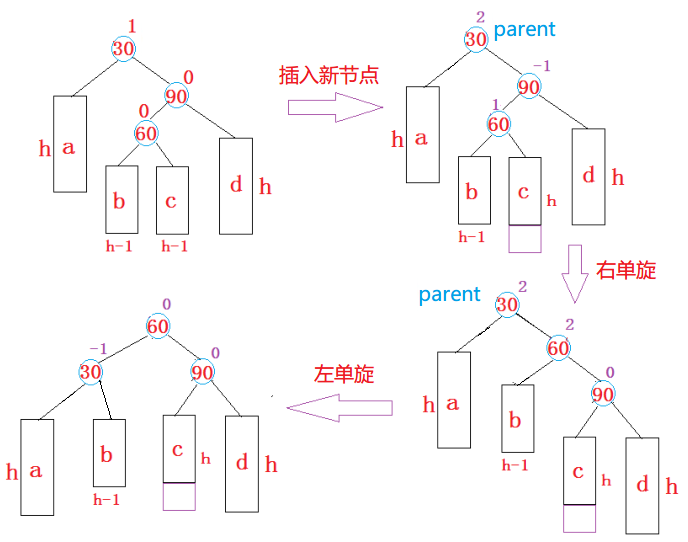
This is a h = 1 The situation of :

The conditions for the initiation of double rotation :
- The path that causes the rotation is a straight line or a single rotation , If it is a broken line, it is a double rotation
- parent The equilibrium factor of 2, parent The balance factor of the right child is -1, Observation found that , The balance factor is one positive and one negative , explain 「 The right child is tall on the left 」,「 Father is tall on his right 」, Also explained ==【 The path causing the rotation is a polyline 】==, So we have to first 「 Rotate the right child 」, Again 「 Perform left-hand rotation on the father 」.
After left-right double rotation operation , According to the structure of the tree , When updating the balance factor , We need to pay attention to :
Insert the new node at a different location , After right and left double spin , The structure of the tree will be different , The balance factor will also vary , There are three situations :
- The new node is inserted into 「parent Right child's left tree 」 Of Left edge
- The new node is inserted into 「parent Right child's left tree 」 Of Right edge
- The new node is 「parent Right child's left child 」
A phenomenon can be observed here , According to this phenomenon, we can deduce the equilibrium factor after rotation :
node 60 The left and right subtrees of are separated , The left subtree b Finally, it becomes a node 30 The right subtree , Right subtree c Finally, it becomes a node 90 The left subtree .

The code is as follows :
//  Right left double rotation
void treeRotateRL(Node* parent)
{

    Node* subR = parent->_right; //  Record parent The right child
    Node* subRL = subR->_left;   //  Record parent My right child's left child

    //  Before spinning , Because the new node is inserted in a different location ,subRL The equilibrium factor of may be -1/0/1

    int bf = subRL->_bf; //  Record subRL The equilibrium factor of

    treeRotateRight(parent->_right); //  First pair parent The right child carries out right single rotation
    treeRotateLeft(parent);          //  Right again parent Make the left radio selection

    //  After the rotation is complete , Adjust the balance factors of other nodes according to the tree structure
    if (bf == -1)
    {

        parent->_bf = 0;
        subR->_bf = 1;
        subRL->_bf = 0;
    }
    else if (bf == 1)
    {

        parent->_bf = -1;
        subR->_bf = 0;
        subRL->_bf = 0;
    }
    else if(bf == 0)
    {

        parent->_bf = 0;
        subR->_bf = 0;
        subRL->_bf = 0;
    }
    else
    {

        assert(false);
    }
}
1.4 AVL Verification of trees
AVL The tree is based on the binary search tree and adds the restriction of balance , So verify AVL Trees , There are two steps :
- Verify that it is a binary search tree
If the middle order traversal can get an ordered sequence , It is explained as a binary search tree .
- Verify that it is a balanced tree
The absolute value of the height difference of each node subtree shall not exceed 1
Whether the balance factor of the node is calculated correctly
(1) First, write a function to calculate the current tree height
//  Calculate the height of the current tree
int Height(Node* root)
{

    //  The current tree is empty , Then the height is 0
    if (root == nullptr)
        return 0;

    //  The current tree is not empty , Calculate the height of the left and right subtrees
    int leftHeight = Height(root->_left);
    int rightHeight = Height(root->_right);

    //  The height of the current tree  =  The one with the highest height in the left and right subtrees 1
    return max(leftHeight, rightHeight) + 1;
}
(2) Check AVL Whether the tree is balanced , Train of thought : A top-down solution to violence
//  Check AVL Whether the tree is balanced , Train of thought
bool IsBalance1()
{

    return _IsBalance1(_root);
}
bool _IsBalance1(Node* root)
{

    //  The current tree is empty , The explanation is balanced
    if (root == nullptr)
        return true;

    //  The current tree is not empty , Calculate the height of the left and right subtrees
    int leftHeight = Height(root->_left);
    int rightHeight = Height(root->_right);

    if (rightHeight - leftHeight != root->_bf) //  Check whether the balance factor of the current tree is calculated correctly
    {

        cout << " The balance factor is abnormal :" << root->_kv.first << endl;
    }

    //  The absolute value of subtracting the height of the left and right subtrees is less than 2, It shows that the current tree is balanced , Then continue to judge other subtrees
    return abs(leftHeight - rightHeight) < 2
        && _IsBalance1(root->_left)
        && _IsBalance1(root->_right);
}
(3) Check AVL Whether the tree is balanced , Train of thought two : An efficient bottom-up solution ( Dynamic programming , The solution of the previous subproblem , It can be used to solve the latter problem )
//  Check AVL Whether the tree is balanced , Train of thought two
bool IsBalance2()
{

    return _IsBalance2(_root) != -1;
}

int _IsBalance2(Node* root)
{

    //  First judge the left of the current tree 、 Whether the right subtree is balanced , Then judge whether the current tree is balanced
    //  Unbalanced return -1, Balance returns the height of the current tree

    //  The current tree is empty , Return to altitude 0
    if (root == nullptr)
        return 0;

    //  The current tree is not empty , Calculate the height of left and right subtrees respectively
    int leftHeight = _IsBalance2(root->_left);
    int rightHeight = _IsBalance2(root->_right);

    if (rightHeight - leftHeight != root->_bf) //  Check whether the balance factor of the current tree is calculated correctly
    {

        cout << " The balance factor is abnormal :" << root->_kv.first << endl;
    }

    //  The height of the left subtree is equal to -1、 The height of the right subtree is equal to -1、 The absolute value of the height difference between the left and right subtrees is greater than 1, Indicates that the current tree is unbalanced
    if (leftHeight == -1 || rightHeight == -1 || abs(leftHeight - rightHeight) > 1)
        return -1;

    //  Run here , It shows that the current tree is balanced , Returns the height of the current tree
    return max(leftHeight, rightHeight) + 1;
}
1.5 AVL Trees - Delete node ( understand )
because AVL The tree is also a binary search tree , Nodes can be deleted in the form of binary search tree , Then update the balance factor , If there is an unbalanced tree , Rotate . Just different from binary search tree ,AVL Update the balance factor after deleting nodes in the tree , In the worst case, always adjust to the position of the root node .
1.6 AVL Tree performance
AVL The tree is an absolutely balanced binary search tree , Close to a complete binary tree , It requires that the absolute value of the height difference between the left and right subtrees of each node should not exceed 1, This can ensure efficient query time complexity , namely O(log2N). But if you want to be right AVL The tree does some structure modification , Very poor performance , such as : Maintain its absolute balance when inserting , The number of rotations is more , Worse, when deleting , It is possible to keep the rotation up to the root . therefore : If you need a query efficient and orderly data structure , And the number of data is static ( That will not change ), You can consider AVL Trees , But a structure is often modified , It's not suitable for .
边栏推荐
- 无线网络安全的12个优秀实践
- 怎么用好MySQL索引
- 城链科技董事长肖金伟:践行数据经济系国家战略,引领数字时代新消费发展!
- Not just offline caching- On how to make good use of serviceworker
- Half search method
- Google Earth engine (GEE) - long time series monthly VCI data extraction, analysis and area calculation (Mexico as an example)
- P1363 幻象迷宫(dfs)
- 【LeetCode】23. Merge K ascending linked lists
- 【owt】owt-client-native-p2p-e2e-test vs2017构建2 :测试单元构建及运行
- 【owt】owt-client-native-p2p-e2e-test vs2017构建 3 : 无 测试单元对比, 手动生成vs项目
猜你喜欢
![[OWT] OWT client native P2P E2E test vs2017 construction 4: Construction and link of third-party databases p2pmfc exe](/img/cd/7f896a0f05523a07b5dd04a8737879.png)
[OWT] OWT client native P2P E2E test vs2017 construction 4: Construction and link of third-party databases p2pmfc exe

基于FPGA的VGA协议实现
![[OWT] OWT client native P2P E2E test vs2017 build 2: test unit construction and operation](/img/b0/4ea8069a88ce19ca7dbfa67ac9fcba.png)
[OWT] OWT client native P2P E2E test vs2017 build 2: test unit construction and operation

Centos7 installing MySQL and configuring InnoDB_ ruby

How to process large volume xlsx/csv/txt files?
![[greed] leetcode991 Broken Calculator](/img/6e/ce552b55899c6e8d3c37f524f99f82.png)
[greed] leetcode991 Broken Calculator

会话和守护进程

Web page dynamic and static separation based on haproxy

第一批00后下场求职:不要误读他们的“不一样”

仿360桌面悬浮球插件
随机推荐
靜態查找錶和靜態查找錶
Software project management 8.4 Software project quality plan
高效的远程办公经验 | 社区征文
[binary tree] 993 Cousins in Binary Tree
Form development mode
P1363 幻象迷宫(dfs)
How to realize data transaction
选择排序法
Web page dynamic and static separation based on haproxy
仿360桌面悬浮球插件
d重载嵌套函数
MySQL common instructions
mysql如何删除表的一行数据
Ideal car × Oceanbase: when new forces of car building meet new forces of database
Tcapulusdb Jun · industry news collection (V)
Tcapulusdb Jun · industry news collection (III)
[leetcode] flip linked list II
给你的AppImage创建桌面快捷方式
[tcapulusdb knowledge base] [list table] example code of batch deleting data at specified location in the list
Source code encryption of data encryption technology