当前位置:网站首页>[Software Engineering] design module
[Software Engineering] design module
2022-06-22 14:46:00 【Tcoder-l3est】
Chapter 6 Design module
6.1 Design principles
- modular (module) And components (component)
- modular : Define input 、 Program entities for output and properties
- artifacts : Reusable software components
Design principles It refers to the guidelines for decomposing system functions and behaviors into modules 6 Three important principles :
modularization 、 Interface 、 Information hiding 、 Incremental development 、 abstract 、 generality
modularization
modularization It is a principle to separate the irrelevant parts of the system , So that each part can study independently , Also known as separation of concerns
• If the principle is applied properly , Each module has its own unique purpose , And relatively independent of other modules
– Each module will be easier to understand and develop
– Fault location is simpler (because there are fewer suspect modules per fault)
– System modification is simpler (because a change to one module affects relatively few other modules
• To determine if the concerns are well separated , We use two concepts to measure module independence : Coupling degree and Degree of cohesion
Coupling degree
coupling Measure how closely different modules depend on each other .
There is a strong dependency between the two modules, which is called Tightly coupled , There is less dependency between two modules, which is called Loose coupling , Modules that do not have any dependencies are called Uncoupled . The looser the coupling , The smaller the connection between modules , The more independent the module is .
The strength of the coupling depends on the following factors :
(1) A reference from one module to another **
Such as module A Call module B So module A The function of depends on the module B The function of
(2) To transfer data
(3) Exert control
(4) Interface complexity
Indirect coupling
Both modules can work independently without the existence of the other , This indicates that there are no connections between the modules , The lowest degree of coupling .
Data coupling
If two modules exchange information with each other through parameters , And the information exchanged is just data , So this kind of coupling is called data coupling . Data coupling is the simplest form of coupling , The coupling between modules is low .
Tag coupling
The parameters passed between the two modules are data structure variables , For example, array names in high-level languages 、 Record name, file name, etc , This connection between modules is called tag coupling .
This coupling should be avoided or eliminated by other methods in the design , But sometimes because of other functions , Tag coupling is inevitable .
Control coupling
What is passed between the two modules is Control information , Such as switching value 、 Logo, name, etc , The coupling between these two modules is called control coupling .
Public coupling
A group of modules all access the same The common data environment , Then the coupling between these modules is called common coupling . A common data environment can be a global data structure 、 Shared communication area 、 The common footprint of memory 、 Files on any storage medium, etc .
If a module only transmits data to the public data environment , The other module only extracts data from the public data environment , Then this kind of public coupling is called loose public coupling , Here's the picture a Shown
If the two modules transmit data to the previous public data environment and extract data from it , Then this kind of coupling is called close common coupling , Here's the picture b Shown .
Such as using common coupling , Loose public coupling should be used as far as possible

Content coupling
Content coupling is the highest degree of coupling , If , Content coupling occurs between the two modules :
① One module directly accesses the internal data of another module .
② The first mock exam module does not pass through the normal entrance to another module .
③ Part of the program code of the two modules overlaps

Degree of cohesion
cohesion It's a measure The degree to which various elements in a module are closely combined with each other . The more cohesive a module is , It indicates that the stronger the association between the elements within the module
To gather by chance
Each element inside the module is functionally irrelevant or loosely related .
Accidental cohesion is considered the worst kind of cohesion , The drawback is that : The module is not easy to understand , Difficult to maintain , Not easy to reuse .
Logical cohesion
The tasks completed by a module are Logic The same or similar class is called logical cohesion . The called module in the figure below is a logical cohesion module , It determines to execute corresponding functions according to the input control information
Time converges
A module contains the information required in Same time period Multiple tasks performed in , The cohesion of the module is called time cohesion . for example , The initialization of multiple variables is implemented in the same module .
advantage : There is no need to select parameters , All tasks can be executed in any order , The logic is simple .
shortcoming : This module combines many unrelated tasks , Once the module fails , It is difficult to directly determine which task failed .
Process cohesion
The processing elements within a module are related , And it has to be Execute in a specific order , It's called process cohesion . for example , When using flow chart to divide modules , If the loop part of the same process is completed in the flowchart 、 Judgment part 、 The calculation part is divided into 3 A module , Then this 3 The first module is the process cohesion module .
6.2 Object oriented design method
Process oriented :SP
object-oriented :OOP
An overview of object-oriented design principles
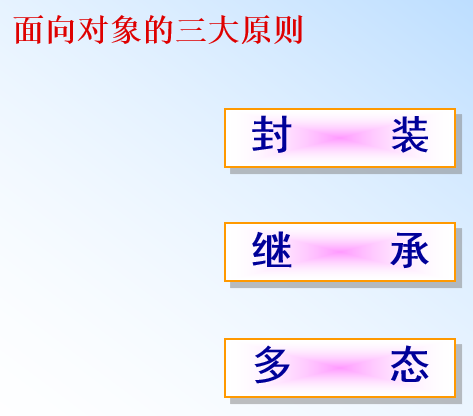
You must take one

Principle of single responsibility
In software system , A class is only responsible for the corresponding responsibilities in a functional area
In terms of a class , There should be a reason for his change
The responsibilities of the class mainly include two aspects : Data responsibility and behavior responsibility , Data responsibility is embodied by its attributes , And the responsibility of behavior is embodied by its methods . The principle of single responsibility is to achieve High cohesion 、 Low coupling Guidelines for , It can be found in many code refactoring techniques , It is the simplest but most difficult principle to apply , The designer needs to discover the different responsibilities of the class and separate them , The multiple responsibilities of discovery class require designers to have strong analysis and design ability and relevant reconstruction experience .
Example :
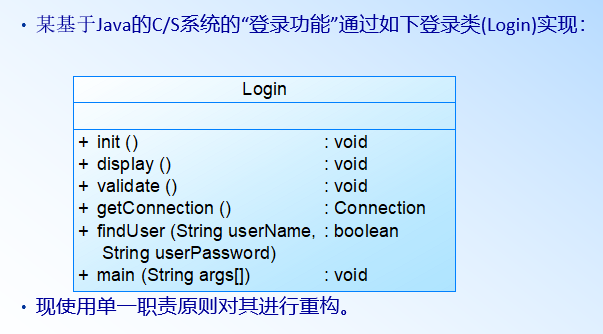

Opening and closing principle
A software entity should Open to expansion , Turn off for changes .
That is to say, when designing a module , This module should be able to be extended without modification , That is to change the behavior of this module without modifying the source code . In the definition of opening and closing principle , Software entity can refer to a software module 、 A local structure of multiple classes or an independent class
Richter substitution principle
All reference base classes ( Parent class ) Must be able to transparently use objects of its subclasses
If you can use base class objects in software , Then you must be able to use its subclass object . Replace the base class with its subclass , The program will not produce any errors or exceptions , The reverse is not true , If a software entity uses a subclass , So it doesn't have to be able to use base classes .
Richter substitution principle is one of the important ways to realize the open - close principle , Because where base class objects are used, subclass objects can be used , Therefore, try to use base class types to define objects in your program , The subclass type is determined at run time , Replace the superclass object with a subclass object
Dependence Inversion Principle
– Dependence Inversion Principle (Dependence Inversion Principle, DIP) Is defined as follows :
• High level modules should not rely on low level modules , They should all depend on abstraction . Abstractions should not depend on details , Details should depend on abstractions .
– Another expression is :
• To program for an interface , Don't program for implementation .
– Simply speaking , The principle of dependency inversion means : Code depends on abstract classes , Don't rely on specific classes ; To program against an interface or abstract class , Instead of programming for specific classes .
Composite reuse
Try to use object combinations , Instead of inheritance to achieve reuse
Dimitar's law
Also known as the minimum knowledge principle – There are many ways to define it , Several typical definitions are as follows :
•(1) Do not mix “ A stranger ” speak .
•(2) Only communicate with your direct friends .
•(3) Every software unit has the least knowledge of other units , And limited to those software units closely related to the unit .
Demeter's Law means A software entity should interact with as few other entities as possible . such , When a module is modified , It will affect other modules as little as possible , Expansion will be relatively easy , This is a limitation on communication between software entities , It requires limiting the width and depth of communication between software entities .
6.3 Object oriented design pattern
** Design patterns (Design pattern)** It's a set that's been used over and over again 、 Most people know
Of 、 Catalogued 、 Summary of code design experience .
Why advocate design patterns ?
The root cause is for code reuse , Increase maintainability .
Design patterns contribute to the understanding of frame structures , Mature frameworks often use multiple
Design patterns .
• Design patterns are divided into three major types from the perspective of application
– Create pattern
– Structural mode
Behavioral patterns
Create a model of design
Single case model
Ensure that a class has and only has one instance , Provide a global access point
Factory method (Factory Method)
The parent class is responsible for defining the public interface for creating objects , Subclasses are responsible for generating concrete objects , Delay the instantiation of the class to the subclass
Abstract factory (Abstract Factory)
Provide a unified creation interface for a product family . When you need a family of products , You can select the corresponding series from the abstract factory to create a concrete factory class
Builder pattern (Builder)
Separate the construction of complex objects from their representation , The same build process can create different representations . Allows users to build complex objects simply by specifying their type and content , The user does not know the specific internal construction details
Archetypal model
adopt “ Copy ” An existing instance to return a new instance , Instead of creating a new instance . The copied instance is what we call “ Prototype ”, This prototype is customizable . Prototype patterns are often used to create complex or time-consuming instances , Because in this case , Copying an existing instance makes the program run more efficiently ; Or create equal values , It's just the same kind of data with different names
Structural design pattern
• Structural patterns are about the structure of classes and objects , It uses inheritance mechanisms to combine interfaces or implementations ( Class structure pattern ), Or by combining some objects , In order to achieve new functions ( Object structured mode )
– synthesis (Composite) Pattern : Define an interface , Make it available to a single object , It can also be applied to object groups composed of multiple single objects
– decorate (Decorator) Pattern : Add some additional responsibilities to an object dynamically , It's like adding decorations to an object , Perfect its function
– agent (Proxy) Pattern : In software system , Some objects sometimes cross the network or other obstacles , And can't or don't want to directly access another object , Direct access will bring unnecessary complexity to the system , At this time, an intermediate layer can be added between the client program and the target object , Let the proxy object do everything instead of the target object , This is the agency (Proxy) Pattern
– Enjoying yuan (Flyweight) Pattern :Flyweight Is a shared object , It can be used in different contexts at the same time (Context) Use
– appearance (Facade) Pattern : Appearance patterns provide a higher level for subsystems 、 A simpler interface , Thus, the complexity and dependency of the subsystem are reduced . This makes the subsystem easier to use and manage . The facade assumes responsibility for interacting with classes in the subsystem
– bridge (Bridge) Pattern : The purpose of the bridge pattern is to separate the abstraction and implementation of the problem , Solve the problem of explosive subclass growth by using aggregation instead of inheritance
– Adapter (Adapter) Pattern : Adapt the interface of a class to the interface expected by the user . An adapter allows classes that cannot work together because of interface incompatibility , The approach is to wrap the class's own interface in an existing class
Behavioral design patterns
• Focus on solving the communication relationship between class entities , I hope to describe a control process in an object-oriented way
– template method (Template Method): An algorithm step is defined , And allow subcategories to provide implementation for one or more steps . Let subcategories without changing the algorithm architecture , Redefine some steps in the algorithm
– The observer (Observer) Pattern : Defines one to many dependencies between objects , When the state of this object changes , Multiple objects receive notifications , Opportunity to give feedback
– iterator (Iterator) Pattern : Provides a way to access elements of an aggregate object in sequence , Without exposing the internal representation of the object
The singleton pattern
Characteristics of singleton design pattern :
1. The singleton design pattern ensures that a class has only one instance ;
2. To provide a global access point to access instances of this class of objects .
The most important thing about singleton mode is to Ensure that a class has only one instance and that the class
Easy to access .
A global class makes an object accessible , But doing so will not prevent
You instantiate multiple objects .
1. In order to avoid other programs creating too many objects of this class , It is forbidden to build other programs first
Create an instance of this object ( Privatize the constructor ).
2. In order to facilitate other programs to access the objects of this class , You have to customize one in this class
object , from 1 It can be seen that the object is static Of , And provide access to the outside world .
Hungry Chinese style ( summary )
Object preload , Threads are safe , When the class is created, the object is generated ,
Calling the method to get the object instance is fast , The code is concise .
Slacker type ( summary )
Object delay loading , Efficient , Instantiate objects only when they are used , if
Improperly designed threads are unsafe , The code is relatively complex , First addition
The reaction is not fast when loading class objects .
边栏推荐
- Rongyun: let the bank go to the "cloud" easily
- 【考研攻略】北京交通大学网络空间安全专业2018-2022年考研数据分析
- How to understand fold change? Multiple analysis?
- 拜登签署两项旨在加强政府网络安全的新法案
- 网络地址转换NAT
- Thoroughly understand the factory mode
- C语言学生管理系统(开源)
- 2022orace database installation and use
- Policy deployment of firewall Foundation
- Madcap flare 2022, documentation in language or format
猜你喜欢

JS高级程序设计第 4 版:迭代器的学习

Transformers vit image model vector acquisition

【无标题】

Understand the quality assurance of open source software (OSS)

拜登簽署兩項旨在加强政府網絡安全的新法案

Data collection: skillfully using Bloom filter to extract data summary

C # WinForm photo album function, picture zooming, dragging, preview Pagination

CVE-2022-22965复现

轻松上手Fluentd,结合 Rainbond 插件市场,日志收集更快捷

Network address translation nat
随机推荐
D security can call the system
一文彻底弄懂工厂模式(Factory)
C generic method
Getting started with go web programming: validators
The diffusion model is crazy again! This time the occupied area is
Using pictures to locate app elements sikulix
As a passer-by, some advice for programmers who are new to the workplace
数据采集之:巧用布隆过滤器提取数据摘要
Flink status management
Database employment consulting system for your help
Groovy list operation
Excuse me, is Zhongyan futures reliable? Is the fund safe?
安装和使用protobuf-c
Differences and performance of array, list, ArrayList, directory and LinkedList in C #
Transformers vit image model vector acquisition
[untitled]
bochs 软件使用记录
Struggle, programmer chapter 45 tenderness is like water and a good time is like a dream
Closure of groovy
Cve-2022-22965 reappearance