当前位置:网站首页>LinkedList source code analysis
LinkedList source code analysis
2022-06-22 22:24:00 【Small code】
LinkedList The bottom layer is based on linked list , Adding or deleting does not require moving data , So it's very efficient . But the efficiency of querying and modifying data is low , You can't quickly locate the data according to the subscript like an array , You need to traverse the data one by one .
data structure
LinkedList It is a structure based on linked list , The main core is Node node , Source code is as follows :
private static class Node<E> {
    E item;
    Node<E> next;
    Node<E> prev;

    Node(Node<E> prev, E element, Node<E> next) {
        this.item = element;
        this.next = next;
        this.prev = prev;
    }
}
The structure is shown in the following figure :

This is a double linked list structure , Yes prev Leading pointer and next Post pointer .
And the first node first、 Caudal node last、 length size:
transient int size = 0;

transient Node<E> first;

transient Node<E> last;
Add data
LinkedList There are two ways to add elements :add(E e) and **add(int index,E e)**.
add(E e) Add data at the end of the linked list add(int index,E e) Add data at the specified linked list location
add(E e)
add Method is called linkLast Method :
public boolean add(E e) {
    linkLast(e);
    return true;
}
linkLast Indicates that the specified element is added at the end of the linked list :
void linkLast(E e) {
    //  Record the original tail node
    final Node<E> l = last;
    //  Create a new node , The front node of the new node is the original tail node
    final Node<E> newNode = new Node<>(l, e, null);
    //  Update tail node
    last = newNode;
    if (l == null)
        //  The tail node is empty , Update the header node
        first = newNode;
    else
        //  The tail is not empty , The original trailing node is the new node
        l.next = newNode;
    // size  and  modCount  Self increasing
    size++;
    modCount++;
}
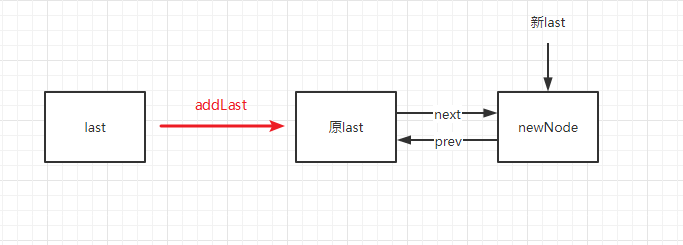
Record the original tail node l Create a new node , The front node points to the original tail node . If l It's empty , Update the header node Update tail node If l Not empty ,l The post pointer to the new node
If the original tail node is empty , Create a node directly , This node is last and first node . If the original tail node is not empty , Create a new node , The front of the new node points to the original last, The original last Of next Point to a new node .
add(int index,E e)
This method is to add elements to the specified position of the linked list , The subscript of the linked list is the same as that of the array , Also from the 0 From the beginning :

Have a look first add(int index, E element) Method
public void add(int index, E element) {
    //  Check if the subscript is out of range
    checkPositionIndex(index);
    if (index == size)
        //  The subscript is equal to size, Add directly to the end of the list
        linkLast(element);
    else
        //
        linkBefore(element, node(index));
}
checkPositionIndex Determine if the subscript is out of bounds ,index >= 0 && index <= size index Whether in 0 ~ size Within limits .
If index be equal to size, and add(E e) Same operation , Are added at the end of the linked list . If index Less than size, call linkBefore Method , Insert a node into the middle of the linked list . First of all to see node Method :
Node<E> node(int index) {
    // assert isElementIndex(index);
    // size >> 1  Express  size  Moves to the right one , Namely  size/2 size Half of
    // index  Less than  size  Half of , Traverse back from the first node
    if (index < (size >> 1)) {
        Node<E> x = first;
        for (int i = 0; i < index; i++)
            x = x.next;
        return x;
    // index  Greater than  size  Half of , Traverse forward from the last node
    } else {
        Node<E> x = last;
        for (int i = size - 1; i > index; i--)
            x = x.prev;
        return x;
    }
}
node() The way is to find index Corresponding node node .
For example, a length of 5 The linked list of :

node(1) from first node ( The first 0 Nodes ) Go back through one , That is to say 1 Corresponding node . node(3) from last node ( The first 4 Nodes ) Go ahead and traverse a , That is to say 3 Corresponding node .
Find the node by subscript , The linked list generally needs to be traversed , You need to traverse half of the linked list at most , It mainly uses the characteristics of double linked list , You can traverse from front to back , You can traverse from back to front .
size>>1 Express size/2, Judge index Is it in the first half or the second half of the linked list , If you traverse back from the first node in the first half , If you traverse forward from the last node in the second half ,, This traverses at most size Half of , Avoid traversing the entire linked list . find index After the node under , Look again linkedBefore Method :
void linkBefore(E e, Node<E> succ) {
    // assert succ != null;
    //  Record the front node  pred
    final Node<E> pred = succ.prev;
    //  Create a new node , New nodes pre Point to  pred,next Point to succ node
    final Node<E> newNode = new Node<>(pred, e, succ);
    // succ pre Point to a new node
    succ.prev = newNode;
    //  If pred It's empty , Express succ It's the first node , The new node is assigned to the first node
    if (pred == null)
        first = newNode;
    else
    // pred Of next  Point to a new node
        pred.next = newNode;
    size++;
    modCount++;
}
Record succThe front node of the nodepred.The new node , prePoint topred,nextPoint tosucc.succOfprePoint to a new node .If predby null, Indicates that the first node issucc, Assign a node tofirstnode .If predNot for null,predOfnextPoint to a new node .
For example, a length of 5 The linked list of , The subscript for 1 Add data to the location of :

get data
Data acquisition mainly includes get、getFirst、getLast.
get The method is mainly through node Method subscript node , Get the item data .
getFirst Method to get Head node Of item.
getLast Method to get Caudal node Of item.
Delete data
remove(Object o)
Remove the first matching element from the list
public boolean remove(Object o) {
    //  Judge whether it is null
    if (o == null) {
        //  Traverse node
        for (Node<E> x = first; x != null; x = x.next) {
            if (x.item == null) {
                unlink(x);
                return true;
            }
        }
    } else {
        //  Traverse node
        for (Node<E> x = first; x != null; x = x.next) {
            if (o.equals(x.item)) {
                unlink(x);
                return true;
            }
        }
    }
    return false;
}
Deletes the specified element , You need to determine whether the element is null.
If null, Just usex.item == nullSentence judgment .If not for null, Just useo.equals(x.item)Sentence judgment .
Then call unlink Method :
E unlink(Node<E> x) {
    // assert x != null;
    //  Record nodes element、next and prev
    final E element = x.item;
    final Node<E> next = x.next;
    final Node<E> prev = x.prev;
    // prev by null,next  Assign to the first node
    if (prev == null) {
        first = next;
    } else {
        // prev Of next Point to next node
        prev.next = next;
        // x node prev Set as null
        x.prev = null;
    }
    // next by null,prev Assign as tail node
    if (next == null) {
        last = prev;
    } else {
        // next Of prev Point to prev
        next.prev = prev;
        // x node next Set as null
        x.next = null;
    }
    // x.item Set as null
    x.item = null;
    //  The length decreases
    size--;
    modCount++;
    return element;
}
Pictured , To delete 1 Data node :

remove(int index)
Delete the data of the specified subscript :
public E remove(int index) {
    checkElementIndex(index);
    return unlink(node(index));
}
First, through node Find the node corresponding to the subscript , Call again unlink Delete the data .
边栏推荐
- [path planning] week 1: hodgepodge
- Implementation of depth traversal adjacency table in Figure 6-7
- Rendu stéréo
- British teddy bear joins the pubg mobile game
- Task cache compilation caused by gradle build cache
- VS代码一键整理快捷键
- 5 minutes to quickly launch web applications and APIs (vercel)
- [ROS introduction] cmakelist Txt and packages XML interpretation
- 6月25日PMI认证考点防疫要求及考场安排
- Implementation of breadth traversal adjacency matrix of 6-6 graph
猜你喜欢

IDC releases China Data Governance Report Yixin Huachen No. 1

CYCA少儿形体礼仪 深圳市培训成果考核圆满落幕

RapidEye快鸟、SPOT卫星遥感影像数据
IDC publie le rapport sur la gouvernance des données en Chine

【持续更新中...】2021年全国大学生电子设计大赛 (三)匿名四轴拓空者飞控系统设计解读

Adblock blocks Baidu hot search

In 2022, the "product innovation and achievement transformation" training camp of Chaoyang District Science and technology innovation class was successfully completed

6-6 图的广度遍历-邻接矩阵实现
![下一个排列[发挥主观能动性发现规律]](/img/bb/262e1a21e4babb8d221d737ced3bcc.png)
下一个排列[发挥主观能动性发现规律]

The required reading for candidates | PMP the test on June 25 is approaching. What should we pay attention to?
随机推荐
Oracle数据库中文字符串和英文字符串的截取不同
June25,2022 PMP Exam clearance manual-6
Why do you think it is common for Chinese people to earn more than 10000 yuan a month?
Task cache compilation caused by gradle build cache
Cryptography series: certificate format representation of PKI X.509
SPA项目开发之CRUD+表单验证
组合总数[标准回溯 + 回溯技巧--降低栈深度]
6月PMP考试准考证问题及注意事项,考生必读
7-9 超级玛丽
6-1 二叉搜索树的操作集
SPA项目开发之动态树+数据表格+分页
Shell (34): time
【象棋人生】01 人生如棋
In 2022, the "product innovation and achievement transformation" training camp of Chaoyang District Science and technology innovation class was successfully completed
RuntimeError: CUDA error: CUBLAS_ STATUS_ EXECUTION_ FAILED when calling `cublasSgemmStridedBatched( ha
Capital and share increase of avita technology under Chang'an is settled: Ningde times will hold about 24%!
2022年6月25日PMP考试通关宝典-6
Icml2022 | using virtual nodes to promote graph structure learning
6-5 图的深度遍历-邻接矩阵实现
6-1 operation set of binary search tree