当前位置:网站首页>RAID configuration experiment
RAID configuration experiment
2022-07-24 06:35:00 【Walking Di five flowers】
Catalog
One 、RAID Disk array Introduction
Two 、 Commonly used RAID Array Introduction
1、RAID0 Disk array Introduction
2、RAID 1 Disk array Introduction
3、RAID 5 Disk array Introduction
4、RAID 10 Disk array Introduction
3、 ... and 、RAID Array experiment
One 、RAID Disk array Introduction
RAID: Independent redundant disk array
working principle : Combine multiple independent physical hard disks in different ways to form a hard disk group ( Logical hard disk ), So as to provide higher storage performance than a single hard disk and provide data backup technology
RAID Commonly used :RAID0,RAID1,RAID5,RAID6,RAID1+0,RAID 0+1 etc.
Two 、 Commonly used RAID Array Introduction
1、RAID0 Disk array Introduction
working process : Put multiple physical hard disk devices ( At least two ) Connected in series by hardware or software , Form a large volume group , And write the data to each physical hard disk in turn , It is a kind of striped storage .

analysis :RAID 0 It has a high data transmission rate ; There is no redundant ( Backup )、 check , The reliability guarantee of data is low , It cannot be used in occasions with high safety requirements .
2、RAID 1 Disk array Introduction
working process : Put multiple physical hard disk devices ( At least two ) Connected in series by hardware or software , Form a large volume group , The contents of each disk are the same , It is a kind of mirrored storage .

analysis : Disk data mirroring realizes data redundancy ( Backup ), When raw data is busy , Data can be read directly from the mirror copy , therefore RAID 1 Can improve read performance , But the reading performance is not RAID 0 high . High data security and reliability . When a disk fails , The system can automatically switch to read and write on the mirror disk .
3、RAID 5 Disk array Introduction
working principle : Save data parity information to other hard disk devices .RAID 5 The parity information of the data in the disk array is not stored separately in a — Block hard disk device , Instead, it is stored on other hard disk devices besides itself .

analysis : from N( At least 3 Block hard disk ) The disks form an array , A data generation N-1 A strip , As well as 1 Check data , common N The data is in N Cycle balanced storage on the block disk ;N Read and write at the same time , High reading performance , But because of the problem of checking mechanism , Write performance is relatively low (N-1)/N Disk utilization ; High reliability , Allow bad 1 Block plate , It doesn't affect all the data
4、RAID 10 Disk array Introduction
working principle :RAID 10 The technology is RAID1+RAID0 One of the technologies “ assembly ”. You need at least 4 Block hard disk to build , Two of them are made into RAID 1 disk array , To ensure data security ; And then two more RAID1 Raid implementation RAID 0 technology , Into the — Step 1: improve the reading and writing speed of hard disk devices .

analysis : RAID1+0 array : First make a mirror image , And then make a strip ,N Block plate (N For the even , At least 4 A hard disk ) After two mirror images , Then combine it into a RAID 0, High performance , High reliability .
Four kinds of RAID Array comparison :
| RAID Level | Number of hard disks | Disk utilization | Check function | Can break several disks | Write performance |
| RAID0 | N individual | N | nothing | 0 | Of a single hard disk N times |
| RAID1 | N individual ( even numbers ) | N/2 | nothing | 1 | Need to write two hard disks , Prepare for each other |
| RAID5 | least 3 individual | (N-1)/N | Yes | 1 | Need to calculate and verify |
| RAID10 | least 4 individual | N/2 | nothing | At most, each group can only be broken 1 individual | Double write calculation verification is required |
3、 ... and 、RAID Array experiment
RAID Use command mdadm
mdadm function : Used to manage RAID Raid group , You can create 、 adjustment 、 monitor 、 Delete and other complete management operations
Grammar format :mdadm [ Options ] Device name
Options :-D ---- Show RAID Device details
-G ---- change RAID Size or shape of equipment
-C ---- hold RAID Information is written into each member super block
-v ----- Show RAID Details of the creation process
-l ----- Appoint RAID The level of
-n ---- Appoint RAID Number of active devices in
-f ---- hold RAID Members are listed as having problems , To remove the member
-r ---- hold RAID Members move out RAID equipment
-a ---- towards RAID Add — Members
-x ----- Specify initial RAID Number of spare members of the device
newly added 4 A hard disk , Set one for each hard disk 2G Main partition

Turn off firewall and central protection

1、RAID 0 disk array
( hold sdb1 and sdc1 Form a RAID 0 Array of disks )

① Grammatical format analysis :mdadm -Cv /dev/md0 -n2 -l0 /dev/sd[b,c]1
mdadm: command , At this point, create a disk array
-Cv Can be written separately -C -v : Means to create a disk card , And show the detailed process
/dev/md0 : Name of the array created
-n2 : Appoint RAID The number of active devices in is 2
-10 : Appoint RAID The number of levels is 0
/dev/sd[b,c]1 Which disks make up the disk array


It can also be permanently attached :

mount -a
Speed measurement test :

2、RAID 1 disk array
① hold sdd1 and sde1 Form a RAID 0 Array of disks

② see mdadm -D /dev/md1

③ format

④ mount Or permanently mount vim /etc/fstab

3、RAID 5 disk array
Use sdb2、sdc2、sdd2 form raid 5 And sde1 As a backup
① 
②

③ format

④ Mount or permanently mount vim /etc/fstab
NAME MAJ:MIN RM SIZE RO TYPE MOUNTPOINT
sda 8:0 0 100G 0 disk
├─sda1 8:1 0 500M 0 part /boot
├─sda2 8:2 0 7.8G 0 part [SWAP]
└─sda3 8:3 0 91.7G 0 part /
sdb 8:16 0 20G 0 disk
├─sdb1 8:17 0 4G 0 part
│ └─md127 9:127 0 8G 0 raid0 /data/raid0
├─sdb2 8:18 0 2G 0 part
│ └─md5 9:5 0 4G 0 raid5 /data/raid5
├─sdb3 8:19 0 2G 0 part
├─sdb4 8:20 0 1K 0 part
└─sdb5 8:21 0 12G 0 part
└─md10 9:10 0 22G 0 raid10 /data/raid10
sdc 8:32 0 20G 0 disk
├─sdc1 8:33 0 4G 0 part
│ └─md127 9:127 0 8G 0 raid0 /data/raid0
├─sdc2 8:34 0 2G 0 part
│ └─md5 9:5 0 4G 0 raid5 /data/raid5
├─sdc3 8:35 0 2G 0 part
├─sdc4 8:36 0 1K 0 part
└─sdc5 8:37 0 12G 0 part
└─md10 9:10 0 22G 0 raid10 /data/raid10
sdd 8:48 0 20G 0 disk
├─sdd1 8:49 0 4G 0 part
│ └─md126 9:126 0 4G 0 raid1 /data/raid1
├─sdd2 8:50 0 2G 0 part
│ └─md5 9:5 0 4G 0 raid5 /data/raid5
├─sdd3 8:51 0 3G 0 part
├─sdd4 8:52 0 1K 0 part
└─sdd5 8:53 0 11G 0 part
└─md10 9:10 0 22G 0 raid10 /data/raid10
sde 8:64 0 20G 0 disk
├─sde1 8:65 0 4G 0 part
│ └─md126 9:126 0 4G 0 raid1 /data/raid1
├─sde2 8:66 0 2G 0 part
├─sde3 8:67 0 2G 0 part
│ └─md5 9:5 0 4G 0 raid5 /data/raid5
├─sde4 8:68 0 1K 0 part
└─sde5 8:69 0 12G 0 part
└─md10 9:10 0 22G 0 raid10 /data/raid10
sr0 11:0 1 4.3G 0 rom
Simulate this sdb2 The dish is broken
Before bad :

Set fault : Set up sdb2 Something goes wrong

see raid 5

4、RAID 10 disk array
①

②

③ format
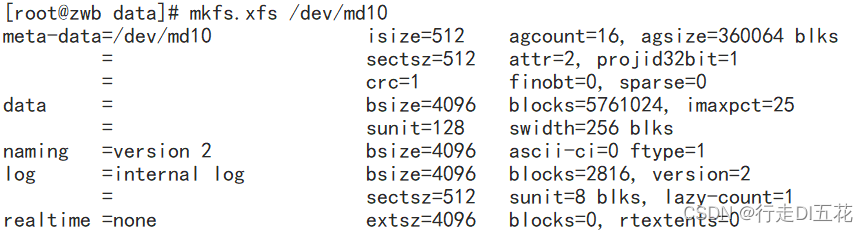
④ Mount or permanently mount vim /etc/fstab

⑤ [[email protected] data]# lsblk
NAME MAJ:MIN RM SIZE RO TYPE MOUNTPOINT
sda 8:0 0 100G 0 disk
├─sda1 8:1 0 500M 0 part /boot
├─sda2 8:2 0 7.8G 0 part [SWAP]
└─sda3 8:3 0 91.7G 0 part /
sdb 8:16 0 20G 0 disk
├─sdb1 8:17 0 4G 0 part
│ └─md127 9:127 0 8G 0 raid0 /data/raid0
├─sdb2 8:18 0 2G 0 part
│ └─md5 9:5 0 4G 0 raid5 /data/raid5
├─sdb3 8:19 0 2G 0 part
├─sdb4 8:20 0 1K 0 part
└─sdb5 8:21 0 12G 0 part
└─md10 9:10 0 22G 0 raid10 /data/raid10
sdc 8:32 0 20G 0 disk
├─sdc1 8:33 0 4G 0 part
│ └─md127 9:127 0 8G 0 raid0 /data/raid0
├─sdc2 8:34 0 2G 0 part
│ └─md5 9:5 0 4G 0 raid5 /data/raid5
├─sdc3 8:35 0 2G 0 part
├─sdc4 8:36 0 1K 0 part
└─sdc5 8:37 0 12G 0 part
└─md10 9:10 0 22G 0 raid10 /data/raid10
sdd 8:48 0 20G 0 disk
├─sdd1 8:49 0 4G 0 part
│ └─md126 9:126 0 4G 0 raid1 /data/raid1
├─sdd2 8:50 0 2G 0 part
│ └─md5 9:5 0 4G 0 raid5 /data/raid5
├─sdd3 8:51 0 3G 0 part
├─sdd4 8:52 0 1K 0 part
└─sdd5 8:53 0 11G 0 part
└─md10 9:10 0 22G 0 raid10 /data/raid10
sde 8:64 0 20G 0 disk
├─sde1 8:65 0 4G 0 part
│ └─md126 9:126 0 4G 0 raid1 /data/raid1
├─sde2 8:66 0 2G 0 part
├─sde3 8:67 0 2G 0 part
│ └─md5 9:5 0 4G 0 raid5 /data/raid5
├─sde4 8:68 0 1K 0 part
└─sde5 8:69 0 12G 0 part
└─md10 9:10 0 22G 0 raid10 /data/raid10
sr0 11:0 1 4.3G 0 rom
summary :
RAID 0 It is a strip type Don't break any disk , Read write speed block , No backup
RAID 1 It is an image type Can break a disk , The reading and writing speed is not RAID 0 block , But there are backups , High safety
RAID 5 It is a strip plus check type , The most widely used type in production . The worst one is allowed
RAID 10 It's the mirror image first and the strip , Each group raid 1 A bad one is allowed at most
边栏推荐
- MeterSphere一站式开源持续测试平台
- Function application of MySQL
- [219] what is the difference between app testing and web testing?
- Common commands and package management of go language
- [226] instructions for Wireshark parameters
- RESTful API介绍
- Use and principle of spark broadcast variable and accumulator
- Unable to boot after permanent mounting
- 手动安装Apache
- 系统安全及应用
猜你喜欢
![[218] what are the advantages and disadvantages of CS architecture and BS architecture and data on the server and client?](/img/d8/a367c26b51d9dbaf53bf4fe2a13917.png)
[218] what are the advantages and disadvantages of CS architecture and BS architecture and data on the server and client?

Homework in the second week
【217】#!/ The meaning of usr/bin/env

The public network uses Microsoft Remote Desktop remote desktop to work remotely at any time

Flink time stream processing

系统安全及应用

Log collection and analysis platform

LVM与磁盘配额
![Map the intranet to the public network [no public IP required]](/img/d0/b391bcfcaeb4c7ad439e241334361b.png)
Map the intranet to the public network [no public IP required]

Top 10 vulnerability assessment and penetration testing tools
随机推荐
SSH远程访问及控制
Wasm vs EVM, Boca's choice predicts the future of the public chain
grep与正则的搭配使用
Customize ZABBIX agent RPM package
List of problems in the re disk guidance of the project
sed命令
[226] instructions for Wireshark parameters
General paging 01
Flex layout
CentOS操作系统安全加固
使用自定义zabbix包(4.0.5版本)安装agent和proxy
Leetcode refers to offer jz5 to replace the space string
history命令历史记录中加时间
Sed command
Ia class summary (1)
Iterators and generators
Grid layout
RAID的配置实验
Maximum value of jz47 gifts (dynamic planning ideas)
Flink production environment configuration recommendations