当前位置:网站首页>IP notes (7)
IP notes (7)
2022-07-24 06:16:00 【Nine character Chen】
type | LS ID | Notifier | Scope of action | Carry information |
Type-1LSA Router | Announcer's RID | All cloud centers in the area OSPF Protocol router RID | Single area | Direct connection topology of local interface |
Type-2LSA Network | DR Interface IP Address | Single MA The network is high DR On the router RID | Single area | Single MA Supplementary information of network topology information |
Type-3LSA Sum-Net(summary) | The target network number of the routing information | ABR, After passing the next ARP The device will be modified to new ABR equipment | ABR Adjacent single areas | Inter domain routing information |
Type-5 LSA External(ase) | The target network number of the extraterritorial route | ASBR | Whole OSPF The Internet | Extraterritorial routing information |
Type-4LSA Sum-Asbr | ASBR Of RID | Yu ASBR In the same area ABR | get out ASBR Single area of the area | ASBR Location information for |
Type-7LSA NSSA |
Type-5 LSA External(ase):5 class LSA The foreign routing information imported through republishing , Because different networks have different evaluation standards for metrics , therefore , When overseas Luo you comes to this network , We will give up the original cost value , And give him a defined value ---seed-metric--- Seed measure ,OSPF The default seed metric in the network is 1.

E Type--- A marker bit , When marking position 0 when , Represents the use type 1; When marking position 1 when , Represents the use type 2--- It refers to the type of cost value ---OSPF The default usage type of the Protocol 2.
type 1: If the cost value type is 1, Then the cost value of all devices reaching the target network segment outside the domain is equal to the cost value of the local notifier plus the seed metric
type 2: If the cost value type is 2, Then the cost value of all devices in the domain to reach the target network segment outside the domain is equal to the seed metric
Forwarding Address--- Forwarding address -- A redirection address , Be similar to RIPV2 Next hop field in , When poor route selection occurs , The best routing information will be carried in this field , Then it will find the next hop according to the forwarding address , Instead of searching for notifiers according to the algorithm .5 class LSA in , Without poor route selection , Will use 0.0.0.0 To supplement .
Tag---- Routing tags --- You can give 5 class LSA Marking , It is convenient to grab the flow through the mark later

Type-4LSA Sum-Asbr---
LINK type :
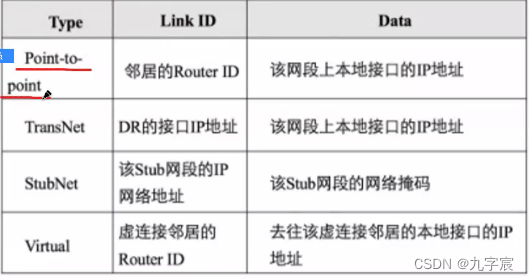

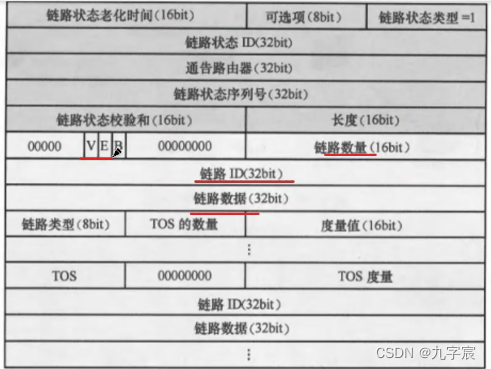
V--- Set up 1, It means that the router is VLINK An endpoint of
E--- Set up 1, It means that the router is ASBR equipment
B--- Set up 1, It means that the router is an area boundary device ABR
OSPF The optimization of the :
1. Summary --- Reduce the of backbone area LSA Number
2. Special area --- Reduce non backbone areas LSA Number
One 、 Summary :
OSPF The summary of is different from RIP Interface summary , It is called Regional summary . because OSPF Routing information is passed between regions .
1. Inter domain routing summary --- In essence, through ABR Three types of transmission between areas on the device LSA To summarize .

Be careful : Inter domain routing summary can only be summarized ABR The device itself passes 1 class ,2 class LSA Information learned routing information .
2. Extraterritorial routing summary --- In fact, the essence is ASBR On , By republishing , Speaking of Ru 5 class 、7 class LSA Enter into OSPF Summarize after the network .

Be careful :5 class LSA The cost value calculation method after summary :
Type2--- The cost value of the summary network segment is equal to the maximum of all detailed routing cost values plus 1
Type1--- The cost value of the summary network segment is equal to the maximum of all detailed routing cost values .
Two 、 Special area :
OSPF The special areas of are generally divided into two categories , Four sub categories
Conditions set as the first category ---1. It can't be the backbone area ;2. Virtual links cannot exist ;3. Can't exist ASBR equipment
1. We call this area The terminal area (STUB)---- If a region is configured as a terminal region, this region is not learning 4 Classes and 5 class LSA. Such an area will refuse to learn extraterritorial routing information , however , There is still a need to access extraterritorial routes , therefore , When the configuration is complete , It will automatically generate a line pointing to the backbone area 3 Class default .

Be careful : Once you make a special area , Then the equipment in all areas must be made into special areas
2. Completely peripheral area ---totally stub--- Based on the peripheral region , Further refuse to learn 3 class LSA, Keep only 3 Class defaults

Set the conditions of the second category ---1. It can't be the backbone area ;2. Virtual links cannot exist ;3. There is ASBR equipment
1. We call such a region incomplete terminal region (NSSA)---- If a region is configured as an incomplete terminal region, this region is not learning 4 Classes and 5 class LSA, However, the region still needs to import the following extraterritorial routing information , For refusing 5 class , So we can only 7 class LSA To continue to pass , after , stay 7 class LSA Information leaving NSSA After area , Need to convert to 5 class LSA To pass . Such an area will refuse to learn extraterritorial routing information , however , There is still a need to access extraterritorial routes , therefore , When the configuration is complete , It will automatically generate a line pointing to the backbone area 7 Class default .

O_NSSA---7 Marking of extraterritorial routing information , The default priority is also 150
E--- General arrangement 1, On behalf of 5 class LSA, If it is made into a special area , be E Bit will be set to 0.
N--- General arrangement 0,NSSA Area set 1, On behalf of 7 class LSA
P--- Generally, set 0, If you put 1, Then represent 7 turn 5
Forwarding Address--- Forwarding address -- A redirection address , Be similar to RIPV2 Next hop field in , When poor route selection occurs , The best routing information will be carried in this field , Then it will find the next hop according to the forwarding address , Instead of searching for notifiers according to the algorithm .5 class LSA in , Without poor route selection , Will use 0.0.0.0 To supplement .
however , stay 7 class LSA among , In the absence of poor route selection , Will ASBR Loopback interface of equipment IP Address as forwarding address , For other routers, as long as they can find the loopback interface IP Address , You can find it ASBR equipment . If there is no loopback interface , The of the physical interface will be used IP Address as forwarding address

2. Complete and incomplete peripheral regions --- complete NSSA Area ---totally NSSA Area --- stay NSSA On a regional basis , Further refuse to learn 3 class LSA, Generate a 3 Class defaults .

Be careful : Configuration becomes complete NSSA After area , Will automatically generate a finger backbone 3 Class default , But before the ordinary NSSA It's produced by the region 7 Class will remain by default , because OSPF LSA The priority of the , The device will choose to use 3 Class defaults instead of 7 Class default .
Be careful : The automatically generated default route must be consistent with the manually added default direction , Otherwise, a loop will appear .
OSP Extended configuration for :
1. Manual certification ---OSPF In all packets interacting with neighbors , Carry password , Password is the same. , Then the identity is legal .
ospf The authentication methods of are divided into 3 Kind of :
1. Interface authentication --- Configure on the interface of neighbor communication

Be careful : Configured on both sides key id It has to be the same , Otherwise, the neighbor relationship authentication will fail
2. Regional certification --- Its essence is interface authentication , It is equivalent to activating all interface configuration interface authentication in a certain area at one time

3. Virtual link authentication --- Add authentication in the virtual link establishment stage

2. Speed up convergence --- Reduce timer time
modify hello Time

Be careful :hello Time modification , The time of death will automatically follow 4 Match the times relationship
Modify the time of death

Be careful dead Time modification ,hello Time does not change automatically
Waiting time--- Waiting for the timer --DR and BDR Election time at election , Equal to the time of death , Once the time of death is modified , The waiting time will change synchronously .
POLL--- poll time ---120s--- And status bits down Our neighbors are happy to send hello Packet interval . stay NBMA In the network environment, if one party specifies the neighbor relationship , Then the state of the neighbor will be changed to the transitional state , The default is 30s One time transmission hello package , however , If the other party has not specified . After a waiting time (120s Equal to the time of death ), The state of the neighbor will be set to down state , After that, according to 120s Send at regular intervals hello package

Retransmit--- Retransmission time --- Default 5s---- Sending information requires confirmation , If no confirmation is received within the retransmission time , Will be retransmitted

Transmit Delay--- Transmission delay ---1s--- This time is added to the aging time , because LSA During transmission , Time doesn't change , So this time is needed to compensate for the time consumed .

3. Silent interface --- Configure an interface as a silent interface , Then this interface only accepts and does not send OSPF Data packets of

4. Default route :(3 class ,5 class ,7 class )
3 Class default --- It can only be generated automatically through special areas --- Common terminal area , Completely peripheral area , Complete and incomplete peripheral regions
characteristic : Marked as OSPF, Default priority 10
5 Class default --- Default generated by hand configuration
characteristic : Marked as O_ASE, The default priority is 150

7 Class default --- It can be automatically distributed by configuring special areas , You can also issue a manual command 7 Class default ( Automatic distribution is really common NSSA In the region .)

5. Summary
6. Route filtering --- refer to OSPF Targeted at 3 class ,5 class ,7 class LSA To filter


边栏推荐
猜你喜欢



随机推荐
不租服务器,自建个人商业网站(3)
Sorting of common AR and MR head mounted display devices
Unity2d game let characters move - next
ue4 换装系统3.最终成果
JDBC elementary learning ------ (learning from Shang Silicon Valley)
IP课总结(3)
快速简单搭建FTP服务器,并内网穿透实现公网访问【无需公网IP】
day4-jvm
什么是单调栈
UE4:浅谈什么是GamePlay框架
IA笔记 1
ue4换装系统 1.换装系统的基本原理
利用内网穿透,实现公网访问内网
Hololens 2 development: development environment deployment
Openpose Unity 插件部署教程
Day2 websocket+ sort
UE4 replacement system 3. Final results
Find the number with the most occurrences in the array
Unity Shader从内置渲染管线迁移到URP
Openpose2d transform 3D pose recognition