当前位置:网站首页>Machine learning notes - trend components of time series
Machine learning notes - trend components of time series
2022-06-26 03:46:00 【Sit and watch the clouds rise】
One 、 What is the trend ?
The trend component of the time series represents the duration of the mean value of the series 、 Long term change . The trend is the slowest part of the series , Represents the importance of the maximum time scale . In the time series of product sales , As more and more people know about this product , The impact of market expansion may be an increasing trend .

ad locum , We will focus on the trend of the mean . More generally , Any continuous and slow-moving change in a sequence may constitute a trend —— for example , Time series usually have trends in their changes .
Two 、 Moving average chart
To see what trends a time series might have , We can use the moving average graph . To calculate the moving average of the time series , We calculate the average of the values in a sliding window that defines the width . Each point on the chart represents the average of all values in the series located in either side of the window . The idea is to eliminate any short-term fluctuations in the sequence , So as to retain only long-term changes .
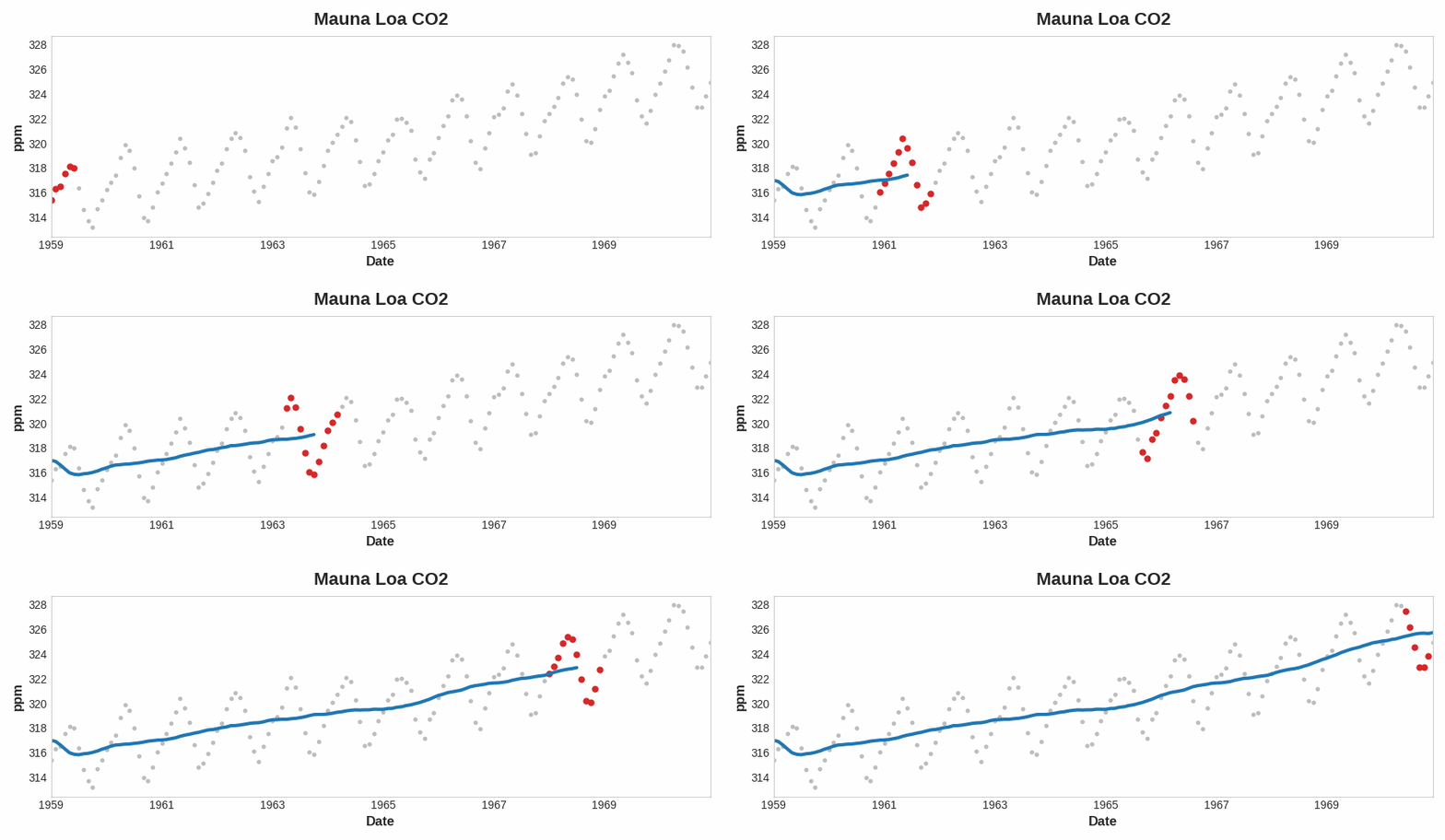
Notice the top Mauna Loa How the series repeats up and down year after year —— A short-term seasonal change . To make change part of the trend , It should take longer than any seasonal change . therefore , To visualize trends , We averaged over a longer period of time than any seasonal cycle in the series . about Mauna Loa series , We chose a size of 12 Windows to smooth the seasons of the year .
3、 ... and 、 Engineering trends
Once we have determined the shape of the trend , We can try to use the time step feature to model it . We have seen how to use the time virtual model itself to simulate linear trends :
target = a * time + bWe can fit many other types of trends through the transformation of time dummy variables . If the trend seems to be quadratic ( parabola ), We just add the square of the time dummy variable to the feature set , obtain :
target = a * time ** 2 + b * time + cLinear regression will learn the coefficient a、b and c.
The trend curves in the figure below use these features and scikit-learn Of LinearRegression Fitting :
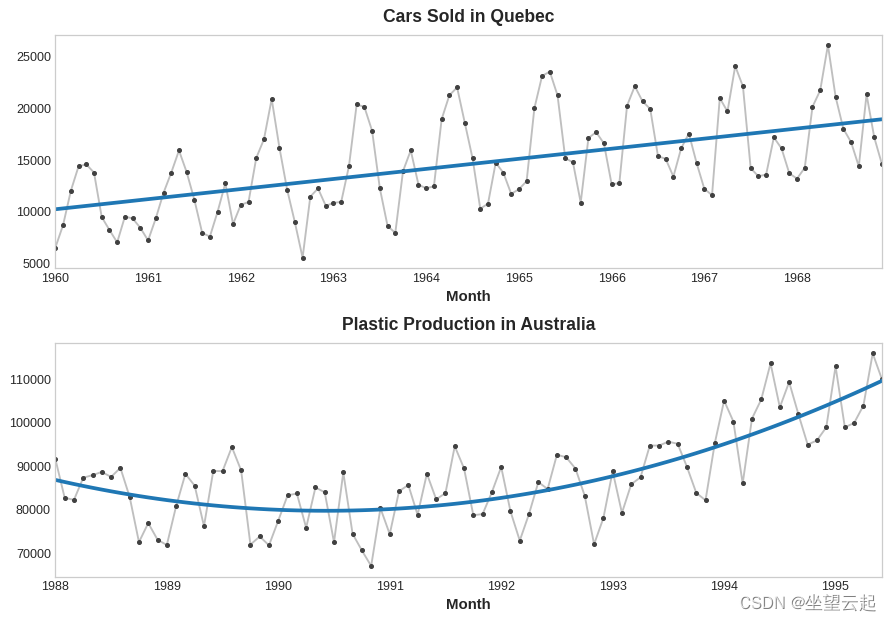
If you haven't seen this technique before , Then you may not realize that linear regression can fit curves other than straight lines . The idea is , If you can provide a curve of appropriate shape as a feature , Then linear regression can learn how to combine them in a way that best suits the target .
Four 、 Example - Tunnel flow
In this case , We will create a trend model for the tunnel traffic data set .
from pathlib import Path
from warnings import simplefilter

import matplotlib.pyplot as plt
import numpy as np
import pandas as pd

simplefilter("ignore")  # ignore warnings to clean up output cells

# Set Matplotlib defaults
plt.style.use("seaborn-whitegrid")
plt.rc("figure", autolayout=True, figsize=(11, 5))
plt.rc(
    "axes",
    labelweight="bold",
    labelsize="large",
    titleweight="bold",
    titlesize=14,
    titlepad=10,
)
plot_params = dict(
    color="0.75",
    style=".-",
    markeredgecolor="0.25",
    markerfacecolor="0.25",
    legend=False,
)
%config InlineBackend.figure_format = 'retina'


# Load Tunnel Traffic dataset
data_dir = Path("../input/ts-course-data")
tunnel = pd.read_csv(data_dir / "tunnel.csv", parse_dates=["Day"])
tunnel = tunnel.set_index("Day").to_period()
Let's make a moving average , See what trends this series has . Because this series has daily observations , Let's choose one 365 A window of days to smooth out any short-term changes in a year .
To create a moving average , First, use the scrolling method to start the window calculation . Calculate the average value of the window according to this method . As we can see , The trend of tunnel flow seems to be linear .
moving_average = tunnel.rolling(
    window=365,       # 365-day window
    center=True,      # puts the average at the center of the window
    min_periods=183,  # choose about half the window size
).mean()              # compute the mean (could also do median, std, min, max, ...)

ax = tunnel.plot(style=".", color="0.5")
moving_average.plot(
    ax=ax, linewidth=3, title="Tunnel Traffic - 365-Day Moving Average", legend=False,
);
In the last article on time series , We are directly in the Pandas Our time virtual machine is designed in . However , from now on , We will use statsmodels One of the libraries is called DeterministicProcess Function of . Using this function will help us avoid some tricky failure cases , These cases may occur with time series and linear regression . order Parameters refer to polynomial order :1 It means linear ,2 Indicates secondary ,3 It means three times , And so on .
from statsmodels.tsa.deterministic import DeterministicProcess

dp = DeterministicProcess(
    index=tunnel.index,  # dates from the training data
    constant=True,       # dummy feature for the bias (y_intercept)
    order=1,             # the time dummy (trend)
    drop=True,           # drop terms if necessary to avoid collinearity
)
# `in_sample` creates features for the dates given in the `index` argument
X = dp.in_sample()

X.head()| Day | const | trend |
|---|---|---|
| 2003-11-01 | 1.0 | 1.0 |
| 2003-11-02 | 1.0 | 2.0 |
| 2003-11-03 | 1.0 | 3.0 |
| 2003-11-04 | 1.0 | 4.0 |
| 2003-11-05 | 1.0 | 5.0 |
( By the way , A deterministic process is a technical term for a nonrandom or completely deterministic time series , It's like const Same as trend series . Characteristics derived from time indices are usually deterministic .)
We basically create the trend model as before , But please note that fit_intercept=False Parameters .
from sklearn.linear_model import LinearRegression

y = tunnel["NumVehicles"]  # the target

# The intercept is the same as the `const` feature from
# DeterministicProcess. LinearRegression behaves badly with duplicated
# features, so we need to be sure to exclude it here.
model = LinearRegression(fit_intercept=False)
model.fit(X, y)

y_pred = pd.Series(model.predict(X), index=X.index)
Our linear regression model found almost the same trend as the moving average graph , This shows that the linear trend is the right decision in this case .
ax = tunnel.plot(style=".", color="0.5", title="Tunnel Traffic - Linear Trend")
_ = y_pred.plot(ax=ax, linewidth=3, label="Trend") In order to make predictions , We apply the model to “ Out of sample ” features . “ Out of sample ” It refers to the time beyond the observation period of training data . Here's how we do it 30 Day prediction method :
X = dp.out_of_sample(steps=30)
y_fore = pd.Series(model.predict(X), index=X.index)
y_fore.head()
2005-11-17 114981.801146 2005-11-18 115004.298595 2005-11-19 115026.796045 2005-11-20 115049.293494 2005-11-21 115071.790944 Freq: D, dtype: float64
Let's draw part of this series to see the future 30 Day trend forecast :
ax = tunnel["2005-05":].plot(title="Tunnel Traffic - Linear Trend Forecast", **plot_params)
ax = y_pred["2005-05":].plot(ax=ax, linewidth=3, label="Trend")
ax = y_fore.plot(ax=ax, linewidth=3, label="Trend Forecast", color="C3")
_ = ax.legend()
Why trend models are useful , There are many reasons . In addition to serving as a baseline or starting point for more complex models , We can also use them as “ hybrid model ” One of the components in , The algorithm cannot learn the trend ( Such as XGBoost And random forest ).
边栏推荐
- Link monitoring pinpoint
- 优化——多目标规划
- MySQL addition, deletion, query and modification (Advanced)
- Digital twin intelligent water service, breaking through the development dilemma of sponge City
- Cloud Computing Foundation -0
- USB driver -debug
- go time包:秒、毫秒、纳秒时间戳输出
- You cannot call Glide. get() in registerComponents(), use the provided Glide instance instead
- Procédures stockées MySQL
- 开源!ViTAE模型再刷世界第一:COCO人体姿态估计新模型取得最高精度81.1AP
猜你喜欢

Restful API interface design standards and specifications

Classic model - Nin & googlenet

. Net core learning journey

Qixia fire department carries out fire safety training on construction site

Nepal graph learning Chapter 3_ Multithreading completes 6000w+ relational data migration

阿里云函数计算服务一键搭建Z-Blog个人博客

Upload file / text / picture, box shadow

【好书集锦】从技术到产品

MySQL高级部分( 四: 锁机制、SQL优化 )

Redux thunk simple case, advantages, disadvantages and thinking
随机推荐
个人用同花顺软件买股票安全吗?怎么炒股买股票呢
WebRTC系列-网络传输之7-ICE补充之偏好(preference)与优先级(priority)
MySQL高级篇第一章(linux下安装MySQL)【下】
2022.6.25-----leetcode. Sword finger offer 091
MySQL development environment
机器学习笔记 - 时间序列的趋势分量
Nepal graph learning Chapter 3_ Multithreading completes 6000w+ relational data migration
IEDA 突然找不到了compact middle packages
Group counting notes - instruction pipeline of CPU
力扣79单词搜索
ABP framework Practice Series (I) - Introduction to persistence layer
Classic model – RESNET
“再谈”协议
Uni app custom selection date 1 (September 16, 2021)
Procédures stockées MySQL
面试阿里测开岗失败后,被面试官在朋友圈吐槽了......(心塞)
Kotlin uses viewpager2+fragment+bottomnavigationview to implement the style of the switching module of the bottom menu bar.
Android gap animation translate, scale, alpha, rotate
MySQL advanced part (IV: locking mechanism and SQL optimization)
Double carbon bonus + great year of infrastructure construction 𞓜 deep ploughing into the field of green intelligent equipment for water conservancy and hydropower