当前位置:网站首页>迭代器与生成器
迭代器与生成器
2022-07-24 05:23:00 【笑 瘾】
迭代器与生成器
一、python推导式
1.列表推导式
a = [1,2,3,4,5,6,7]
b = [x**2 for x in a if x%2 == 1]
print(b)

结果:
	[1, 9, 25, 49]
练习:
1.1 使用列表推导式,输出200以内开平方是整数的数
#方法一:
result = [i*i for i in range(15) if i*i<200]
print(result)
#方法二:
import math
tmp = [i for i in range(200) if math.sqrt(i).is_integer()]
#tmp = [i for i in range(200) if math.sqrt(i)%1==0]
print(tmp)
1.2 对列表中的数,取两位小数
tmp = [2.45345,4.3454325,9,82.234324,9.841234]
num = [round(i,2) for i in tmp ]
# num = ['%.2f'%i for i in tmp ]
print(num)
2.嵌套推导式
#统计出名字里面包含e次数大于两次的,
#方法一:常规方法
result = []
names = [['Tom', 'Billy', 'Jefferson', 'Andrew', 'Wesley', 'Steven', 'Joe'],
         ['Alice', 'Jill', 'Ana', 'Wendy', 'Jennifer', 'Sherry', 'Eva', 'Elven']]
for i in names:
    for j in i:
        if j.lower().count("e")>=2:
          result.append(j)
print(result)

#方法二:嵌套推导式实现
names = [['Tom', 'Billy', 'Jefferson', 'Andrew', 'Wesley', 'Steven', 'Joe'],['Alice', 'Jill', 'Ana', 'Wendy', 'Jennifer', 'Sherry', 'Eva', 'Elven']]
print([name for lst in names for name in lst if name.lower().count('e')>=2])
3.字典推导式
d1 = {
    "a":1,"b":2,}
d2 = {
    v:k for k,v in d1.items()}
print(d2)

结果:
	{
    1: 'a', 2: 'b'}
练习
3.1 统计字符串中每一字符出现的次数
#方法一:
str1 = "fasfasgwreasdg3tagjdhg"
print({
    x:str1.count(x) for x in str1 })
#方法二:
tmp = {
    }
for i in str1:
    tmp[i] = tmp.get( i, 0) +1
4.集合推导式
和列表推导式一致,只是这里使用{},自带去重功能
lst = [-1,1,2,1]
s1 = {
    i*i for i in lst}
print(s1)

结果:
	{
    1, 4}
5.推导式综合练习

答案
1、q1 = ['a','ab','abc','abcd','abcde']
print([x.upper() for x in q1 if len(x)>=3])

2、print([(x,y) for x in range(6) for y in range(6) if x%2==0 and y%2!=0])

3、dict1 = {
    'a': 10, 'b': 34}
print({
    x:y for y,x in dict1.items()})

4、q4 = {
    'B':3,'a':1,'b':6,'c':3,'A':4}
print({
    x.lower():q4.get(x.lower(),0)+q4.get(x.upper(),0) for x,y in q4.items() })
python中可迭代对像和迭代器
1.可迭代对象:
实现了__iter__方法,并且该方法返回一个迭代器的对象
lst = ["x","y",1,2,3]
print(dir(lst))

from collections.abc import Iterable
print(isinstance(lst,Iterable))
print(isinstance(lst,list))
print(isinstance(lst,str))
2.目前接触的可迭代对象–容器类型
str、list、tuple、dict、set,打开的文件files、range等等
3.迭代器,实现了__iter__()和__next__()方法的都叫做迭代器
__iter__方法返回自身
__next__方法不断返回下一个值
迭代器一定是一个可迭代对象
str1 = "abc"
result = str1.__iter__()
print(result)
print(dir(result))
print(result.__next__())
print(result.__next__())
print(result.__next__())

range_iter = iter(range(10))
from collections.abc import Iterable,Iterator
print(isinstance(range_iter,Iterable))
print(isinstance(range_iter,Iterator))
4.for 语法糖
for 先调用可迭代对象的__iter__方法,返回一个迭代器,然后再对迭代器调用__next__方法,不断的返回下一个值,直到最后一个退出,
容器中没有更多的元素了,则抛出StopIteration,for循环遇到异常就退出
5.懒加载
惰性求值,需要的时候再生成
迭代器的作用:不会一次性消耗大量的内存,一个一个加载
lst = [1,2,3,4,5,6,7,8]  #一次性全部生成,保存在内存中
#range(1,9)
for i in range(1,9):
	print(i)
6.生成无限序列
from itertools import count
counter = count(start=10)
print(counter,type(counter))
print(next(counter))
print(next(counter))
print(next(counter))

结果:
    count(10) <class 'itertools.count'>
    10
    11
    12
7.从有限的序列中生成无限序列

8.实现一个迭代器
class NumIter():
    def __init__(self):
        self.num = 0
    def __iter__(self):
        return self
    def __next__(self):
        self.num +=1
        return self.num
n1 = NumIter()
print(dir(n1))

for i in n1:
    if i ==10:
        break
    print(i)
9.编写迭代器实现range
class MyRange():
    def __init__(self, num):
        self.num = num
        self.i = 0
    def __iter__(self):
        return self
    def __next__(self):
        if self.i < self.num:
            flag = self.i
            self.i += 1
            return flag
        else:
            raise StopIteration
ran  = MyRange(10)
for i in ran:
    print(i)
10、编写迭代器实现斐波拉契数列
class Fib():
    def __init__(self, num):
    #num 表示计算前n项 用以判断迭代的条件
        self.num = num
    #i 用来记录访问的位置
        self.i = 0
        self.num1 = 0
        self.num2 = 1
    def __iter__(self):
    # 可迭代对象需要提供__iter__一个迭代器,在python中, 迭代器 本身就是一个可迭代对象,返回自己
        return self
    def __next__(self):
        if self.i < self.num:
            self.num1,self.num2 = self.num2,self.num1+self.num2
            self.i += 1
            return self.num1
        else:
            raise StopIteration
fib  = Fib(10)
for i in fib:
    print(i)
三、生成器
1.生成器:不需要手动去实现__iter__和__next__方法,是迭代器更优雅的写法
2.生成器只有两个写法:
一种叫做生成器表达式,一种叫做生成器函数
3.生成器表达式
惰性求值,类似与列表推导式
result = (x for x in range(1,31) if x%3 ==0) #=====》惰性求值
print(result)
print(dir(result))

结果:
<generator object <genexpr> at 0x000002B1F715AC80>
['__class__', '__del__', '__delattr__', '__dir__', '__doc__', '__eq__', '__format__', '__ge__', '__getattribute__', '__gt__', '__hash__', '__init__', '__init_subclass__', '__iter__', '__le__', '__lt__', '__name__', '__ne__', '__new__', '__next__', '__qualname__', '__reduce__', '__reduce_ex__', '__repr__', '__setattr__', '__sizeof__', '__str__', '__subclasshook__', 'close', 'gi_code', 'gi_frame', 'gi_running', 'gi_yieldfrom', 'send', 'throw']
4.生成器函数:
包含了yield关键字的函数就叫做生成器函数
1、yield关键字
yield保留中间算法,下次继续执行
当调用next时,遇到yield就暂停运行,并且返回yield后面表达式的值
当再次调用yield时,就会从刚才暂停的地方继续运行,直到遇到下一个yield或者整个生成器结束为止
def get_content():
    x = 2
    yield x
    y = 3
    yield y
    z = 4
    yield z
g = get_content()
print(g)
print(dir(g))
print(next(g)) #第一次执行next的时候,遇到yield就退出,并且返回yield后面携带的参数,还会记录当前执行的位置
print(next(g)) #第二次执行的时候,就会从上一次执行的地方继续执行
print(next(g))

结果:
<generator object get_content at 0x000001D2D9C9AAC0>
['__class__', '__del__', '__delattr__', '__dir__', '__doc__', '__eq__', '__format__', '__ge__', '__getattribute__', '__gt__', '__hash__', '__init__', '__init_subclass__', '__iter__', '__le__', '__lt__', '__name__', '__ne__', '__new__', '__next__', '__qualname__', '__reduce__', '__reduce_ex__', '__repr__', '__setattr__', '__sizeof__', '__str__', '__subclasshook__', 'close', 'gi_code', 'gi_frame', 'gi_running', 'gi_yieldfrom', 'send', 'throw']
2
3
4
#生成器实现range方法
def Myrange(num):
    i = 0
    while i<num:
        yield i
        i +=1
for i in Myrange(10):
    print(i)
5.生成器函数,实现斐波拉契数列
def Fib(num):
    i = 0
    num1 = 0
    num2 = 1
    while i<num:
        num1,num2 = num2,num1+num2
        yield num1
        i +=1
for i in Fib(10):
    print(i)
6.生成器的好处:
可以使用更少的代码来实现迭代器的效果
相比于容器类型更加节省内存
7.生成器对大文件的处理,可以兼顾效率和内存爆了的处理
def read_file(path):
    SIZE = 65535
    with open(path,"rb") as f:
        while True:
            block = f.read(SIZE)
            if block:
                yield block
            else:
                return
7.1、特大大的文件处理:
生成器 + 切割多个小文件并行处理
7.2、大文件的传输
切割小文件 + 哈希验证
8.send方法
def counter():
    count = 1
    while 1:
        val = yield count
        print(f'val is {val}')
        if val is not None:
            print(f'val is {val}')
            count = val
        else:
            count +=1

count = counter()
#count.send(10) #修改数据,必须先激活生成器,可以调用next激活
print(next(count))
count.send(10)      #返回一个新的值给yield count
print(next(count))

#手动关闭当前生成器,关闭之后不能再继续生成值
# count.close()
# print(next(count))
9.yield和yield from
def f1():
    yield range(10)
def f2():
    yield from range(10)
iter1 = f1()
iter2 = f2()
print(iter1)
print(iter2)
print(next(iter1))
#print(next(iter1)) #会报错,因为已经停止了
print(next(iter2))
print(next(iter2))      #yield from 后面需要传入一个可迭代对象
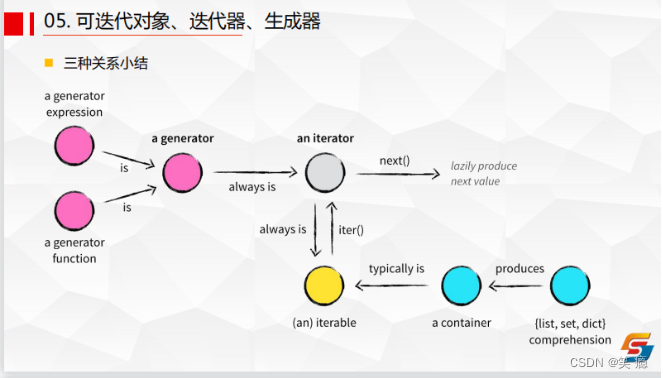
四、生成器、迭代器、可迭代对象三者的关系
五、hash算法
1、哈希算法定义
结果都是以空间换时间的的概念
把任意长度的输入,变成固定长度的输出
2、常见的哈希算法:
md5 sha1 sha2 sha256 sha512---》单向加密技术
3、应用:
校验文件的完整性--》文件的传输;
密码验证和密码加密
边栏推荐
- 公网访问内网IIS网站服务器【无需公网IP】
- Remote connection to Qunhui NAS at home [no public IP, free intranet penetration]
- Hololens 2 Chinese development document MRTK V2
- Data set and pre training model
- 利用内网穿透,实现公网访问内网
- Do not rent servers, build your own personal business website (2)
- Remember 20 classic interview questions of performance test in three minutes
- Mysql database - SQL summary (remember to pay attention to me! Come on in China!)
- Simple three-step fast intranet penetration
- 进行挂载永久挂载后无法开机
猜你喜欢

JSP tag 02

UE4 reload system 1. basic principle of reload system
![Configure a fixed remote desktop address [intranet penetration, no need for public IP]](/img/17/4e119be86189d80b100eb000254a86.png)
Configure a fixed remote desktop address [intranet penetration, no need for public IP]

Process and planned task management

Do not rent servers, build your own personal business website (1)

Hololens 2 development: use MRTK and simulate gesture input in unity
![[226] instructions for Wireshark parameters](/img/47/0d3fd221695920e02b1f690a2a21c1.png)
[226] instructions for Wireshark parameters

Luckyframeweb testing platform (a full latitude free open source testing platform that supports interface automation, Web UI automation, APP automation, and distributed testing)

简单三步快速实现内网穿透

Do not rent servers, build your own personal business website (2)
随机推荐
如何建立一个仪式感点满的网站,并发布到公网 2-2
如何建立一个仪式感点满的网站,并发布到公网 1-2
Flink state use
Remote connection to Qunhui NAS at home [no public IP, free intranet penetration]
【251】常见的测试工具
IP笔记(11)
Jenkins自动化无人值守运行(上/下)
Leetcode sword finger offer jz73 flip word sequence
Pycharm set code template
简单三步快速实现内网穿透
Remember to get the password of college student account once, from scratch
Li Kou 986. Intersection of interval lists
[218] what are the advantages and disadvantages of CS architecture and BS architecture and data on the server and client?
数据集和预训练模型
【222】内存溢出及定位
[251] common test tools
Process and planned task management
Unity (III) three dimensional mathematics and coordinate system
MySQL从基础到入门到高可用
【217】#!/ The meaning of usr/bin/env