当前位置:网站首页>卷积神经网络模型之——GoogLeNet网络结构与代码实现
卷积神经网络模型之——GoogLeNet网络结构与代码实现
2022-07-25 12:43:00 【1 + 1=王】
文章目录
GoogLeNet网络简介
GoogLeNet原文地址:Going Deeper with Convolutions:https://www.cv-foundation.org/openaccess/content_cvpr_2015/papers/Szegedy_Going_Deeper_With_2015_CVPR_paper.pdf
GoogLeNet在2014年由Christian Szegedy提出,它是一种全新的深度学习结构。
GoogLeNet网络的主要创新点在于:
提出Inception结构在多个尺寸上同时进行卷积再聚合;

使用1X1的卷积进行降维以及映射处理;
添加两个辅助分类器帮助训练;
辅助分类器是将中间某一层的输出用作分类,并按一个较小的权重加到最终分类结果中。使用平均池化层代替全连接层,大大减少了参数量。
GoogLeNet网络结构
GoogLeNet的完整网络结构如下所示: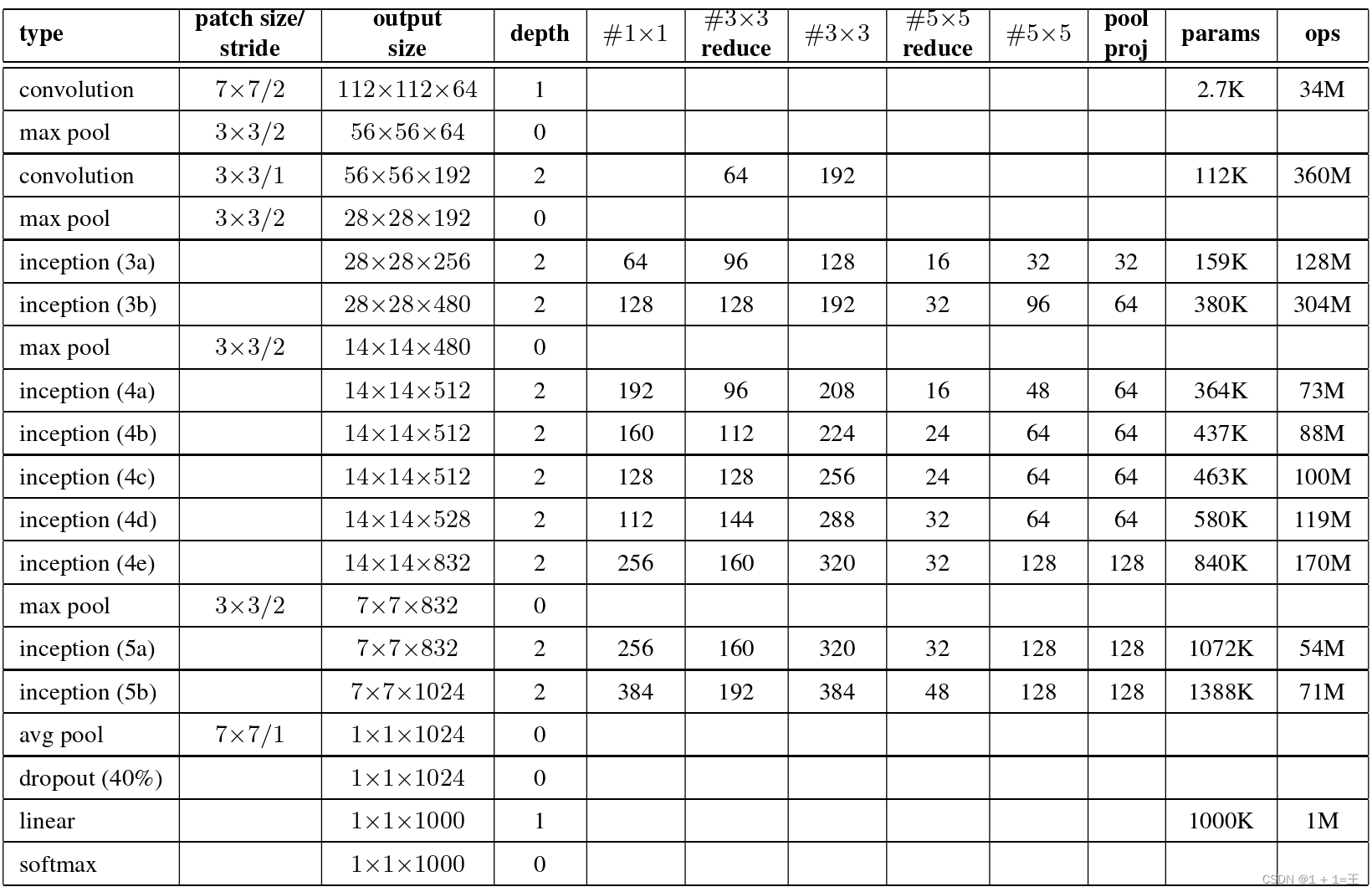
下面我们将其逐层拆分讲解并结合代码分析
Inception之前的几层结构
在进入Inception结构之前,GoogLeNet网络先堆叠了两个卷积(实则3个,有一个1X1的卷积)和两个最大池化层。

# input(3,224,224)
self.front = nn.Sequential(
    nn.Conv2d(3, 64, kernel_size=7, stride=2, padding=3),   # output(64,112,112)
    nn.ReLU(inplace=True),

    nn.MaxPool2d(kernel_size=3,stride=2,ceil_mode=True),    # output(64,56,56)

    nn.Conv2d(64,64,kernel_size=1),
    nn.Conv2d(64,192,kernel_size=3,stride=1,padding=1),     # output(192,56,56)
    nn.ReLU(inplace=True),

    nn.MaxPool2d(kernel_size=3,stride=2,ceil_mode=True),    # output(192,28,28)
)
Inception结构

Inception模块只会改变特征图的通道数,而不会改变尺寸大小。
Inception结构相对复杂,我们重新创建一个类来构建此结构,并通过参数不同的参数来控制各层的通道数。
class Inception(nn.Module):
    ''' in_channels: 输入通道数 out1x1:分支1输出通道数 in3x3:分支2的3x3卷积的输入通道数 out3x3:分支2的3x3卷积的输出通道数 in5x5:分支3的5x5卷积的输入通道数 out5x5:分支3的5x5卷积的输出通道数 pool_proj:分支4的最大池化层输出通道数 '''
    def __init__(self,in_channels,out1x1,in3x3,out3x3,in5x5,out5x5,pool_proj):
        super(Inception, self).__init__()

        self.branch1 = nn.Sequential(
            nn.Conv2d(in_channels, out1x1, kernel_size=1),
            nn.ReLU(inplace=True)
        )
        self.branch2 = nn.Sequential(
            nn.Conv2d(in_channels,in3x3,kernel_size=1),
            nn.ReLU(inplace=True),
            nn.Conv2d(in3x3,out3x3,kernel_size=3,padding=1),
            nn.ReLU(inplace=True)
        )
        self.branch3 = nn.Sequential(
            nn.Conv2d(in_channels, in5x5, kernel_size=1),
            nn.ReLU(inplace=True),
            nn.Conv2d(in5x5, out5x5, kernel_size=5, padding=2),
            nn.ReLU(inplace=True)
        )

        self.branch4 = nn.Sequential(
            nn.MaxPool2d(kernel_size=3,stride=1,padding=1),
            nn.Conv2d(in_channels,pool_proj,kernel_size=1),
            nn.ReLU(inplace=True)
        )

    def forward(self,x):
        branch1 = self.branch1(x)
        branch2 = self.branch2(x)
        branch3 = self.branch3(x)
        branch4 = self.branch4(x)

        outputs = [branch1,branch2,branch3,branch4]
        return torch.cat(outputs,1)	# 按通道数叠加
Inception3a模块

# input(192,28,28)
self.inception3a = Inception(192, 64, 96, 128, 16, 32, 32)		# output(256,28,28)
Inception3b + MaxPool

# input(256,28,28)
self.inception3b = Inception(256, 128, 128, 192, 32, 96, 64)		# output(480,28,28)
self.maxpool3 = nn.MaxPool2d(3, stride=2, ceil_mode=True)			# output(480,14,14)
Inception4a

# input(480,14,14)
self.inception4a = Inception(480, 192, 96, 208, 16, 48, 64)		# output(512,14,14)
Inception4b

# input(512,14,14)
self.inception4b = Inception(512, 160, 112, 224, 24, 64, 64)		# output(512,14,14)
Inception4c

# input(512,14,14)
self.inception4c = Inception(512, 160, 112, 224, 24, 64, 64)		# output(512,14,14)
Inception4d

# input(512,14,14)
self.inception4d = Inception(512, 112, 144, 288, 32, 64, 64)		# output(528,14,14)
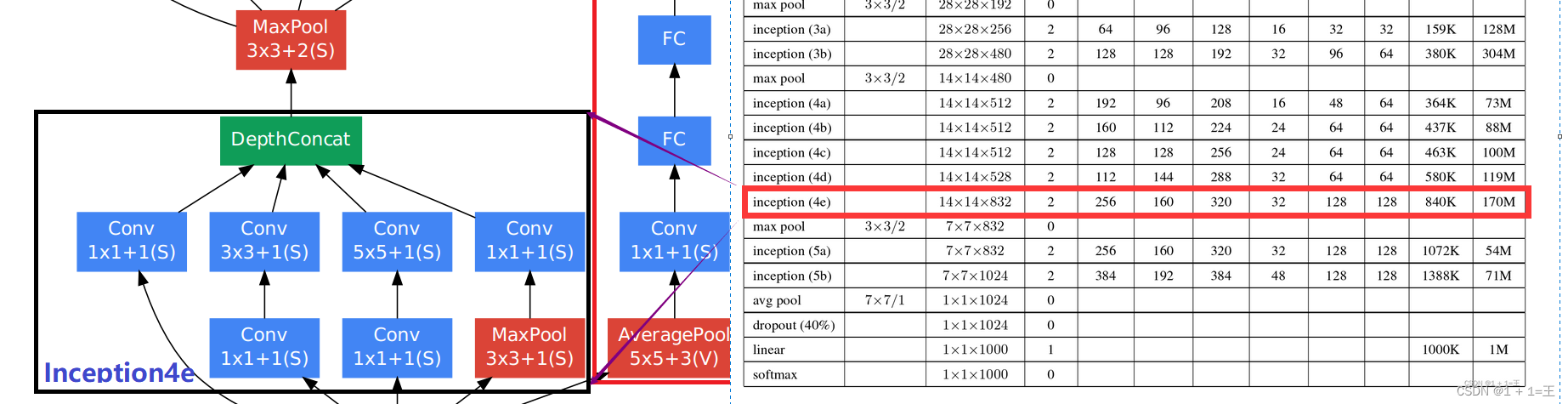
Inception4e+MaxPool
# input(528,14,14)
self.inception4e = Inception(528, 256, 160, 320, 32, 128, 128)	# output(832,14,14)
self.maxpool4 = nn.MaxPool2d(3, stride=2, ceil_mode=True)		# output(832,7,7)
Inception5a

# input(832,7,7)
self.inception5a = Inception(832, 256, 160, 320, 32, 128, 128)		# output(832,7,7)
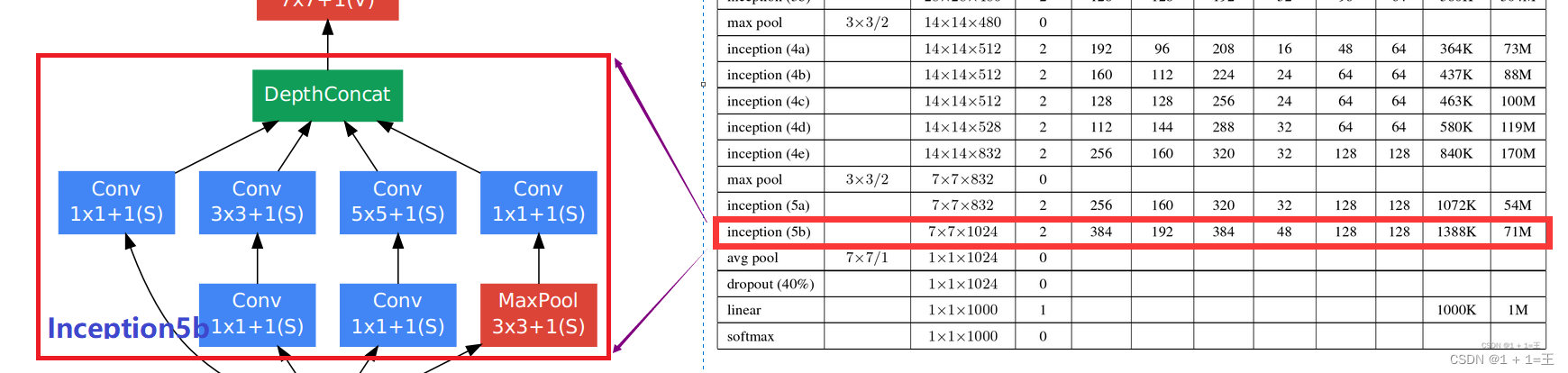
Inception5b
# input(832,7,7)
self.inception5b = Inception(832, 384, 192, 384, 48, 128, 128)		# output(1024,7,7)
Inception之后的几层结构

辅助分类模块
除了以上主干网络结构以外,GoogLeNet还提供了两个辅助分类模块,用于将中间某一层的输出用作分类,并按一个较小的权重(0.3)加到最终分类结果。
与Inception模块一样,我们也重新创建一个类来搭建辅助分类模块结构。
class AccClassify(nn.Module):
	# in_channels: 输入通道
	# num_classes: 分类数
    def __init__(self,in_channels,num_classes):
        self.avgpool = nn.AvgPool2d(kernel_size=5, stride=3)
        self.conv = nn.MaxPool2d(in_channels, 128, kernel_size=1)  # output[batch, 128, 4, 4]
        self.relu = nn.ReLU(inplace=True)

        self.fc1 = nn.Linear(2048, 1024)
        self.fc2 = nn.Linear(1024, num_classes)

    def forward(self,x):
        x = self.avgpool(x)
        x = self.conv(x)
        x = self.relu(x)
        x = torch.flatten(x, 1)
        x = F.dropout(x, 0.5, training=self.training)
        x = F.relu(self.fc1(x), inplace=True)
        x = F.dropout(x, 0.5, training=self.training)
        x = self.fc2(x)

        return x
辅助分类模块1
第一个中间层输出位于Inception4a之后,将Inception4a的输出经过平均池化,1X1卷积和全连接后等到分类结果。
self.acc_classify1 = AccClassify(512,num_classes)
辅助分类模块2
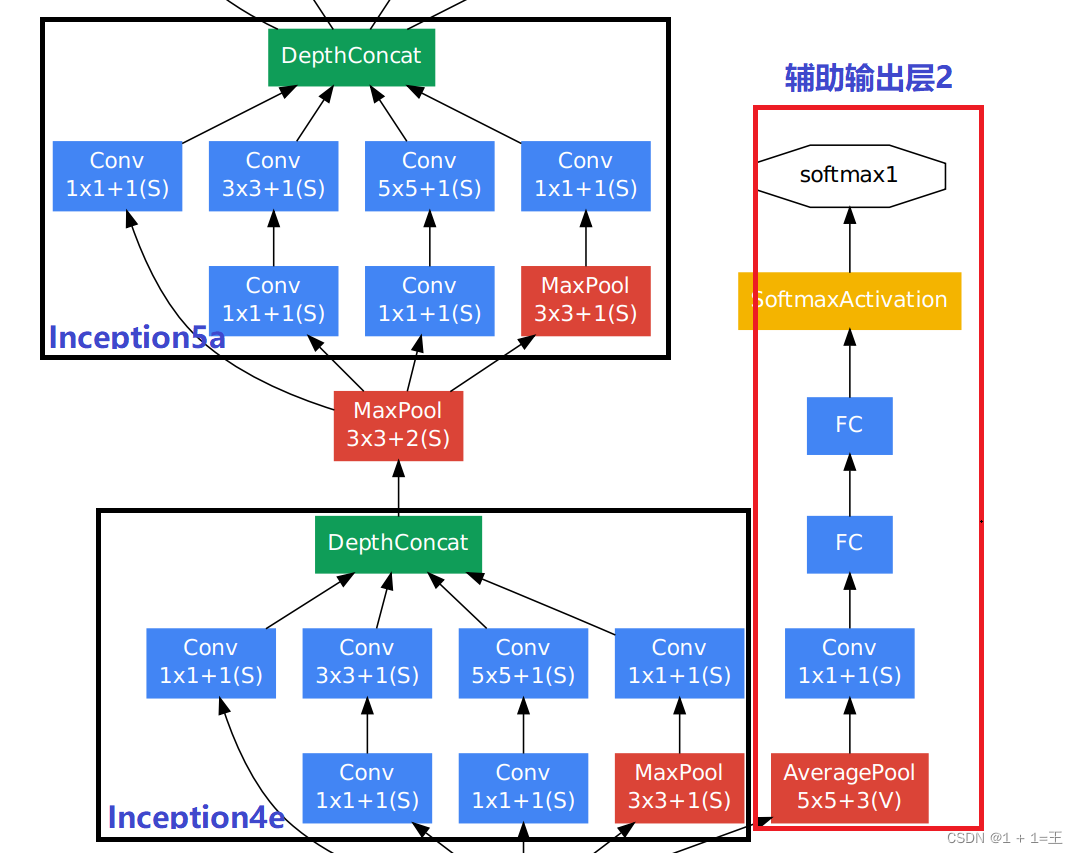
self.acc_classify2 = AccClassify(528,num_classes)
整体网络结构
pytorch搭建完整代码
""" #-*-coding:utf-8-*- # @author: wangyu a beginner programmer, striving to be the strongest. # @date: 2022/7/5 18:37 """
import torch.nn as nn
import torch
import torch.nn.functional as F


class GoogLeNet(nn.Module):
    def __init__(self,num_classes=1000,aux_logits=True):
        super(GoogLeNet, self).__init__()
        self.aux_logits = aux_logits

        # input(3,224,224)
        self.front = nn.Sequential(
            nn.Conv2d(3, 64, kernel_size=7, stride=2, padding=3),   # output(64,112,112)
            nn.ReLU(inplace=True),

            nn.MaxPool2d(kernel_size=3,stride=2,ceil_mode=True),    # output(64,56,56)

            nn.Conv2d(64,64,kernel_size=1),
            nn.Conv2d(64,192,kernel_size=3,stride=1,padding=1),     # output(192,56,56)
            nn.ReLU(inplace=True),

            nn.MaxPool2d(kernel_size=3,stride=2,ceil_mode=True),    # output(192,28,28)
        )

        # input(192,28,28)
        self.inception3a = Inception(192, 64, 96, 128, 16, 32, 32)  # output(64+128+32+32=256,28,28)
        self.inception3b = Inception(256, 128, 128, 192, 32, 96, 64)  # output(480,28,28)
        self.maxpool3 = nn.MaxPool2d(3, stride=2, ceil_mode=True)  # output(480,14,14)

        self.inception4a = Inception(480, 192, 96, 208, 16, 48, 64)  # output(512,14,14)
        self.inception4b = Inception(512, 160, 112, 224, 24, 64, 64)  # output(512,14,14)
        self.inception4c = Inception(512, 128, 128, 256, 24, 64, 64)  # output(512,14,14)
        self.inception4d = Inception(512, 112, 144, 288, 32, 64, 64)  # output(528,14,14)
        self.inception4e = Inception(528, 256, 160, 320, 32, 128, 128)  # output(832,14,14)
        self.maxpool4 = nn.MaxPool2d(3, stride=2, ceil_mode=True)  # output(832,7,7)

        self.inception5a = Inception(832, 256, 160, 320, 32, 128, 128)  # output(832,7,7)
        self.inception5b = Inception(832, 384, 192, 384, 48, 128, 128)  # output(1024,7,7)

        if self.training and self.aux_logits:
            self.acc_classify1 = AccClassify(512,num_classes)
            self.acc_classify2 = AccClassify(528,num_classes)

        self.avgpool = nn.AdaptiveAvgPool2d((1,1))        # output(1024,1,1)
        self.dropout = nn.Dropout(0.4)
        self.fc = nn.Linear(1024,num_classes)


    def forward(self,x):
        # input(3,224,224)
        x = self.front(x)       # output(192,28,28)

        x= self.inception3a(x)  # output(256,28,28)
        x = self.inception3b(x)
        x = self.maxpool3(x)

        x = self.inception4a(x)

        if self.training and self.aux_logits:
            classify1 = self.acc_classify1(x)

        x = self.inception4b(x)
        x = self.inception4c(x)
        x = self.inception4d(x)

        if self.training and self.aux_logits:
            classify2 = self.acc_classify2(x)

        x = self.inception4e(x)
        x = self.maxpool4(x)

        x = self.inception5a(x)
        x = self.inception5b(x)

        x = self.avgpool(x)
        x = torch.flatten(x,dims=1)
        x = self.dropout(x)
        x= self.fc(x)

        if self.training and self.aux_logits:
            return x,classify1,classify2

        return x


class Inception(nn.Module):
    ''' in_channels: 输入通道数 out1x1:分支1输出通道数 in3x3:分支2的3x3卷积的输入通道数 out3x3:分支2的3x3卷积的输出通道数 in5x5:分支3的5x5卷积的输入通道数 out5x5:分支3的5x5卷积的输出通道数 pool_proj:分支4的最大池化层输出通道数 '''
    def __init__(self,in_channels,out1x1,in3x3,out3x3,in5x5,out5x5,pool_proj):
        super(Inception, self).__init__()

        # input(192,28,28)
        self.branch1 = nn.Sequential(
            nn.Conv2d(in_channels, out1x1, kernel_size=1),
            nn.ReLU(inplace=True)
        )
        self.branch2 = nn.Sequential(
            nn.Conv2d(in_channels,in3x3,kernel_size=1),
            nn.ReLU(inplace=True),
            nn.Conv2d(in3x3,out3x3,kernel_size=3,padding=1),
            nn.ReLU(inplace=True)
        )
        self.branch3 = nn.Sequential(
            nn.Conv2d(in_channels, in5x5, kernel_size=1),
            nn.ReLU(inplace=True),
            nn.Conv2d(in5x5, out5x5, kernel_size=5, padding=2),
            nn.ReLU(inplace=True)
        )

        self.branch4 = nn.Sequential(
            nn.MaxPool2d(kernel_size=3,stride=1,padding=1),
            nn.Conv2d(in_channels,pool_proj,kernel_size=1),
            nn.ReLU(inplace=True)
        )

    def forward(self,x):
        branch1 = self.branch1(x)
        branch2 = self.branch2(x)
        branch3 = self.branch3(x)
        branch4 = self.branch4(x)

        outputs = [branch1,branch2,branch3,branch4]
        return torch.cat(outputs,1)


class AccClassify(nn.Module):
    def __init__(self,in_channels,num_classes):
        self.avgpool = nn.AvgPool2d(kernel_size=5, stride=3)
        self.conv = nn.MaxPool2d(in_channels, 128, kernel_size=1)  # output[batch, 128, 4, 4]
        self.relu = nn.ReLU(inplace=True)

        self.fc1 = nn.Linear(2048, 1024)
        self.fc2 = nn.Linear(1024, num_classes)

    def forward(self,x):
        x = self.avgpool(x)
        x = self.conv(x)
        x = self.relu(x)
        x = torch.flatten(x, 1)
        x = F.dropout(x, 0.5, training=self.training)
        x = F.relu(self.fc1(x), inplace=True)
        x = F.dropout(x, 0.5, training=self.training)
        x = self.fc2(x)

        return x

# print(GoogLeNet())
结构图

边栏推荐
- 【运维、实施精品】月薪10k+的技术岗位面试技巧
- Intval MD5 bypass [wustctf2020] plain
- 如何用因果推断和实验驱动用户增长? | 7月28日TF67
- Use of hystrix
- MLX90640 红外热成像仪测温传感器模块开发笔记(五)
- Experimental reproduction of image classification (reasoning only) based on caffe resnet-50 network
- What does the software testing process include? What are the test methods?
- Cmake learning notes (II) generation and use of Library
- Table partition of MySQL
- 【AI4Code】《Contrastive Code Representation Learning》 (EMNLP 2021)
猜你喜欢

If you want to do a good job in software testing, you can first understand ast, SCA and penetration testing

If you want to do a good job in software testing, you can first understand ast, SCA and penetration testing

AtCoder Beginner Contest 261 F // 树状数组

Want to go whoring in vain, right? Enough for you this time!

【AI4Code】《GraphCodeBERT: Pre-Training Code Representations With DataFlow》 ICLR 2021

弹性盒子(Flex Box)详解

Shell常用脚本:判断远程主机的文件是否存在

Interviewer: "classmate, have you ever done a real landing project?"

2022.07.24 (lc_6124_the first letter that appears twice)

零基础学习CANoe Panel(15)—— 文本输出(CAPL Output View )
随机推荐
[300 opencv routines] 239. accurate positioning of Harris corner detection (cornersubpix)
yum和vim须掌握的常用操作
Leetcode 0133. clone diagram
Zero basic learning canoe panel (15) -- CAPL output view
Ministry of Public Security: the international community generally believes that China is one of the safest countries in the world
Is the securities account opened by qiniu safe? How to open an account
ECCV 2022 | climb to the top semantickitti! Semantic segmentation of LIDAR point cloud based on two-dimensional prior assistance
[problem solving] ibatis.binding BindingException: Type interface xxDao is not known to the MapperRegistry.
程序的内存布局
2022.07.24 (lc_6124_the first letter that appears twice)
Zero basic learning canoe panel (16) -- clock control/panel control/start stop control/tab control
跌荡的人生
Docekr学习 - MySQL8主从复制搭建部署
JS sorts according to the attributes of the elements in the array
What is ci/cd?
Software testing interview question: Please list the testing methods of several items?
[shutter -- layout] stacked layout (stack and positioned)
If you want to do a good job in software testing, you can first understand ast, SCA and penetration testing
More accurate and efficient segmentation of organs-at-risk in radiotherapy with Convolutional Neural
Azure Devops (XIV) use azure's private nuget warehouse