当前位置:网站首页>Small sample fault diagnosis - attention mechanism code - Implementation of bigru code parsing
Small sample fault diagnosis - attention mechanism code - Implementation of bigru code parsing
2022-06-24 08:19:00 【Fault diagnosis and python learning】
List of articles
- 1 Reference paper
- 2 Open source code
- 3. Abstract
- 4. Fault diagnosis flow chart
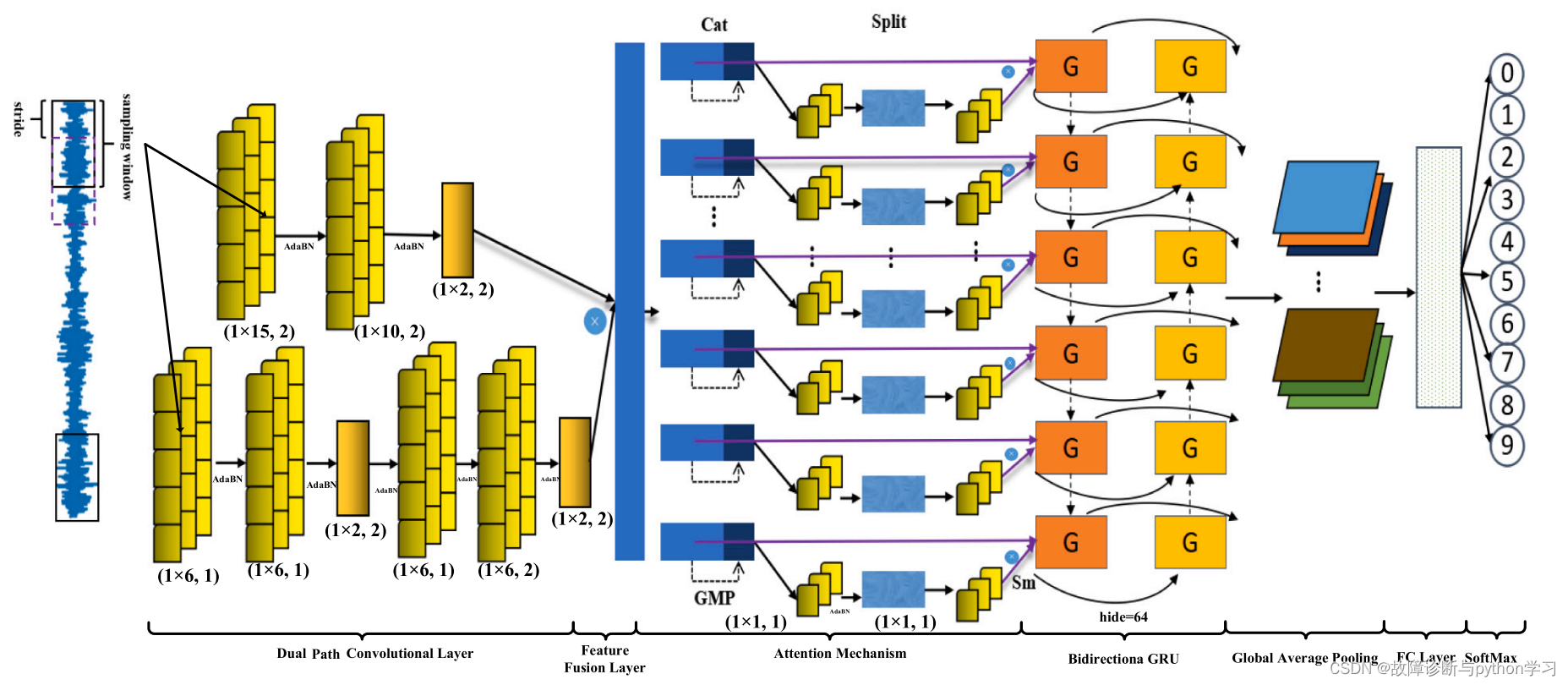
- 5. A network model
- 6. Introduction to network structure
- 7. Network model code
1 Reference paper
Fault diagnosis for small samples based on attention mechanism
2 Open source code
https://github.com/liguge/Fault-diagnosis-for-small-samples-based-on-attention-mechanism
3. Abstract
Aiming at the application of deep learning in fault diagnosis , Mechanical rotating equipment components are prone to failure in complex working environment , There are limited labeled samples of industrial big data 、 Different working conditions 、 Noise and so on . For the above problems , A two path convolution and attention mechanism is proposed (DCA) And two-way gated circulation unit (DCA- bigru) Small sample fault diagnosis method , The performance of this method can be effectively mined by the latest regularization training strategy . utilize BiGRU Realize the fusion of space-time features , utilize DCA Extract the features of the vibration signal fused with the right of attention . Besides , Also pool the global average (GAP) Applied to dimension reduction and fault diagnosis . Experiments show that ,DCA-BiGRU It has excellent generalization ability and robustness , It can effectively diagnose various complex situations .
4. Fault diagnosis flow chart

5. A network model
6. Introduction to network structure
Input 1 D data :[batch_size, 1, 1024]–> Two channel convolution –> Feature fusion (cat)–> Attention mechanism –>Bidirection GRU–> Global average pooling (Global average pool)–> Fully connected layer –>softmax Calculate classification probability
7. Network model code
It is recommended to use pytorch,jupyter notebook
7.1MetaAconC
Module code
import torch
from torch import nn
class AconC(nn.Module):
    r""" ACON activation (activate or not). # AconC: (p1*x-p2*x) * sigmoid(beta*(p1*x-p2*x)) + p2*x, beta is a learnable parameter # according to "Activate or Not: Learning Customized Activation" <https://arxiv.org/pdf/2009.04759.pdf>. """

    def __init__(self, width):
        super().__init__()
        self.p1 = nn.Parameter(torch.randn(1, width, 1))
        self.p2 = nn.Parameter(torch.randn(1, width, 1))
        self.beta = nn.Parameter(torch.ones(1, width, 1))
    def forward(self, x):
        return (self.p1 * x - self.p2 * x) * torch.sigmoid(self.beta * (self.p1 * x - self.p2 * x)) + self.p2 * x


class MetaAconC(nn.Module):
    r""" ACON activation (activate or not). # MetaAconC: (p1*x-p2*x) * sigmoid(beta*(p1*x-p2*x)) + p2*x, beta is generated by a small network # according to "Activate or Not: Learning Customized Activation" <https://arxiv.org/pdf/2009.04759.pdf>. """

    def __init__(self, width, r=16):
        super().__init__()
        self.fc1 = nn.Conv1d(width, max(r, width // r), kernel_size=1, stride=1, bias=True)
        self.bn1 = nn.BatchNorm1d(max(r, width // r), track_running_stats=True)
        self.fc2 = nn.Conv1d(max(r, width // r), width, kernel_size=1, stride=1, bias=True)
        self.bn2 = nn.BatchNorm1d(width, track_running_stats=True)
        self.p1 = nn.Parameter(torch.randn(1, width, 1))
        self.p2 = nn.Parameter(torch.randn(1, width, 1))

    def forward(self, x):
        beta = torch.sigmoid(self.bn2(self.fc2(self.bn1(self.fc1(x.mean(dim=2, keepdims=True))))))
        return (self.p1 * x - self.p2 * x) * torch.sigmoid(beta * (self.p1 * x - self.p2 * x)) + self.p2 * x
Code testing
x = torch.randn(16, 64, 1024)  # Assume that the input x:batch_size=16, channel=64, length=1024
Meta = MetaAconC(64)  # When creating an object, you need to enter parameters width, It is the... Of the input data channel
y = Meta(x)
print(y.shape)
>>>output
x.shape: torch.Size([16, 64, 1024])
y.shape: torch.Size([16, 64, 1024])
The result shows that , Input x Of shape And output y Of shape It's the same
7.2 Attention mechanism
Structure of attention mechanism

Module code
class CoordAtt(nn.Module):
    def __init__(self, inp, oup, reduction=32):
        super(CoordAtt, self).__init__()
        # self.pool_w = nn.AdaptiveAvgPool1d(1)
        self.pool_w = nn.AdaptiveMaxPool1d(1)
        mip = max(6, inp // reduction)
        self.conv1 = nn.Conv1d(inp, mip, kernel_size=1, stride=1, padding=0)
        self.bn1 = nn.BatchNorm1d(mip, track_running_stats=False)
        self.act = MetaAconC(mip)
        self.conv_w = nn.Conv1d(mip, oup, kernel_size=1, stride=1, padding=0)

    def forward(self, x):
        identity = x
        n, c, w = x.size()
        x_w = self.pool_w(x)
        y = torch.cat([identity, x_w], dim=2)
        y = self.conv1(y)
        y = self.bn1(y)
        y = self.act(y)
        x_ww, x_c = torch.split(y, [w, 1], dim=2)
        a_w = self.conv_w(x_ww)
        a_w = a_w.sigmoid()
        out = identity * a_w
        return out
Module code test
x = torch.randn(16, 64, 1024)  # Assume that the input x:batch_size=16, channel=64, length=1024
Att = CoordAtt(inp=64, oup=64)  # Create an attention mechanism object , Input parameters inp and oup The parameters are channel
y = Att(x)
print('y.shape:',y.shape)
>>>output
y.shape: torch.Size([16, 64, 1024])
The result shows that , Input x Of shape And output y Of shape It's the same
7.3 BiGRU test
BiGRU chart

x = torch.randn(16, 64, 128)  # Assume that the input x:batch_size=16, channel=64, length=128
gru = nn.GRU(128, 64, bidirectional=True)  # establish GRU object ,128 It's input data x The length of ;
                                           # If bidirectional by False,64 Is the length of the output data ; If bidirectional by True, Then the output length is 64*2
y = gru(x)
print('y Value :\n',y)
print('y[0] Of shape',y[0].shape)
>>>output
y Value :
 (tensor([[[-0.7509, -0.0468,  0.2881,  ..., -0.6559,  0.5780,  0.3481],
         [ 0.4099,  0.1912, -0.2534,  ..., -0.2067, -0.1099, -0.3594],
         [ 0.0275,  0.0937, -0.4309,  ..., -0.6266,  0.5375,  0.2510],
         ...,
         [-0.1896, -0.0118, -0.4895,  ...,  0.2022,  0.3144,  0.1806],
         [-0.5026,  0.4926, -0.2578,  ..., -0.3386, -0.3908, -0.1203],
         [-0.0431, -0.1084,  0.4494,  ...,  0.4320, -0.2916,  0.4126]]],
       grad_fn=<StackBackward0>))
y[0] Of shape torch.Size([16, 64, 128])
As can be seen from the results ,y The output of is a tuple A tuple type , So it USES y[0] Get the inside tensor data .
7.4 Global average pooling GAP test
#  The first step is to type x
x = torch.randn(16, 64, 32) # Assume that the input x:batch_size=16, channel=64, length=128
print('x Value :\n',x)
print('x[0][0] Value :',x[0][0])
print('x[0][0] Average value :',torch.mean(x[0][0]))

#  The second step is adaptive average pooling
adavp = nn.AdaptiveAvgPool1d(1) #
y = adavp(x)
print('y Value :',y)
print('y Of shape:',y.shape)

#  The third step
z = y.squeeze()
print('z Of shape:',z.shape)
x Value :
 tensor([[[ 7.8979e-01,  1.3657e-01, -9.9066e-01,  ...,  9.5261e-01,
           9.8295e-02,  6.5511e-01],
         [-3.5707e-01, -2.3277e+00, -3.2558e-01,  ..., -2.2010e-01,
          -1.6210e+00, -1.2564e+00],
         [ 1.0400e+00, -1.8403e-01,  1.1634e+00,  ...,  5.7404e-02,
          -7.0334e-01, -1.5286e-01],
         ...,
         [-1.7541e+00,  5.9410e-01, -1.3539e-01,  ...,  8.6600e-02,
           1.2851e+00, -2.1541e+00],
         [ 1.6649e+00, -3.0008e+00, -6.5557e-01,  ...,  3.8984e-01,
          -2.4122e+00,  1.3892e+00],
         [ 3.2660e-01,  1.4245e+00,  8.2627e-01,  ..., -1.1504e+00,
           8.5084e-01, -2.3794e-02]]])
x[0][0] Value : tensor([ 0.7898,  0.1366, -0.9907, -0.9970,  1.6666, -1.5021,  0.9952,  0.5044,
         0.0828,  1.1746, -1.1589, -1.2519, -1.6039, -0.9943,  0.4700, -0.5370,
         0.5983, -0.6333, -1.3765, -0.9212, -0.3939, -0.7217,  0.4318,  0.4706,
         0.6322, -0.4217, -1.0003,  1.6015,  0.5162,  0.9526,  0.0983,  0.6551])
x[0][0] Average value : tensor(-0.0852)
y Value : tensor([[[-0.0852],
         [-0.6024],
         [-0.0316],
         ...,
         [ 0.0157],
         [-0.2135],
         [ 0.1926]]])
y Of shape: torch.Size([16, 64, 1])
z Of shape: torch.Size([16, 64])
As can be seen from the results , input data x1.shape=[16, 64, 32] Global average pooling is the last dimension of input data , And 32 Data points are averaged . obtain [16, 64]
7.5 Overall network test
Overall network code
class Net(nn.Module):
    def __init__(self):
        super(Net, self).__init__()
        self.p1_1 = nn.Sequential(nn.Conv1d(in_channels=1, out_channels=50, kernel_size=18, stride=2),
                                  nn.BatchNorm1d(50, track_running_stats=False),
                                  MetaAconC(50))
        self.p1_2 = nn.Sequential(nn.Conv1d(50, 30, kernel_size=10, stride=2),
                                  nn.BatchNorm1d(30, track_running_stats=False),
                                  MetaAconC(30))
        self.p1_3 = nn.MaxPool1d(2, 2)
        self.p2_1 = nn.Sequential(nn.Conv1d(1, 50, kernel_size=6, stride=1),
                                  nn.BatchNorm1d(50, track_running_stats=False),
                                  MetaAconC(50))
        self.p2_2 = nn.Sequential(nn.Conv1d(50, 40, kernel_size=6, stride=1),
                                  nn.BatchNorm1d(40, track_running_stats=False),
                                  MetaAconC(40))
        self.p2_3 = nn.MaxPool1d(2, 2)
        self.p2_4 = nn.Sequential(nn.Conv1d(40, 30, kernel_size=6, stride=1), nn.BatchNorm1d(30, track_running_stats=False),MetaAconC(30))
        self.p3_0 = CoordAtt(30, 30)
        self.p2_5 = nn.Sequential(nn.Conv1d(30, 30, kernel_size=6, stride=2),
                                  nn.BatchNorm1d(30, track_running_stats=False),
                                  MetaAconC(30))
        self.p2_6 = nn.MaxPool1d(2, 2)

        self.p3_1 = nn.Sequential(nn.GRU(124, 64, bidirectional=True))  #
        # self.p3_2 = nn.Sequential(nn.LSTM(128, 512))
        self.p3_3 = nn.Sequential(nn.AdaptiveAvgPool1d(1))  #GAP
        self.p4 = nn.Sequential(nn.Linear(30, 10))

    def forward(self, x):
        p1 = self.p1_3(self.p1_2(self.p1_1(x)))
        print('p1.shape:',p1.shape)

        p2 = self.p2_6(self.p2_5(self.p2_4(self.p2_3(self.p2_2(self.p2_1(x))))))
        print('p2.shape:',p2.shape)

        encode = torch.mul(p1, p2)
        print('encode.shape:',encode.shape)

        # p3 = self.p3_2(self.p3_1(encode))
        p3_0 = self.p3_0(encode).permute(1, 0, 2)
        print('p3_0.shape:',p3_0.shape)

        p3_2, _ = self.p3_1(p3_0)
        print('p3_2.shape:',p3_2.shape)

        # p3_2, _ = self.p3_2(p3_1)
        p3_11 = p3_2.permute(1, 0, 2)  #
        print('p3_11.shape:',p3_11.shape)

        p3_12 = self.p3_3(p3_11).squeeze()
        print('p3_12.shape:',p3_12.shape)
        # p3_11 = h1.permute(1,0,2)
        # p3 = self.p3(encode)
        # p3 = p3.squeeze()
        # p4 = self.p4(p3_11) # LSTM(seq_len, batch, input_size)
        # p4 = self.p4(encode)
        p4 = self.p4(p3_12)
        print('p4.shape:',p4.shape)
        return p4
Code testing
model = Net()
x = torch.randn(16, 1, 1024) # Assume that the input x:batch_size=16, channel=1, length=1024
y = model(x)
>>>output
p1.shape: torch.Size([16, 30, 124])
p2.shape: torch.Size([16, 30, 124])
encode.shape: torch.Size([16, 30, 124])
p3_0.shape: torch.Size([30, 16, 124])
p3_2.shape: torch.Size([30, 16, 128])
p3_11.shape: torch.Size([16, 30, 128])
p3_12.shape: torch.Size([16, 30])
p4.shape: torch.Size([16, 10])
8 Experimental setup
8.1 Model parameter settings

8.2 Experimental data setting

9 Experimental verification
Case study 1:CWRU
Different batch_size The next result

Results under different loads

( Continue to improve in the future )
notes :
① If this paper is helpful to you , It is suggested to quote this thesis ~
② Welcome to the official account 《 Fault diagnosis and maintenance Python Study 》
③ If there is good open source code , Welcome to contact the backstage to recommend ~
边栏推荐
- 5g industrial router Gigabit high speed low delay
- 模型效果优化,试一下多种交叉验证的方法(系统实操)
- 1279_VMWare Player安装VMWare Tools时VSock安装失败解决
- Swift 基础 闭包/Block的使用(源码)
- Search and recommend those things
- Shader common functions
- JDBC 在性能测试中的应用
- 不止于观测|阿里云可观测套件正式发布
- Interview tutorial - multi thread knowledge sorting
- Easyplayerpro win configuration full screen mode can not be full screen why
猜你喜欢

李白最经典的20首诗排行榜

Utilisation de la fermeture / bloc de base SWIFT (source)

longhorn安装与使用

JDBC 在性能测试中的应用

Understanding of the concept of "quality"

2022年制冷与空调设备运行操作上岗证题库及模拟考试

对于flex:1的详细解释,flex:1

More appropriate development mode under epidemic situation

Swift Extension NetworkUtil(网络监听)(源码)
For a detailed explanation of flex:1, flex:1
随机推荐
WCF TCP protocol transmission
问题4 — DatePicker日期选择器,2个日期选择器(开始、结束日期)的禁用
贷款五级分类
李白最经典的20首诗排行榜
12--合并两个有序链表
Auto usage example
How to design a highly available and extended image storage function
2021-03-11 COMP9021第八节课笔记
Application of JDBC in performance test
Solve the problem of notebook keyboard disabling failure
宝塔面板安装php7.2安装phalcon3.3.2
1-4metaploitable2 introduction
Review of postgraduate English final exam
[introduction to point cloud dataset]
Introduction to software engineering - Chapter 2 - feasibility study
Swift 基礎 閉包/Block的使用(源碼)
C language_ Love and hate between string and pointer
11--无重复字符的最长子串
Simple refraction effect
Decltype usage introduction