当前位置:网站首页>Thesis reading (53):universal advantageous perturbations
Thesis reading (53):universal advantageous perturbations
2022-06-23 18:04:00 【Inge】
List of articles
1 summary
1.1 subject
2017CVPR: Universal anti disturbance (Universal adversarial perturbations)
1.2 Method
The point is as follows :
1) It shows that for a given cutting-edge neural network classifier , Only a universal and minimal disturbance can cause high probability misclassification of natural images ;
2) Put forward a kind of A systematic algorithm for computing general perturbations , It is shown that the most advanced deep neural network is very susceptible to this disturbance , And the human eye can almost detect ;
3) Further empirical analysis of these universal perturbations , And show their application in neural network Good generalization performance ;
4) The existence of universal perturbation reveals the important geometric correlation between the high-dimensional decision boundaries of classifiers . It further outlines the potential security vulnerabilities in a single direction in the input space , Attackers may use these directions to destroy classifiers on most natural images .
1.3 Code
Tensorflow:https://github.com/LTS4/universal
Torch:https://github.com/NetoPedro/Universal-Adversarial-Perturbations-Pytorch
1.4 Bib
@inproceedings{
    Moosavi:2017:17651773,
author		=	{
    Seyed-Mohsen Moosavi-Dezfooli and Alhussein Fawzi and Omar Fawzi and Pascal Frossard},
title		=	{
    Universal adversarial perturbations},
booktitle	=	{
    {
    IEEE} Conference on Computer Vision and Pattern Recognition},
pages		=	{
    1765--1773},
year		=	{
    2017}
}
2 Universal disturbance
Make μ \mu μ Indicates that the image is in space R d \mathbb{R}^d Rd The distribution on , k ^ \hat{k} k^ Is a tool for acquiring images x ∈ R d x\in\mathbb{R}^d x∈Rd Assessment tags k ^ ( x ) \hat{k}(x) k^(x) Classifier . The purpose of this paper is Find a perturbation vector v ∈ R b v\in\mathbb{R}^b v∈Rb, It can fool k ^ \hat{k} k^ In most cases μ \mu μ On the data points of :
k ^ ( x + v ) ≠ k ^ ( x ) f o r ′ ′ m o s t ′ ′ x ∼ μ . \hat{k}(x+v)\neq\hat{k}(x)\ for ''most'' \ x\sim\mu. k^(x+v)=k^(x) for′′most′′ x∼μ. The universal disturbance represents a fixed disturbance independent of the image , It will cause the labels of most images sampled from the data distribution to change . Here we focus on distribution μ μ μ Represents a natural image set , So it contains a lot of variability . In this case , Universal small perturbations that mislead most images will be discovered . seek v v v Need to meet the following constraint :
1) ∥ v ∥ p ≤ ξ \|v\|_p\leq\xi ∥v∥p≤ξ ;
2) P x ∼ μ ( k ^ ( x + v ) ≠ k ^ ( x ) ) ≥ 1 − δ \mathbb{P}_{x\sim\mu}(\hat{k}(x+v)\neq\hat{k}(x))\geq1-\delta Px∼μ(k^(x+v)=k^(x))≥1−δ.
here ξ \xi ξ Used to control the v v v The intensity of , δ \delta δ Used to control the misleading rate .
Algorithm
Make X = { x 1 , … , x m } X=\{x_1,\dots,x_m\} X={ x1,…,xm} It means that it obeys the distribution μ \mu μ A collection of images . Based on constraints and optimization objectives , The algorithm will be in X X X Iterate over and build the universal perturbation step by step , Such as chart 2. In each iteration , Calculate the current perturbation point x i + v x_i+v xi+v The minimum disturbance sent to the decision boundary of the classifier v i v_i vi, And it is aggregated to the current instance of universal disturbance .
chart 2: The semantic representation of the proposed algorithm in computing universal perturbations . spot x 1 x_1 x1、 x 2 x_2 x2, as well as x 3 x_3 x3 In superposition state , Different classification areas A \mathcal{A} A Displayed in different colors . The purpose of the algorithm is to find the minimum disturbance , Make a point of x i + v x_i+v xi+v Move out of the correct classification area
Assume that the current generic perturbation v v v Data points cannot be fooled x i x_i xi, We solve the following optimization problems to find data points that can be cheated x i x_i xi Additional perturbation of the minimum norm of v i v_i vi:
Δ v i ← arg min r ∥ r ∥ 2 s . t . k ^ ( x i + v + r ) ≠ x ^ i . (1) \tag{1} \Delta v_i\leftarrow\argmin_r\|r\|_2\qquad s.t.\qquad \hat{k}(x_i+v+r)\neq\hat{x}_i. Δvi←rargmin∥r∥2s.t.k^(xi+v+r)=x^i.(1) To ensure that constraints are met ∥ v ∥ p ≤ ξ \|v\|_p\leq\xi ∥v∥p≤ξ, The updated universal perturbation is further projected to a radius of ξ \xi ξ、 Center in 0 0 0 Of ℓ p \ell_p ℓp On the ball . therefore , Projection operations are defined as :
P p , ξ ( v ) = arg min v ′ ∥ v − v ′ ∥ 2 s . t . ∥ v ′ ∥ p ≤ ξ . \mathcal{P}_{p,\xi}(v)=\argmin_{v'}\|v-v'\|_2\qquad s.t.\qquad\|v'\|_p\leq\xi. Pp,ξ(v)=v′argmin∥v−v′∥2s.t.∥v′∥p≤ξ. then , The update rule changes to v ← P p , ξ ( v + Δ v i ) v\leftarrow\mathcal{P}_{p,\xi}(v+\Delta v_i) v←Pp,ξ(v+Δvi). The data set X X X The quality of the universal disturbance will be improved by the multiple transmission of . The algorithm will be applied to perturbed data sets X v : = { x 1 + v , … , x m + v } X_v:=\{x_1+v,\dots,x_m+v\} Xv:={ x1+v,…,xm+v} The fooling rate of exceeds the threshold 1 − δ 1-\delta 1−δ Stop when :
Err ( X v ) : = 1 m ∑ i = 1 m 1 k ^ ( x i + v ) ≠ k ^ ( x i ) ≥ 1 − δ . \text{Err}(X_v):=\frac{1}{m}\sum_{i=1}^m1_{\hat{k}(x_i+v)\neq\hat{k}(x_i)}\geq1-\delta. Err(Xv):=m1i=1∑m1k^(xi+v)=k^(xi)≥1−δ. Algorithm 1 Show more details . X X X Number of data points in m m m It doesn't take much to compute a pair of global distributions μ \mu μ Effective universal perturbation . Special , m m m It can be set to a value much smaller than the training sample .
The proposed algorithm involves solving the formula at each transfer 1 At most of the optimization problems in m m m An example , Here the Deepfool To deal with this problem efficiently . It is worth noting that , Algorithm 1 It is not possible to find a minimum universal perturbation that fools as many sample points as possible , Only one perturbation with a sufficiently small norm can be found . X X X Different random shuffles will naturally lead to various universal perturbations that satisfy the required constraints v v v.
3 Universal disturbance and depth network
This section analyzes how the leading edge deep learning classifier responds to Algorithm 1 Robustness of universal perturbations in .
First experiment in , Evaluate different algorithms in ILSVRC 2012 Verify the universal perturbation on the data set , And show Fooling rate , That is, the proportion of the image label that will change after the universal disturbance . The experiment will take place in X = 10000 X=10000 X=10000; p = 2 p=2 p=2 and p = ∞ p=\infty p=∞ Proceed under , The corresponding ξ \xi ξ Respectively 2000 2000 2000 and 10 10 10. These values are chosen to obtain perturbations whose norm is significantly smaller than the image norm , So when added to a natural image , Disturbances are imperceptible . surface 1 It shows the experimental results . Each result is reported in the set used to calculate the disturbance X X X And validation set ( It is not used in the calculation of general disturbance ). The results show that the universal perturbation has a high fooling rate .
chart 3 It shows GoogleNet Visualization results of disturbed images . in the majority of cases , Universal disturbances are imperceptible , Such image perturbations effectively fool many leading edge classifiers .
chart 4 The universal perturbation results of different networks are shown . It should be noted that , Universal perturbations are not unique , Because many different universal perturbations can be generated for the same network ( Both satisfy the two required constraints ).
chart 5 It shows X X X Different universal perturbations under different random shuffles . The results show that the universal perturbations are different in similar modes . Besides , This is also confirmed by calculating the normalized inner product between two pairs of disturbed images , Because the normalized inner product does not exceed 0.1, This shows that different universal perturbations can be found .
The second experiment Used to verify X X X The influence of the size of the on the universal disturbance . chart 6 It shows GoogleNet In different X X X The fooling rate . Experiments show that only in X = 500 X=500 X=500 when , The fooling rate can reach 30%.
3.1 Cross model universality
After calculating the disturbance at an unknown data point , It can be proved that they are universal across models , That is, on a special network such as VGG-19 The disturbance of training , It can still be on another network, such as GoogleNet Effective on . surface 2 Shows the cross model fooling rate .
3.2 Visualization of universal disturbance performance
In order to visually demonstrate the utility of universal perturbations on natural images , We will ImageNet The label distribution on the validation set is visualized : Undirected graph G = ( V , E ) G=(V,E) G=(V,E), Where the fixed point represents the label , edge e = ( i → j ) e=(i\rightarrow j) e=(i→j) Indicates that the icon label changes from... After the disturbance is applied i i i Be misled into j j j, Such as chart 7.
3.3 Fine tuning of universal perturbations
It is used to test the performance of the network after fine-tuning using the disturbed image . Use VGG-F framework , And fine tune the network based on the modified training set , The universal perturbation is added to a small number of clean training samples : For each training point , With 0.5 The probability of adding generic perturbations , And the original sample is 0.5 Probability retention . To explain the diversity of universal perturbations ,10 Two precomputed universal perturbations will be randomly selected . The network will be fine tuned five times on the modified dataset . Set during fine adjustment p = ∞ p=\infty p=∞ And ξ = 10 \xi=10 ξ=10. The results showed that the fooling rate decreased .
4 The vulnerability of neural networks
This section is used to illustrate the vulnerability of neural networks to pervasive disturbances . First, compare it with other types of disturbances , Explain the uniqueness of universal perturbations , Include :
1) Random disturbance ;
2) Against disturbance ;
3) X X X Up against the sum of disturbances ;
4) The mean value of the image .
chart 8 Different disturbances are shown ξ \xi ξ And ℓ 2 \ell_2 ℓ2 The fooling rate under the norm . Specially , The great difference between the universal disturbance and the random disturbance indicates that , Universal perturbations utilize some geometric correlations between different parts of the classifier decision boundary . in fact , If the direction of the decision boundary near different data points is completely irrelevant ( And it has nothing to do with the distance of decision boundary ), Then the norm of the optimal universal perturbation will be equal to that of the random perturbation . further , The random perturbation norm required to deceive a particular data point is precisely expressed as Θ ( d ∥ r ∥ 2 ) \Theta(\sqrt{d}\|r\|_2) Θ(d∥r∥2), among d d d Is the dimension of the input space . about ImageNet Classification task , Yes d ∥ r ∥ 2 ≈ 2 × 1 0 4 \sqrt{d}\|r\|_2\approx2\times10^4 d∥r∥2≈2×10⁴. For most data points , This is better than the universal perturbation ( ξ = 2000 \xi = 2000 ξ=2000) One order of magnitude larger . therefore , The substantial difference between random disturbance and universal disturbance indicates that the geometry of decision boundary explored at present is redundant .
For each image in the validation set x x x, The anti disturbance vector obtained is r ( x ) = arg min r ∥ r ∥ 2 s . t . k ^ ( x + r ) ≠ k ^ ( x ) r(x)=\argmin_r\|r\|_2\ s.t.\ \hat{k}(x+r)\neq\hat{k}(x) r(x)=rargmin∥r∥2 s.t. k^(x+r)=k^(x). Obviously r ( x ) r(x) r(x) The decision boundary with the classifier is x + r ( x ) x+r(x) x+r(x) Orthogonal at . therefore r ( x ) r(x) r(x) To capture decision boundaries in x x x Local geometric features in adjacent regions . In order to quantify the correlation between different regions of the classifier decision boundary , Defines the validation set n n n Normal vector matrix of decision boundary near data points :
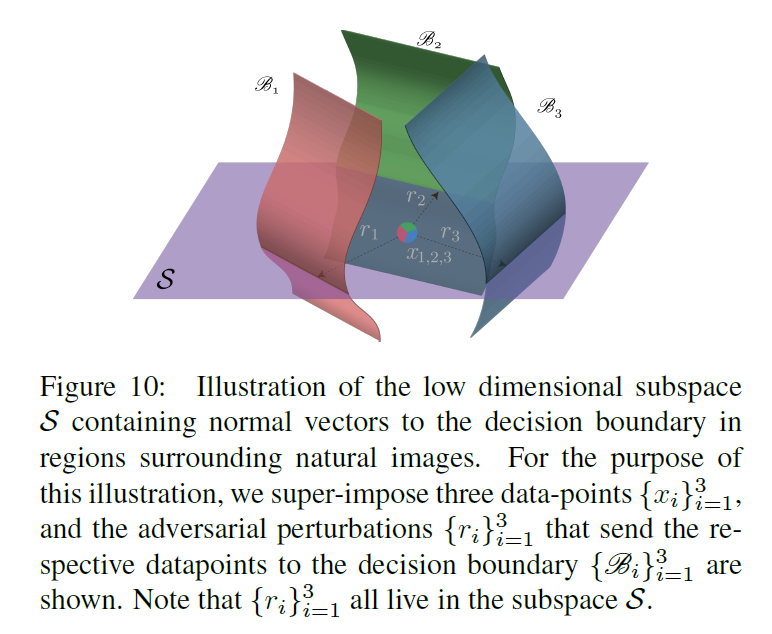
N = [ r ( x 1 ) ∥ r ( x 1 ) ∥ 2 ⋯ r ( x n ) ∥ r ( x n ) ∥ 2 ] N=\left[\frac{r(x_1)}{\|r(x_1)\|_2} \cdots \frac{r(x_n)}{\|r(x_n)\|_2} \right] N=[∥r(x1)∥2r(x1)⋯∥r(xn)∥2r(xn)] For binary classifier , The decision boundary is a hyperplane 、 N N N The rank of is 1, And all normal vectors are collinear . In order to more generally capture the correlation in the decision boundary of complex classifiers , We calculate the matrix N N N The singular value of . adopt CaffeNet Calculated matrix N N N The singular value of is as follows chart 9. The figure shows when N N N Column the singular values obtained when sampling randomly and uniformly from the unit sphere . Although the singular value of the latter decays slowly , but N N N The singular value of decays rapidly , This proves that the decision boundary of the deep network has large correlation and redundancy . More precisely , This indicates that there is a low dimension d ′ ≪ d d'\ll d d′≪d Subspace S S S, It contains most of the normal vectors of the decision boundary in the region around the natural image . Suppose that the existence of universal perturbations that fool most natural images is due to the existence of such a low dimensional subspace , The subspace captures the correlation between different regions of the decision boundary . in fact , This subspace “ collect ” The normals of decision boundaries in different regions are given , Therefore, the disturbance belonging to this subspace may deceive the data points . To test this hypothesis , We choose a norm ξ = 2000 ξ = 2000 ξ=2000 The random vector of , Of the former 100 A subspace traversed by a singular vector S S S, And calculate the fooling rate of different image sets ( That is, a group that has not been used to calculate SVD Image ). This disturbance can deceive the near 38% Image , So it shows that in this subspace S S S The random direction in is obviously better than the random disturbance ( This disturbance can only deceive 10% The data of ).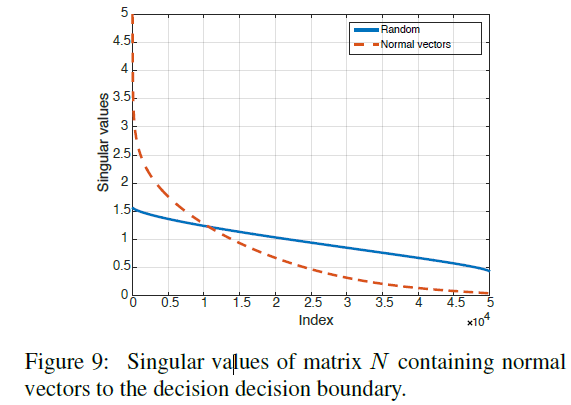
chart 10 It shows the relevance subspace in the capture decision boundary S S S. It should be noted that , The existence of this low dimensional subspace explains chart 6 The surprising generalization properties of the universal perturbations obtained in , Among them, people can use very few images to construct relatively generalized universal perturbations .
Different from the above experiment , The proposed algorithm does not select a random vector in this subspace , Instead, choose a specific direction to maximize the overall fooling rate . This explains the use of S S S Random vector strategy and algorithm in 1 The difference between the obtained fooling rates .
边栏推荐
- An error is reported when latex uses \usepackage{hyperref}: paragraph ended before [email protected] @link was complete
- Which securities company is good for opening a mobile account? Is online account opening safe?
- Mobile SSH connection tool
- Deploy LNMP environment and install Typecho blog
- The principle of MySQL index algorithm and the use of common indexes
- JS regular verification time test() method
- First use of kubernetes cronjob
- Thymeleaf - learning notes
- Transaction processing of cloud development database
- 论文阅读 (57):2-hydr_Ensemble: Lysine 2-Hydroxyisobutyrylation Identification with Ensemble Method (任务)
猜你喜欢
论文阅读 (53):Universal Adversarial Perturbations
![[esp8266 - 01s] obtenir la météo, Ville, heure de Beijing](/img/8f/89e6f0d482f482ed462f1ebd53616d.png)
[esp8266 - 01s] obtenir la météo, Ville, heure de Beijing

Self supervised learning (SSL)

客服系统搭建教程_宝塔面板下安装使用方式_可对接公众号_支持APP/h5多租户运营...

【win10 VS2019 opencv4.6 配置参考】

QML类型:Loader
12 initialization of beautifulsoup class
[esp8266-01s] get weather, city, Beijing time

微信小程序startLocationUpdateBackground()简单实现骑手配送位置

csdn涨薪秘籍之Jenkins集成allure测试报告全套教程
随机推荐
论文阅读 (51):Integration of a Holonic Organizational Control Architecture and Multiobjective...
论文阅读 (58):Research and Implementation of Global Path Planning for Unmanned Surface Vehicle Based...
iMeta | 南农沈其荣团队发布微生物网络分析和可视化R包ggClusterNet
【ESP8266-01s】获取天气,城市,北京时间
How to use JSON data format
【win10 VS2019 opencv4.6 配置参考】
MySQL installation, configuration and uninstall
[websocket] knowledge points for developing online customer service system meaning of status code returned by websocket
13. IP address and subnet partitioning (VLSM)
PostgreSQL series articles -- the world's most advanced open source relational database
How to design a seckill system - geek course notes
客服系统搭建教程_宝塔面板下安装使用方式_可对接公众号_支持APP/h5多租户运营...
[Hyperf]Entry “xxxInterface“ cannot be resolved: the class is not instantiable
Analysis of object class structure in Nanny level teaching (common class) [source code attached]
【ESP8266-01s】獲取天氣,城市,北京時間
[tool C] - lattice simulation test 2
7、VLAN-Trunk
What is the problem with TS File Error 404 when easynvr plays HLS protocol?
Skills that all applet developers should know: applying applet components
论文阅读 (47):DTFD-MIL: Double-Tier Feature Distillation Multiple Instance Learning for Histopathology..