当前位置:网站首页>Notes on the seventh day
Notes on the seventh day
2022-07-23 13:22:00 【Ma ordinary】

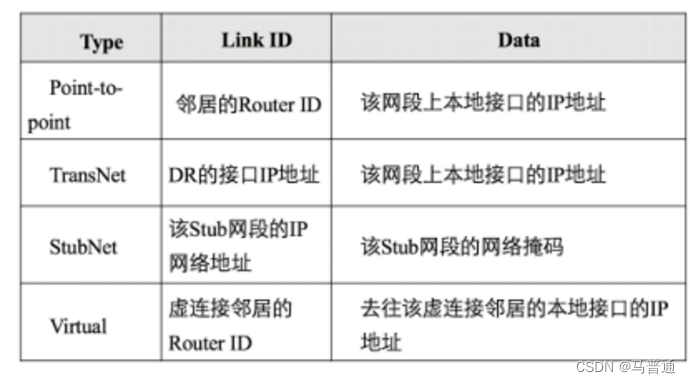
All that carry routing information LSA All need to pass 1 Classes and 2 class LSA Check calculation . The so-called checking calculation , It means that the location information of the advertiser who transmits the routing information needs to pass 1 class 、2 class LSA The information is calculated .
1、Type-5 LSA
Metric(cost)---5 class LSA Carry the imported extraterritorial routing information through republishing , Because different networks have different evaluation standards for metrics . therefore , When the extraterritorial route is imported into the network , We will give up the original cost value , And give it a defined value ---seed-met--- Seed measure .OSPF The default seed metric in the network is 1.
[r4-ospf-1]import-route rip 1 cost 10--- Modify the seed measure when republishing .
2、E Type--- A marker bit , When marking position 0 when , Represents the use type 1; When marking position 1 when , Means to make Use type 2--- It refers to the type of cost value ---OSPF The default usage type of the Protocol 2.
type 1: If the cost value type is type 1, Then the cost of all devices in the domain to reach the target network segment outside the domain is equal to this The cost of arriving at the advertiser plus the seed metric .
type 2: If the cost value type is type 2, Then the cost of all devices in the domain reaching the target network segment outside the domain is the same In the seed measure .
Forwarding Address--- Forwarding address --- A redirection address , Be similar to RIPV2 Next hop field in , When poor route selection occurs , Then the best routing information will be carried in this field , Then it will find the next hop according to the forwarding address , Instead of searching for notifiers according to the algorithm .5 class LSA in , In the absence of poor route selection , Will use 0.0.0.0 To fill in .
Tag--- Routing tags --- You can give 5 class LSA Marking , It is convenient to grab the flow through the mark later .
[r4-ospf-1]import -route rip 1 tag ?
INTEGER<0-4294967295>Tag value
Type-4LSA--- auxiliary 5 class LSA Complete the checking process , find ASBR The location of . There is only one cost value in it , It refers to the arrival of the announcer ASBR The cost of .

V--- Set up 1, It means that the router is VLINK An endpoint of
E--- Set up 1, It means that the router is ASBR equipment
B--- Set up 1, It means that the router is an area boundary device ABR
3、OSPF The optimization of the
(1) Summary --- Reduce the of backbone area LSA Number
(2) Special area --- Reduce non backbone areas LSA Number
Summary :
OSPF The summary of is different from RIP Interface summary , It is called Regional summary . because OSPF What passes between regions is Routing information .
(1) Inter domain routing summary : In essence, it is through ABR Three types of transmission between areas on the device LSA To summarize .
[r10ospf-1-area-0.0.0.2]abr-summary 192.168.0.0 255.255.252.0
Be careful : Inter domain routing summary can only be summarized ABR The device itself passes 1 class ,2 class LSA Information learning to routing letter Rest .
(2) Extraterritorial routing summary : Its essence is in ASBR On , By republishing , Will be imported 5 class /7 Class into OSPF network Summarize after networking .
[r4-ospf 1]asbr-summary 172.16.0.0 255.255.252.0
Be careful :5 class LSA The calculation method of the summarized cost value :
Type2--- The cost value of the summary network segment is equal to the maximum of all detailed routing cost values plus 1.
Type2--- The cost value of the summary network segment is equal to the maximum of all detailed routing cost values .
4、 Special area :
OSPF The special areas of can be roughly divided into two categories , Four sub categories
Conditions set as the first category ---① It can't be the backbone area ② Virtual links cannot exist ③ Can't exist ASBR equipment .
(1) We call such a region the terminal region (STUB)--- If an area is configured as a terminal area , Then this Areas will no longer learn 4 Classes and 5 class LSA. Such an area will refuse to learn extraterritorial routing information , however , Its basis Old has the need to access extraterritorial routes , So after configuration , It will automatically generate a line pointing to the backbone area 3 class default .
[r5-ospf-1-area-0.0.0.2]stub--- Configure the end area
Be careful : Once you make a special area , Then the equipment in all areas must be made into special areas .
(2) Completely peripheral area ----totally stub--- Based on the peripheral region , Further refuse to learn 3 class LSA, Keep only 3 Class defaults .
[r1-ospf-1-area-0.0.0.2]stub no-summary--- This command only needs to be in ABR Just configure it on the device .
5、 Conditions set as the second largest category ---① It can't be the backbone area ② Virtual links cannot exist ③ There is ASBR equipment .
(1) We call such a region incomplete terminal region (NSSA)--- If you configure an area to be incomplete The terminal area , Then this area will no longer learn 4 Classes and 5 class LSA. However, the region still needs to turn the following extraterritorial Route information import , For refusing 5 class , So we can only 7 class LSA Form to continue to pass , After the 7 class LSA Information leaving NSSA After area , It needs to be converted into 5 class LSA To pass .
Such an area will refuse to learn extraterritorial routing information , however , It still has the need to access extraterritorial routes , therefore , When the configuration is complete , It will automatically generate a line pointing to the backbone area 7 Class default .
[r4-ospf-1-area-0.0.0.1]nssa
O_NSSA---7 Marking of extraterritorial routing information , The default priority is also 150
--- General arrangement 1, On behalf of 5 class LSA. If it is made into a special area , be E Bit will be set to 0
N--- General arrangement 0,NSSA Area set 1, On behalf of 7 class LSA
P--- If you put 1, On behalf of support 7 turn 5
Fording Address--- Forwarding address --- A redirection address , Be similar to RIPV2 Next hop field in , When poor route selection occurs , Then the best information and routing information will be carried in this field , Will be in accordance with Forwarding address to find the next hop , Instead of searching for notifiers according to the algorithm .5 class LSA in , In the absence of poor route selection , Will use 0.0.0.0 To fill in .
however , stay 7 class LSA among , In the absence of poor route selection , Will ASBR Loopback interface of equipment IP Address as forwarding address . For other routers , As long as you can find the loopback interface IP Address , You can find it ASBR equipment . If there is no loopback interface , The of the physical interface will be used IP Address as forwarding address .

(2) Complete and incomplete peripheral regions --- complete NSSA Area ---totally NSSA Area ,--- stay NSSA On a regional basis , Further refuse to learn 3 class LSA, Generate a 3 Class defaults .
[r3-ospf 1-area-0.0.0.1]nssa no-summary
Be careful : Configuration is called complete NSSA After area , It will automatically generate three types of default that point to the backbone , however , Before the ordinary NSSA It's produced by the region 7 Class will remain by default , because OSPF ISA The priority of the , The device will choose to use 3 Class defaults instead of 7 Class default .
Be careful : The automatically generated default must be in the same direction as the manually added default , Otherwise, a loop may appear .
6、OSPF Extended configuration
(1) Manual authentication --- Certification is in OSPF In all packets interacting with neighbors , Carry password . Password is the same. , Then the identity is legal .
OSPF The authentication methods of are divided into 3 Kind of :
① Interface authentication --- Configure on the interface of neighbor communication
[r5-GigabitEthernet0/0/0]ospf authentication-mode md5 1 cipher 123456
Be careful : Configured on both sides key id It has to be the same , Otherwise, the neighbor relationship authentication will fail .
② Regional certification --- Its essence is interface authentication , It is equivalent to all connections that will be activated in a certain area at one time Port configuration interface authentication .
[r3-ospf-1-area-0.0.0.0]authentication-mode md5 1 cipher 123456
③ Virtual link authentication --- Add authentication in the virtual link establishment stage , Its essence is also interface authentication .
[r4-ospf-1-area-0.0.0.1]vlink-peer 3.3.3.3 md5 1 cipher 123456
(2) Speed up convergence --- Reduce timer time
modify hello Time
[r5-GigabitEthernet0/0/0]ospf timer hello 5
Be careful :hello Time modification , The time of death will automatically follow 4 Match the times relationship
Modify the time of death
[r1-GigabitEthernet0/0/0]ospf timer dead 20
Be careful :dead Time modification ,hello Time does not change automatically
Waiting time--- Waiting for the timer ---DR and BDR Election time at election , Equal to the time of death , Once the time of death is modified , The waiting time will change synchronously .
POLL--- Rotation time ---120s--- And the status is down Neighbor relationship sending hello Packet interval . stay NBMA In the network environment , If one party specifies the neighbor relationship , Then the state of the neighbor will be changed to the excessive state , The period will follow the default 30s One time transmission Hello package , however , If the other party has not specified , After a waiting time (120s Equal to the time of death ), The state of the neighbor will be set to down state . after , Will be in accordance with the 120s Send at regular intervals hello package .
[r5-GigabitEthernet0/0/0]ospf timer poll?
INTEGER<1-3600>Second(s)
Retransmit--- Retransmission time --- Default 5s--- Sending information requires confirmation , If no confirmation is received within the retransmission time , Will be retransmitted .
[r5-GigabitEthernet0/0/0]ospf timer retransmit?
INTEGER<1-3600>Second(s)
Transmit Delay--- Transmission delay ---1s--- This time is attached to LSA Aging time , because LSA During transmission , Time doesn't change , Therefore, this time is needed to compensate for the time consumed in the transmission process .
[r5-GigabitEthernet0/0/0]ospf trans-delay 2
(3) Silent interface --- Configure an interface as a silent interface , Then this interface will only accept and not send ospf Data packets of .
[r5-ospf-1]silent-interface GigabitEthernet0/0/2--- stay ospf in , The silent interface will take effect for unicast and multicast packets .
(4) Default route
3 Class default ,5 Class default ,7 Class default
3 Class default --- It can only be generated automatically through special areas , Common terminal area , Completely peripheral area , Complete and incomplete peripheral regions
characteristic --- Marked as ospf, The default priority is 10
5 Class default --- The default generated by manual configuration
[r2-ospf-1]default-route-advertise--- It is equivalent to republishing the default route learned in other ways on this device to OSPF In the Internet
characteristic --- Marked as 0_ASE, The default priority is 150
[r2-ospf-1]default-route-advertise always--- When there is no other network default information on the device , You can issue a mandatory 5 Class default .
7 Class default --- It can be automatically distributed by configuring special areas , You can also issue a manual command 7 Class default
Automatic distribution is common NSSA In the region .
[r4-ospf-1-area-0.0.0.1]nssa default-route-advertise--- Hand issue a 7 Class default information .
(5) Route filtering
refer to OSPF Targeted at 3 class ,5 Classes and 7 class LSA To filter .
[r1-ospf-1-area-0.0.0.2]abr-summary 192.168.0.0 255.255.252.0 not-advertise--- Filter 3 class LSA
[r4-ospf-1]asbr-summary 172.16.0.0 255.255.252.0 not-advertise--- Filter 5 class /7 class LSA
边栏推荐
- Beifu PLC and C transmit int array type variables through ads communication
- Beifu and C transmit real type through ads communication
- OpenCV图像处理(中) 图像平滑+直方图
- In the Internet era, how to refine user operations?
- C language - big end storage and small end storage
- Li Kou 729. My schedule I
- Beifu PLC and C transmit string array type variables through ads communication
- Signal integrity (SI) power integrity (PI) learning notes (XXXI) power distribution network (III)
- How to prevent repeated payment of orders?
- [jzof] path in matrix 12
猜你喜欢

What is the reason for the failure of video playback and RTMP repeated streaming on easygbs platform?

MySQL----复合查询 外连接

When using fastjson to parse and assign JSON data, the order of JSON fields is inconsistent
第十天笔记

com.mysql.cj.jdbc.exceptions.MysqlDataTruncation: Data truncation: Truncated incorrect DOUBLE value:

第十二天笔记

软件测试岗位饱和了?自动化测试是新一代‘offer’技能
![[jzof] 10 Fibonacci series](/img/65/ab5b22b0879644c210abb38b0ce640.png)
[jzof] 10 Fibonacci series
Software testing jobs saturated? Automated testing is a new generation of 'offer' skills

倍福PLC和C#通过ADS通信定时刷新IO
随机推荐
谈谈学习和工作——钱学森
[jzof] 08 next node of binary tree
Beifu PLC and C transmit bool array variables through ads communication
Why does the GOM engine version automatically drop the line or flash back?
High voltage MOS tube knx42150 1500v/3a is applied to frequency converter power supply inverter, etc
The context of virtual memory technology (Part 1)
Opencv image processing (Part 1): geometric transformation + morphological operation
高压MOS管KNX42150 1500V/3A 应用于变频器电源-逆变器等
Beifu PLC and C transmit int array type variables through ads communication
射击游戏 第 1-2 课:使用精灵
信號完整性(SI)電源完整性(PI)學習筆記(三十二)電源分配網路(四)
编译与预处理
【JZOF】10斐波那契数列
互联网时代下,如何精细化用户运营?
【JZOF】09用两个栈实现队列
PostgreSQL k8s deployment template
信号完整性(SI)电源完整性(PI)学习笔记(三十二)电源分配网路(四)
MySQL - composite query external connection
Beifu and C transmit real type through ads communication
OpenCV图像处理(中) 图像平滑+直方图