当前位置:网站首页>Matlab | visualization of mathematical properties related to three interesting circles
Matlab | visualization of mathematical properties related to three interesting circles
2022-06-27 03:48:00 【slandarer】
Quasi circle of ellipse

proposition 1: A point outside the ellipse makes two tangents to the ellipse , If two tangents are perpendicular , Then the locus of the point is a circle .
Simply explain why :
For ellipses x 2 a 2 + y 2 b 2 = 1 \frac{x^2}{a^2}+\frac{y^2}{b^2}=1 a2x2+b2y2=1, Assume its fault ( m , n ) (m,n) (m,n) The tangent equation of the point is y − n = k ( x − m ) y-n=k(x-m) y−n=k(x−m), Bring in the elliptic equation :
b 2 x 2 + a 2 ( k 2 ( x − m ) 2 + 2 n k ( x − m ) + n 2 ) − x 2 b 2 = 0 ( a 2 k 2 + b 2 ) x 2 + 2 k a 2 ( n − m k ) x + a 2 ( k m − n ) 2 − a 2 b 2 = 0 \begin{aligned} &b^2x^2+a^2(k^2(x-m)^2+2nk(x-m)+n^2)-x^2b^2=0\\ &(a^2k^2+b^2)x^2+2ka^2(n-mk)x+a^2(km-n)^2-a^2b^2=0 \end{aligned} b2x2+a2(k2(x−m)2+2nk(x−m)+n2)−x2b2=0(a2k2+b2)x2+2ka2(n−mk)x+a2(km−n)2−a2b2=0
Because it is a tangent, so Δ = 0 \Delta=0 Δ=0, namely ( m 2 − a 2 ) k 2 − 2 m n k + n 2 − b 2 (m^2-a^2)k^2-2mnk+n^2-b^2 (m2−a2)k2−2mnk+n2−b2, This is one about k k k Constraints of , The slopes of the two tangents are obtained from the Weida theorem k 1 , k 2 k_1,k_2 k1,k2 Meet the conditions :
k 1 k 2 = n 2 − b 2 m 2 − a 2 k_1k_2=\frac{n^2-b^2}{m^2-a^2} k1k2=m2−a2n2−b2
Because the two tangents are perpendicular , therefore k 1 k 2 = − 1 k_1k_2=-1 k1k2=−1, So there is :
m 2 + n 2 = a 2 + b 2 m^2+n^2=a^2+b^2 m2+n2=a2+b2
It's a radius of a 2 + b 2 \sqrt{a^2+b^2} a2+b2 The circle of .
Visualization :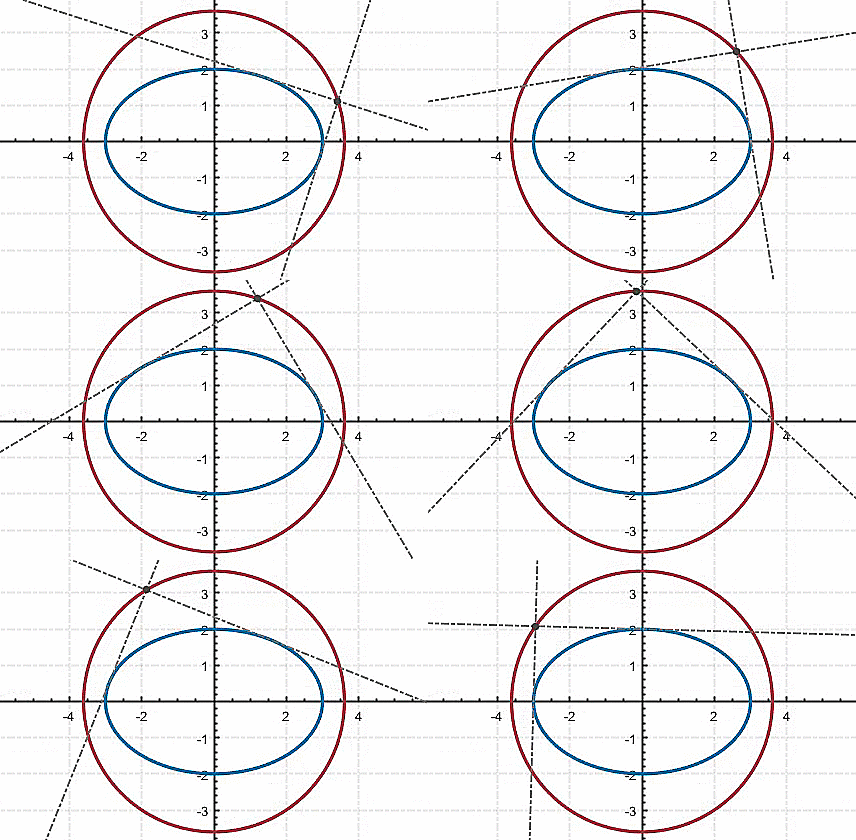
MATLAB Code :
function directorC
% @author : slandarer
%  official account   : slandarer essays
%  You know     : hikari
a=3;b=2;syms k
% axes Basic property settings
ax=gca;
hold on;grid on
ax.XLim=[-6,6];
ax.YLim=[-4,4];
ax.DataAspectRatio=[1,1,1];
ax.XAxisLocation='origin';
ax.YAxisLocation='origin';
ax.LineWidth=1.5;
ax.XMinorTick='on';
ax.YMinorTick='on';
ax.GridLineStyle='-.';
ax.GridAlpha=.09;
%  Draw circles and ellipses
t=linspace(0,2*pi,200);
plot(a.*cos(t),b.*sin(t),'LineWidth',2.5,'Color',[0,118,168]./255)
plot(sqrt(a^2+b^2).*cos(t),sqrt(a^2+b^2).*sin(t),'LineWidth',2.5,'Color',[169,64,71]./255)
%  Draw tangents and intersections
thetaList=linspace(0,2*pi,200);
kline1=plot(0,0,'-.','LineWidth',1.5,'Color',[1,1,1].*.5);
kline2=plot(0,0,'-.','LineWidth',1.5,'Color',[1,1,1].*.5);
kpnt=scatter(a,0,'filled','CData',[1,1,1].*.3);
X=-6:.1:6;
%  Circular drawing
for i=1:length(thetaList)
    theta=thetaList(i);
    m=sqrt(a^2+b^2).*cos(theta);
    n=sqrt(a^2+b^2).*sin(theta);
    kk=double(solve((m^2-a^2)*k^2-2*m*n*k+n^2-b^2==0));
    Y1=kk(1).*(X-m)+n;Y2=kk(2).*(X-m)+n;
    kline1.XData=X;kline1.YData=Y1;
    kline2.XData=X;kline2.YData=Y2;
    kpnt.XData=m;
    kpnt.YData=n;
    drawnow;
    pause(.01)
end
end
The illusion of rotation
proposition 2: Suppose there is a radius of r 2 \frac{r}{2} 2r The small circle of has a radius of r r r Roll in the big circle , The locus of points on a small circle is a straight line .
The proof is simple , Suppose there is a little contact between the small circle and the big circle , At this time, the line between the center of the small circle and the origin is x The included angle in the positive direction of the axis is θ 0 \theta_0 θ0, Now suppose that the rolling of the small circle causes the change of the included angle of the center of the small circle θ \theta θ, Because the radius of the small circle is half of that of the big circle , So when you roll the same way , The included angle of the points on the small circle changes in the opposite direction 2 θ 2\theta 2θ Therefore, the parameter equation of the position change of the point on the small circle can be obtained :
{ x = r 2 c o s ( θ 0 + θ ) + r 2 c o s ( θ 0 + θ − 2 θ ) y = r 2 s i n ( θ 0 + θ ) + r 2 s i n ( θ 0 + θ − 2 θ ) ⇒ { x = ( r 2 c o s ( θ ) ) c o s ( θ 0 ) y = ( r 2 c o s ( θ ) ) s i n ( θ 0 ) \begin{aligned} &\left\{\begin{matrix} x=\frac{r}{2}cos(\theta_0+\theta)+\frac{r}{2}cos(\theta_0+\theta-2\theta)\\ y=\frac{r}{2}sin(\theta_0+\theta)+\frac{r}{2}sin(\theta_0+\theta-2\theta)\\ \end{matrix}\right. \\ \Rightarrow &\left\{\begin{matrix} x=(\frac{r}{2}cos(\theta))cos(\theta_0)\\ y=(\frac{r}{2}cos(\theta))sin(\theta_0) \end{matrix}\right. \end{aligned} ⇒{ x=2rcos(θ0+θ)+2rcos(θ0+θ−2θ)y=2rsin(θ0+θ)+2rsin(θ0+θ−2θ){ x=(2rcos(θ))cos(θ0)y=(2rcos(θ))sin(θ0)
This is a cross origin , The angle is θ 0 \theta_0 θ0 Straight line , The proof is complete , All points on the small circle go straight , For visualization to look good , Here, draw several equal points to make some visualization :
Visualization :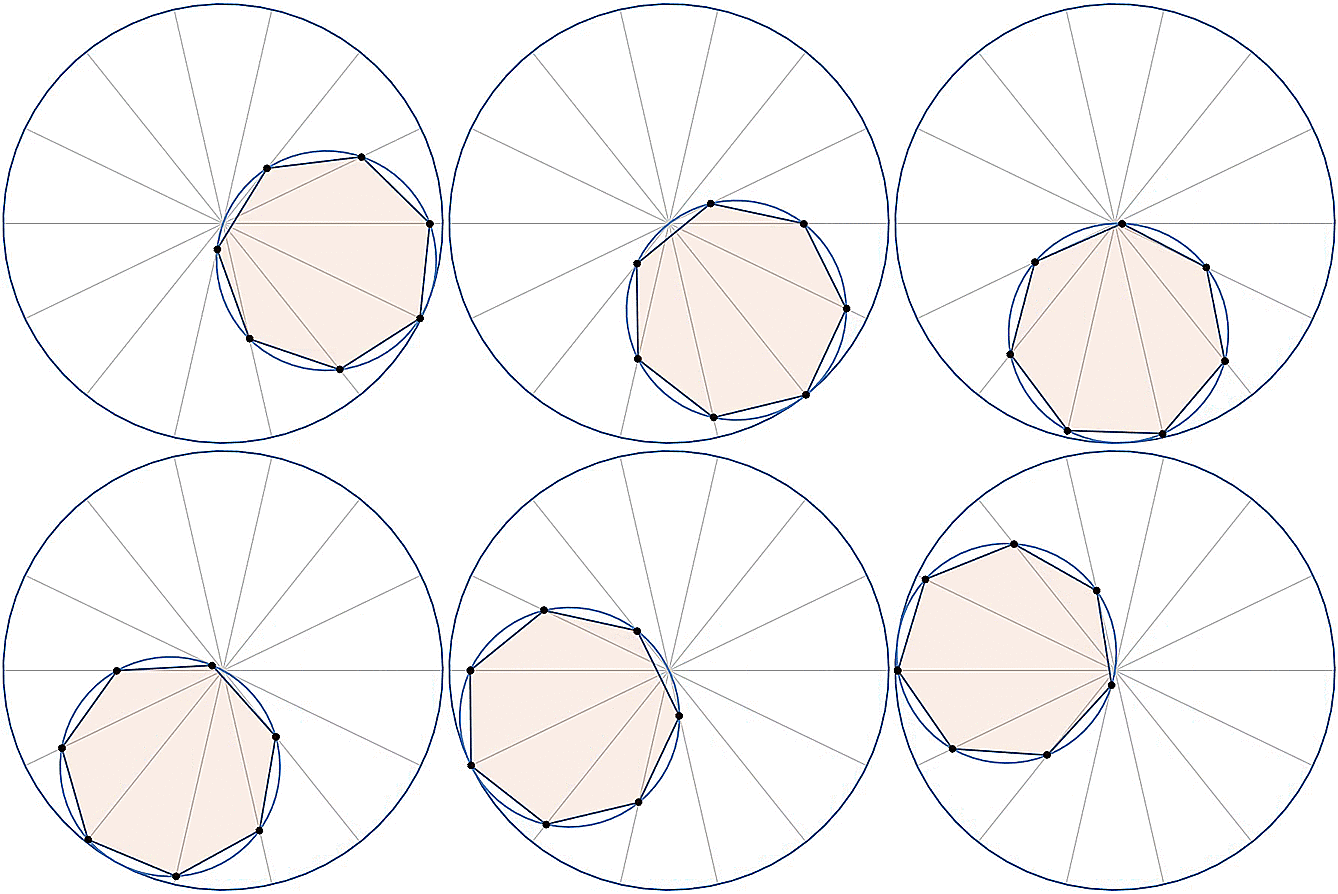
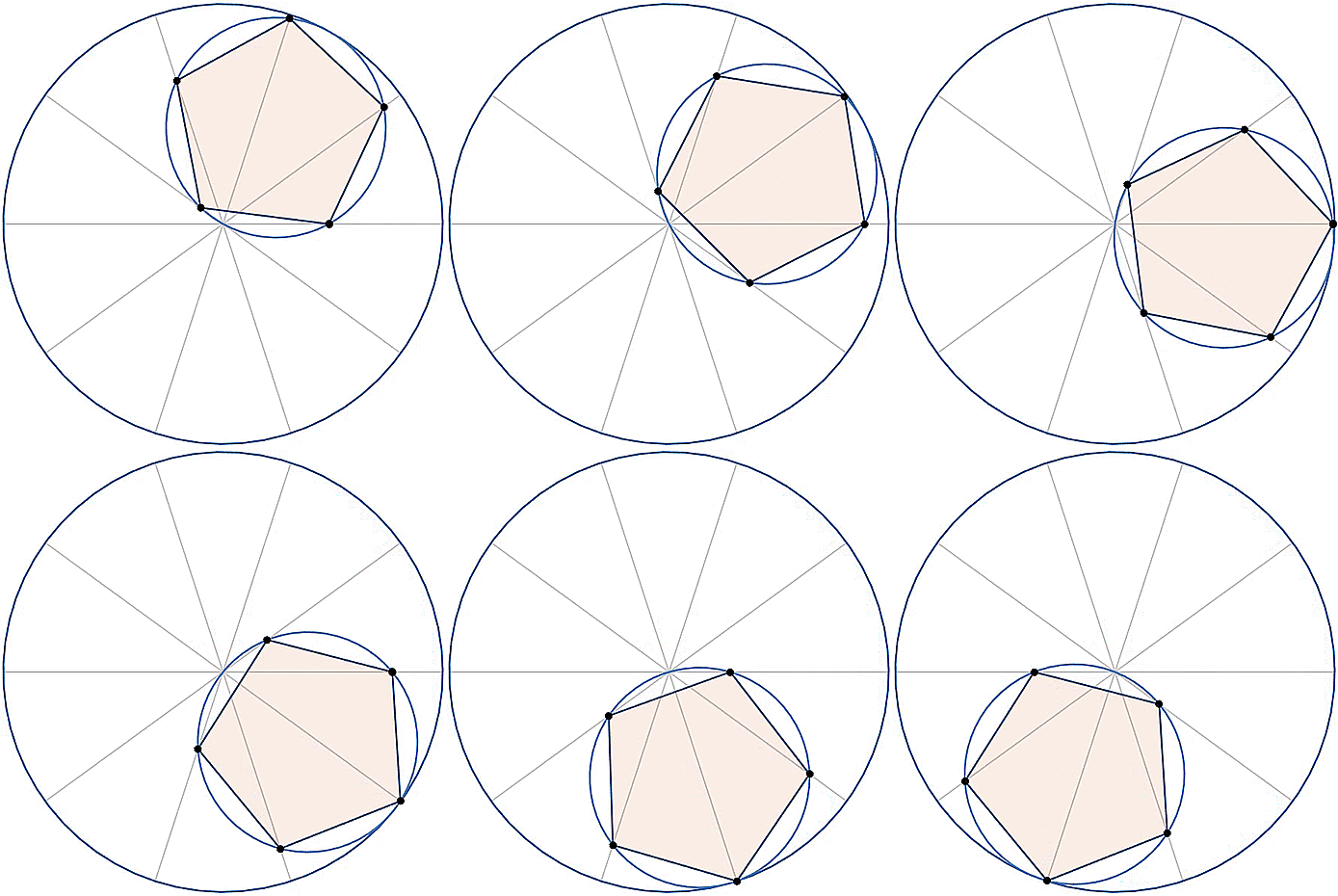
MATLAB Code :
function PointOnLineInCircle(N)
% @author : slandarer
%  official account   : slandarer essays
%  You know     : hikari
if nargin<1||N<2
    N=4;
end
% 0.2157    0.3765    0.5725
% 0.3098    0.5059    0.7412

% figure And axes Basic property settings
fig=gcf;
fig.Name='PoLiC';
fig.Position=[50 100 600 600];
fig.NumberTitle='off';
fig.MenuBar='none';
%
ax=axes(fig);
ax.Position=[0 0 1 1];
ax.XLim=[-2.05 2.05];
ax.YLim=[-2.05 2.05];
ax.XColor='none';
ax.YColor='none';
hold(ax,'on');
% grid on

thetaB=0;
thetaS=0;


%  Draw a straight line
pntsTheta=0:2*pi/N:2*pi;
for i=1:(length(pntsTheta)-1)
    plot([cos(pntsTheta(i)),cos(pntsTheta(i)+pi)].*2,...
         [sin(pntsTheta(i)),sin(pntsTheta(i)+pi)].*2,...
         'Color',[0.8 0.8 0.8],'LineWidth',1.5)
end
if mod(N,2)==0
    for i=1:(length(pntsTheta)-1)
        plot([cos(pntsTheta(i)+2*pi/N/2),cos(pntsTheta(i)+2*pi/N/2+pi)].*2,...
             [sin(pntsTheta(i)+2*pi/N/2),sin(pntsTheta(i)+2*pi/N/2+pi)].*2,...
             'Color',[0.8 0.8 0.8],'LineWidth',1.5)
    end
end
%  Draw a big circle
tempT=0:0.1:2*pi+0.1;
CPnts=[cos(tempT);sin(tempT)];
plot(CPnts(1,:).*2,CPnts(2,:).*2,'Color',[0.2098 0.4059 0.6412],'LineWidth',2);
%  Draw a small circle
sCircleHdl=plot(cos(thetaB)+CPnts(1,:),sin(thetaB)+CPnts(2,:),...
    'Color',[0.3098 0.5059 0.7412],'LineWidth',2);
%  Draw a positive inscribed polygon
pntsHdl=plot(cos(pntsTheta+thetaS)+cos(thetaB),...
    sin(pntsTheta+thetaS)+sin(thetaB),...
    'Color',[0.2157 0.3765 0.5725],'LineWidth',2,'Marker','o',...
    'MarkerFaceColor',[0 0 0],'MarkerEdgeColor',[0 0 0],'MarkerSize',6);

patchHdl=fill(cos(pntsTheta(1:end-1)+thetaS)+cos(thetaB),...
              sin(pntsTheta(1:end-1)+thetaS)+sin(thetaB),...
              [0.8500 0.3250 0.0980],'EdgeColor','none','FaceAlpha',0.1);
%  Circular drawing
while 1
    thetaB=thetaB-2*pi/200;
    thetaS=thetaS+2*pi/200;
    sCircleHdl.XData=cos(thetaB)+CPnts(1,:);
    sCircleHdl.YData=sin(thetaB)+CPnts(2,:);
    pntsHdl.XData=cos(pntsTheta+thetaS)+cos(thetaB);
    pntsHdl.YData=sin(pntsTheta+thetaS)+sin(thetaB);
    patchHdl.XData=cos(pntsTheta(1:end-1)+thetaS)+cos(thetaB);
    patchHdl.YData=sin(pntsTheta(1:end-1)+thetaS)+sin(thetaB);
    pause(0.05);
end
end
Lissajous figure
There's nothing to say about this , It's good to draw a good picture hiahiahia:
Visualization :
MATLAB Code :
function lissajous
% @author : slandarer
%  official account   : slandarer essays
%  You know     : hikari

% figure And axes Basic property settings
fig=gcf;
fig.Position([2,4])=...
[fig.Position(2)-fig.Position(3)+fig.Position(4),fig.Position(3)];
%
ax=gca;hold on
ax.Color=[102,117,149]./255;
ax.XColor='none';ax.XLim=[.4,8.6];ax.YTick=[];
ax.YColor='none';ax.YLim=[.4,8.6];ax.XTick=[];
ax.DataAspectRatio=[1,1,1];
ax.InnerPosition=[0,0,1,1];

%  Draw circles
t=linspace(0,2*pi,200)';
X=cos(t).*0.42;Y=sin(t).*0.42;
plot(X+ones(1,7),Y+(1:7),'Color',[1,1,1,.7],'LineWidth',2);
plot(X+(2:8),Y+ones(1,7).*8,'Color',[1,1,1,.7],'LineWidth',2);
%  Draw points and base lines
[Xpnt,Ypnt]=meshgrid(2:8,1:7);
pntHdl=plot(Xpnt+0.42,Ypnt,'Color',[1,1,1],'LineStyle','none',...
    'Marker','o','MarkerFaceColor',[1,1,1]);
XlineCol=2:8;YlineCol=8.*ones(1,7);
XlineRow=ones(1,7);YlineRow=1:7;
lineColHdl=plot([XlineCol;Xpnt(1,:)]+0.42,[YlineCol;Ypnt(1,:)],...
    'Color',[1,1,1,.5],'LineStyle','-.','Marker','o','MarkerFaceColor',[1,1,1]);
lineRowHdl=plot([XlineRow;Xpnt(:,end)']+0.42,[YlineRow;Ypnt(:,end)'],...
    'Color',[1,1,1,.5],'LineStyle','-.','Marker','o','MarkerFaceColor',[1,1,1]);
%  Draw polyline handle
for m=1:7
    for n=1:7
        lineMatHdl(m,n)=plot(Xpnt(n,m),Ypnt(n,m),...
            'Color',[1,1,1,.6],'LineWidth',1.2);
    end
end
ratio=1:7;
thetaList=linspace(0,2*pi,300);
%  Circular drawing
for i=1:length(thetaList)
    theta=thetaList(i).*ratio;
    tX=cos(theta).*0.42;
    tY=sin(theta).*0.42;
    for j=1:7
        pntHdl(j).XData=Xpnt(:,j)+tX(j);
        pntHdl(j).YData=Ypnt(:,j)+tY(end:-1:1)';
        lineColHdl(j).XData=[XlineCol(j);Xpnt(1,j)]+tX(j);
        lineColHdl(j).YData=[YlineCol(j);Ypnt(1,j)]+[tY(j);tY(7)];
        lineRowHdl(j).XData=[XlineRow(j);Xpnt(j,end)']+[tX(8-j);tX(7)];
        lineRowHdl(j).YData=[YlineRow(j);Ypnt(j,end)']+tY(8-j);
    end
    %
    ttList=thetaList(1:i);
    for m=1:7
        for n=1:7
            lineMatHdl(m,n).XData=cos(ttList.*m).*0.42+Xpnt(n,m);
            lineMatHdl(m,n).YData=sin(ttList.*(8-n)).*0.42+Ypnt(n,m);
        end
    end
    drawnow
    pause(.01)
end
end
边栏推荐
- 手机新领域用法知识
- Kotlin Compose compositionLocalOf 与 staticCompositionLocalOf
- jmeter分布式压测
- Is the truth XX coming? Why are test / development programmers unwilling to work overtime? This is a crazy state
- Pat grade a 1023 have fun with numbers
- Products change the world
- 再探Handler(下)(Handler核心原理最全解析)
- 【promise一】promise的介绍与手撸的关键问题
- FastDDS的服务器记录-译-
- 2021:Zero-shot Visual Question Answering using Knowledge Graphs使用知识图的零次视觉问答
猜你喜欢
![[promise I] introduction of promise and key issues of hand rolling](/img/14/94bd986d3ac8a0db35c83b4234fa8a.png)
[promise I] introduction of promise and key issues of hand rolling

Pat grade a 1021 deep root

Resnet152 pepper pest image recognition 1.0

为什么 C# 访问 null 字段会抛异常?

超级详细,2 万字详解,吃透 ES!

2021:Graphhopper: Multi-Hop Scene Graph Reasoning for Visual Question Answering

如何让 EF Core 6 支持 DateOnly 类型

ESP8266

办公室VR黄片,骚操作!微软HoloLens之父辞职!

promise源码-class版本【三、Promise源码】【代码详细注释/测试案例完整】
随机推荐
ERP demand and sales management Kingdee
I found a JSON visualization tool artifact. I love it!
mysql数据库基础:DQL数据查询语言
Method of decoding iPhone certificate file
NestJS环境变量配置,解决如何在拦截器(interceptor)注入服务(service)的问题
如何让 EF Core 6 支持 DateOnly 类型
2021:Zero-shot Visual Question Answering using Knowledge Graphs使用知识图的零次视觉问答
Uni app's uparse rich text parsing perfectly parses rich text!
如何系统学习LabVIEW?
Topolvm: kubernetes local persistence scheme based on LVM, capacity aware, dynamically create PV, and easily use local disk
实践 DevOps 时,可能面临的六大挑战
Kotlin Compose 自定义 CompositionLocalProvider CompositionLocal
2021:AdaVQA: Overcoming Language Priors with Adapted Margin Cosine Loss∗自适应的边缘余弦损失解决语言先验
手机新领域用法知识
办公室VR黄片,骚操作!微软HoloLens之父辞职!
CVPR2021:Separating Skills and Concepts for Novel Visual Question Answering将技巧与概念分开的新视觉问答
Overview of Tsinghua & Huawei | semantic communication: Principles and challenges
Basic functions of promise [IV. promise source code]
Further exploration of handler (I) (the most complete analysis of the core principle of handler)
GAMES101作业7提高-微表面材质的实现过程