当前位置:网站首页>Leetcode math problems
Leetcode math problems
2022-06-22 13:27:00 【Linchong Fengxue mountain temple】
leetcode Middle mathematics / Array title _MaYingColdPlay The blog of -CSDN Blog 1. Integer inversion idea : The two methods ,1 Is to convert a number into a string , Traversal in reverse order of strings , Need to open up additional space .2 Yes, it is 10 The way to get the remainder .https://leetcode-cn.com/problems/reverse-integer/solution/hua-jie-suan-fa-7-zheng-shu-fan-zhuan-by-guanpengc/... https://blog.csdn.net/MaYingColdPlay/article/details/106610056?spm=1001.2014.3001.5502
5868 An array of interchangeable rectangles
Power button  https://leetcode-cn.com/problems/number-of-pairs-of-interchangeable-rectangles/
I am so stupid , Actually, it is done by traversal . Later, I cut some paper , It's all overtime . Here is my code .
class Solution:
    def interchangeableRectangles(self, rectangles: List[List[int]]) -> int:
        cnt = 0
        for i in range(len(rectangles)):
            w1,h1 = rectangles[i][0],rectangles[i][1]
            for j in range(i+1,len(rectangles)):
                w2,h2 = rectangles[j][0],rectangles[j][1]
                if w1/h1 == w2/h2:
                    cnt=cnt+1
        return cnt
class Solution:
    def interchangeableRectangles(self, rectangles: List[List[int]]) -> int:
        cnt=0
        dp=[[False for _ in range(len(rectangles))] for _ in range(len(rectangles))]
        for i in range(len(rectangles)):
            w1, h1 = rectangles[i][0], rectangles[i][1]
            for j in range(i + 1, len(rectangles)):
                if i>=1:
                    if dp[i - 1][j] == True and dp[i - 1][j - 1] == True and dp[i][j-1]== True:
                        dp[i][j] = True
                        cnt = cnt + 1
                    else:
                        w2, h2 = rectangles[j][0], rectangles[j][1]
                        if w1 / h1 == w2 / h2:
                            dp[i][j] = True
                            cnt = cnt +1
                else:
                    w2, h2 = rectangles[j][0], rectangles[j][1]
                    if w1 / h1 == w2 / h2:
                        dp[i][j] = True
                        cnt = cnt + 1
        return cnt
In fact, it is OK to use the combination formula , Reflect on why you didn't think

class Solution:
    def interchangeableRectangles(self, rectangles: List[List[int]]) -> int:
        # Traversal array , How many different ratios are there
        dic={}
        for i in range(len(rectangles)):
            w=rectangles[i][0]
            h=rectangles[i][1]
            value = w/h
            if value not in dic.keys():
                dic[value]=1
            else:
                dic[value]=dic[value]+1
        res=0
        for key in dic.keys():
            cur_v=dic[key]
            cur_res=cur_v*(cur_v-1)/2
            res=res+cur_res
        return int(res)
5877. Detection square
My messy solution , Only through 4 individual case.
class DetectSquares(object):
    def __init__(self):
        self.dic_x={}
        self.dic_y={}
    def add(self, point):
        """
        :type point: List[int]
        :rtype: None
        """
        x=point[0]
        y=point[1]
        if x not in self.dic_x:
            self.dic_x[x]=[y]
        else:
            self.dic_x[x].append(y)
        if y not in self.dic_y:
            self.dic_y[y]=[x]
        else:
            self.dic_y[y].append(x)
    def count(self, point):
        """
        :type point: List[int]
        :rtype: int
        """
        x=point[0]
        y=point[1]
        print("x,y",point,self.dic_x,self.dic_y)
        if x in self.dic_x and y in self.dic_y:
            y_match=self.dic_x[x]
            x_match=self.dic_y[y]
            y_match_helper={}
            x_match_helper={}
            for y_m in y_match:
                if abs(y-y_m) not in y_match_helper:
                    y_match_helper[abs(y-y_m)]=1
                else:
                    y_match_helper[abs(y-y_m)]=y_match_helper[abs(y-y_m)]+1
            for x_m in x_match:
                if abs(x-x_m) not in x_match_helper:
                    x_match_helper[abs(x-x_m)]=1
                else:
                    x_match_helper[abs(x-x_m)]=x_match_helper[abs(x-x_m)]+1
            print("x",x_match_helper)
            print("y",y_match_helper)
            for key in x_match_helper and y_match_helper:
                    duijiao_x=abs(x-key)
                    duijiao_y=abs(y-key)
                    if duijiao_x in self.dic_x and duijiao_y in self.dic_y:
                        return max(x_match_helper[key],y_match_helper[key])
        return 0
# Your DetectSquares object will be instantiated and called as such:
# obj = DetectSquares()
# obj.add(point)
# param_2 = obj.count(point)
Big guy's clear way to find diagonals
class DetectSquares:
    def __init__(self):
        self.hashmap = collections.defaultdict(int)
        self.v = set()

    def add(self, point: List[int]) -> None:
         x,y = point[0],point[1]
         self.hashmap[(x,y)] += 1
         self.v.add((x,y))

    def count(self, point: List[int]) -> int:
        #  Enumerate diagonals
        ans = 0
        x1,y1 = point[0],point[1]
        for x2,y2 in self.v:
            if x2 == x1 or y2 == y1:
                continue

            if (x1,y2) in self.v and (x2,y1) in self.v:
                d1,d2 = abs(y2 - y1),abs(x2 - x1)
                if d1 == d2:
                    temp = 1
                    temp *= self.hashmap[(x2,y2)]
                    temp *= self.hashmap[(x1,y2)]
                    temp *= self.hashmap[(x2,y1)]
                    ans += temp
        return ans


# Your DetectSquares object will be instantiated and called as such:
# obj = DetectSquares()
# obj.add(point)
# param_2 = obj.count(point)
31. Next spread

class Solution(object):
    def nextPermutation(self, nums):
        """
        :type nums: List[int]
        :rtype: None Do not return anything, modify nums in-place instead.
        """
        # Go back and forth , find nums[i]<nums[i+1] The first element of
        i=len(nums)-2
        while i>=0 and nums[i]>=nums[i+1]:
            i=i-1
        # Go back and forth , find nums[j]>nums[i] The first element of
        if i>=0:
            j=len(nums)-1
            while j>i and nums[i]>=nums[j]:
                j=j-1
            # In exchange for
            nums[i],nums[j]=nums[j],nums[i]
        # from i+1 To the last in ascending order
        left=i+1
        right=len(nums)-1
        while left<right:
            nums[left],nums[right]=nums[right],nums[left]
            left=left+1
            right=right-1
        return nums
60 Arrange the sequence


264. Ugly number II

The smallest pile + Guang Shu ( Rainwater collection 2 It's also )
class Solution(object):
    def nthUglyNumber(self, n):
        """
        :type n: int
        :rtype: int
        """
        # Generate ugly numbers from small to large
        # Generate rules : Minimum number of POPs per time , multiply  2/3/5
        if n==1:
            return 1
        blist=[2,3,5]
        import heapq
        alist=[]
        heapq.heappush(alist,1)
        res=[]
        while len(res)<n:
            min_val=heapq.heappop(alist)
            if min_val not in res:
                res.append(min_val)
            for val in blist:
                new=min_val*val
                if new not in alist:
                    heapq.heappush(alist,new)
        return res[-1]
solution 2: Multiplex merge
279. Complete square

373. Look for the smallest K Pairs of numbers
solution 1: Heap sort
solution 2: Multiplex merge
668. Number... In the multiplication table k Small number
204. Count prime

enumeration


class Solution {
    public int countPrimes(int n) {
        int cnt = 0;
        for (int i = 2; i < n; i++) {
            if (isPrime(i)) {
                cnt++;
            }
        }
        return cnt;
    }

    private boolean isPrime(int num) {
        int max = (int)Math.sqrt(num);
        for (int i = 2; i <= max; i++) {
            if (num % i == 0) {
                return false;
            }
        }
        return true;
    }
}

 author :sweetiee
 link :https://leetcode-cn.com/problems/count-primes/solution/kuai-lai-miao-dong-shai-zhi-shu-by-sweetiee/
 source : Power button (LeetCode)
 The copyright belongs to the author . Commercial reprint please contact the author for authorization , Non-commercial reprint please indicate the source .
Ethmoid


class Solution {

    public int countPrimes(int n) {
        boolean[] isPrim = new boolean[n];
        Arrays.fill(isPrim, true);
        //  from  2  Start enumerating to  sqrt(n).
        for (int i = 2; i * i < n; i++) {
            //  If the current number is prime
            if (isPrim[i]) {
                //  From  i*i  Start ,i  All multiples of are set to  false.
                for (int j = i * i; j < n; j+=i) {
                    isPrim[j] = false;
                }
            }
        }

        //  Count
        int cnt = 0;
        for (int i = 2; i < n; i++) {
            if (isPrim[i]) {
                cnt++;
            }
        }
        return cnt;
    }
}

 author :sweetiee
 link :https://leetcode-cn.com/problems/count-primes/solution/kuai-lai-miao-dong-shai-zhi-shu-by-sweetiee/
 source : Power button (LeetCode)
 The copyright belongs to the author . Commercial reprint please contact the author for authorization , Non-commercial reprint please indicate the source .
# A sieve : Take all the numbers first (2 To n) Marked as prime number , And then from 2 Start , Mark its multiples as composite numbers
# leetcode submit region begin(Prohibit modification and deletion)
class Solution:
def countPrimes(self, n):
is_primes = [1 for _ in range(n)]
for i in range(2, n):
if is_primes[i] == 1:
for j in range(2 * i, n, i):
# Set its multiple to 0
is_primes[j] = 0
count = 0
for i in range(2, n):
if is_primes[i] == 1:
count += 1
return count
n=10
res=Solution().countPrimes(n)
print(res)1447. Simplest fraction

Find the greatest common divisor by division
division ( Find the greatest common divisor )_ A Bula's blog -CSDN Blog


class Solution:
    def simplifiedFractions(self, n: int) -> List[str]:
        # n = 5
        # ["1/2","1/3","1/4","2/3","3/4"] ['1/5','2/5','3/5','4/5']
        if n==1:
            return []
        def gcd(a,b):
            while a>0 and b>0:
                if a>b:
                    a=a%b
                else:
                    b=b%a
            return a+b
        # recursive , The current value plus n-1
        def cal_x(x):
            cur_res=[]
            cur_res.append(str(1) + '/' + str(x))
            for i in range(2,x):
                if gcd(x,i)==1:
                    cur_res.append(str(i)+'/'+str(x))
            return cur_res
        return self.simplifiedFractions(n-1)+cal_x(n)
Find the least common multiple

6019. Replace non coprime numbers in the array


Stack + The greatest common divisor and the least common multiple
class Solution:
    def replaceNonCoprimes(self, nums: List[int]) -> List[int]:
        stack=[]
        def gcd(a1,a2):
            # Find the greatest common divisor
            while a1>0 and a2>0:
                if a1>a2:
                    a1=a1%a2
                else:
                    a2=a2%a1
            return a1+a2
        def check(stack):
            while len(stack)>=2 and gcd(stack[-1],stack[-2])>1:
                lcm=stack[-1]*stack[-2]//gcd(stack[-1],stack[-2])
                stack.pop()
                stack.pop()
                stack.append(lcm)

        for i in range(len(nums)):
            if stack and gcd(nums[i],stack[-1])>1:
                lcm=nums[i]*stack[-1]//gcd(nums[i],stack[-1])
                stack.pop()
                stack.append(lcm)
            else:
                stack.append(nums[i])
            # Check whether there are non coprime numbers in the stack
            check(stack)
        return stack
6015. Statistics can be K The number of subscript pairs divisible

The greatest common factor

k The remaining prime factor is y Prime factors that must be included


class Solution(object):
    def coutPairs(self, nums, k):
        """
        :type nums: List[int]
        :type k: int
        :rtype: int
        """
        # k/gcd(k,nums[i]), yes nums[j] A factor of
        def gcd(x,y):
            while x>0 and y>0:
                if x>y:
                    x=x%y
                else:
                    y=y%x
            return x+y
        alist=[]
        res=0
        for i in range(len(nums)):
            a=gcd(nums[i],k)
            alist.append(a)
        print(alist)

        maps=Counter(alist)
        maps_list=list(maps.keys())
        # Combine , Different key A combination of two (m*n), same key Own internal combination c(2,n),
        for i in range(len(maps_list)):
            if maps_list[i]*maps_list[i] % k==0:
                res+=maps[maps_list[i]]*(maps[maps_list[i]]-1)/2
            for j in range(i+1,len(maps_list)):
                if maps_list[i]*maps_list[j] % k==0:
                    res+=maps[maps_list[i]]*maps[maps_list[j]]
        return res
5994. Find the substring of the given hash value
The property of remainder operation


Positive order ergodic : Overtime
class Solution(object):
    def subStrHash(self, s, power, modulo, k, hashValue):
        """
        :type s: str
        :type power: int
        :type modulo: int
        :type k: int
        :type hashValue: int
        :rtype: str
        """
        # The calculated length is k Hash value of the substring of
        # lookup index
        alist=['a', 'b', 'c', 'd', 'e', 'f', 'g', 'h', 'i', 'j', 'k', 'l', 'm', 'n', 'o', 'p', 'q', 'r', 's', 't', 'u', 'v', 'w', 'x', 'y', 'z']
        # The first power The calculation is stored in the array
        power_i=[0 for _ in range(k)]
        power_i[0]=1
        for i in range(1,k):
            power_i[i]=power_i[i-1]*power
        # The first group
        cur_s=s[:k]
        cur=0
        for j in range(k):
            index=alist.index(cur_s[j])+1
            p=power_i[j]
            cur+=index*p
        if cur%modulo==hashValue:
            return cur_s
        pre=0
        nexts=k
        while nexts<len(s):
            index=alist.index(s[nexts])+1
            p=power_i[k-1]
            cur=(cur-(alist.index(s[pre])+1))/power + index*p
            if cur%modulo==hashValue:
                return s[pre+1:nexts+1]
            pre+=1
            nexts+=1
Modular operations satisfy the distributive law


class Solution(object):
    def subStrHash(self, s, power, modulo, k, hashValue):
        """
        :type s: str
        :type power: int
        :type modulo: int
        :type k: int
        :type hashValue: int
        :rtype: str
        """
        # Divisor is not easy to modulo , The quantity is too large to time out
        # So use the method of flashback traversal , Go back and forth . Modular multiplication satisfies commutative law

        # First save the result of the power operation
        power_i=[0 for _ in range(k)]
        power_i[0]=1%modulo
        for i in range(1,k):
            power_i[i]=power_i[i-1]*power%modulo
         # lookup index
        alist=['a', 'b', 'c', 'd', 'e', 'f', 'g', 'h', 'i', 'j', 'k', 'l', 'm', 'n', 'o', 'p', 'q', 'r', 's', 't', 'u', 'v', 'w', 'x', 'y', 'z']
        res=[]
        # Last group
        cur_s=s[len(s)-k:]
        cur_res=0
        for i in range(k):
            index=alist.index(cur_s[i])+1
            p=power_i[i]
            cur_res=cur_res+index*p
        cur_res=cur_res%modulo
        if cur_res == hashValue:
            res.append(cur_s)
        # Flashback traversal
        remove_index=len(s)-1
        new_index=len(s)-1-k
        while new_index>=0:
            new_value=alist.index(s[new_index])+1
            remove_value=(alist.index(s[remove_index])+1)*power_i[k-1]
            # cur_res=(cur_res-remove_value)*power+new_value
            # if cur_res%modulo == hashValue:
            #     res.append(s[new_index:remove_index])
            cur_res=((cur_res-remove_value)*power+new_value)%modulo
            if cur_res== hashValue:
                res.append(s[new_index:remove_index])
                # return s[new_index:remove_index]
            new_index=new_index-1
            remove_index=remove_index-1
        return res[-1]
2063. Vowels in all substrings


The sliding window , Overtime
class Solution:
    def countVowels(self, word: str) -> int:
        alist=['a','e','i','o','u']
        cnt=0
        # Double pointer
        left=-1
        while left<len(word)-1:
            flag=0
            left+=1
            right=left+1
            cur=word[left]
            if cur in alist:
                cnt+=1
                flag=1
            while right<len(word):
                cur=word[right]
                if cur in alist or flag>0:
                    if cur in alist:
                        flag+=1
                        cnt+=flag
                    else:
                        cnt+=flag
                right+=1
        return cnt
Combinatorial mathematics

class Solution:
    def countVowels(self, word: str) -> int:
        res = 0
        meta = {'a', 'e', 'i', 'o', 'u'}
        n = len(word)
        for i, ch in enumerate(word):
            if ch in meta:
                res += (i + 1) * (n - i)
        return res

 author :ya-li-ge
 link :https://leetcode-cn.com/problems/vowels-of-all-substrings/solution/zu-he-wen-ti-xun-huan-bian-li-python-jie-hoxq/
 source : Power button (LeetCode)
 The copyright belongs to the author . Commercial reprint please contact the author for authorization , Non-commercial reprint please indicate the source .
828. Count the unique characters in the substring

sliding window , Overtime
class Solution:
    def uniqueLetterString(self, s: str) -> int:
        count=0
        # The sliding window
        left=-1
        while left<len(s)-1:
            left+=1
            cur=s[left]
            count+=1
            visited={}
            visited[cur]=1
            right=left+1
            while right<len(s):
                cur = s[right]
                if cur in visited:
                   visited[cur]+=1
                else:
                    visited[cur]=1
                cur_count=0
                for key in visited:
                    if visited[key]==1:
                        cur_count+=1
                count += cur_count
                right += 1
        return count
Combinatorial mathematics


class Solution:
    def uniqueLetterString(self, s: str) -> int:
        res=0
        # Turn into : Each letter is in a substring , contain 1 Number of substrings of current letters .
        for i in range(len(s)):
            cur=s[i]
            # To the left
            j=i-1
            while j>=0 and s[j]!=cur:
                j=j-1
            left_count=i-j
            # To the right
            h=i+1
            while h<=len(s)-1 and s[h]!=cur:
                h=h+1
            right_count=h-i
            cur_count=left_count*right_count
            res+=cur_count
        return res
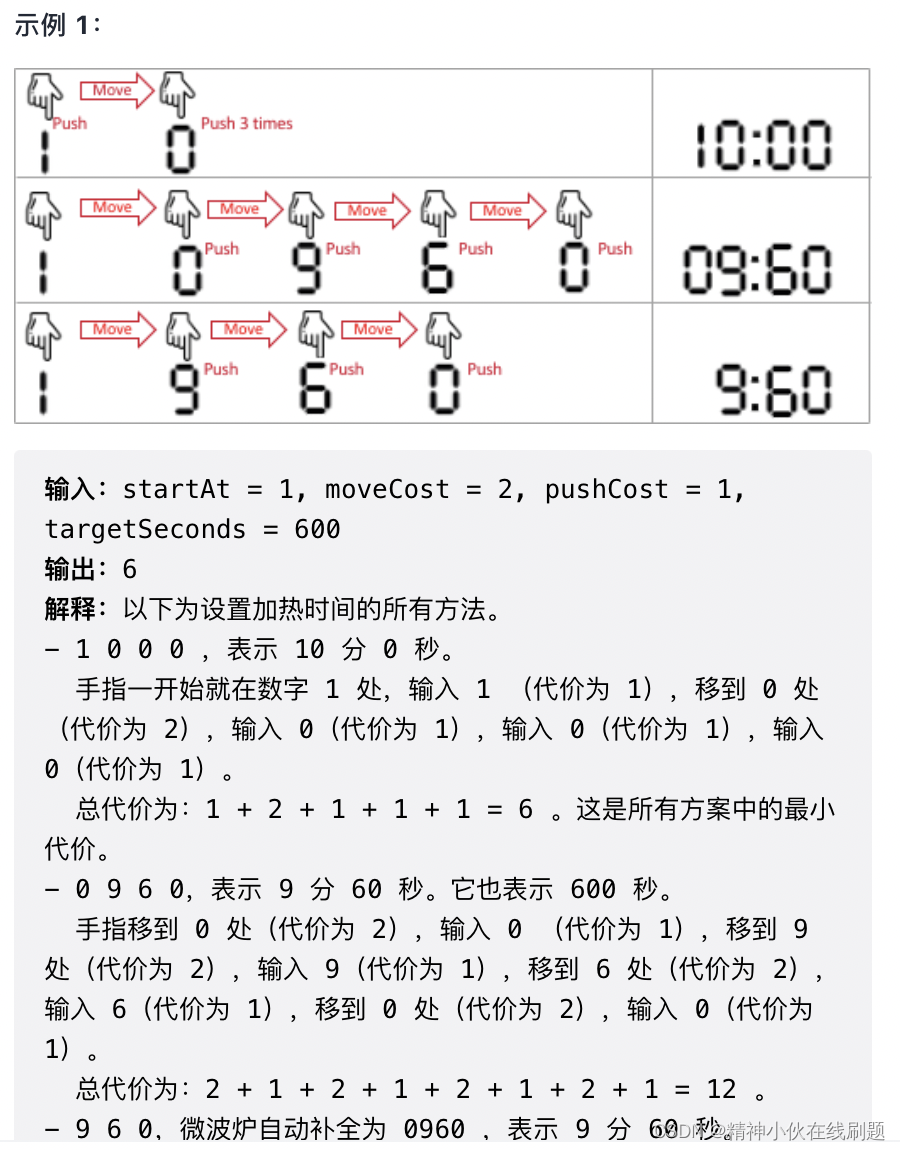
5986. The least cost of setting time



class Solution {
public:
    int minCostSetTime(int startAt, int moveCost, int pushCost, int targetSeconds) {
        int mins = targetSeconds / 60;
        int secs = targetSeconds % 60;
        int ans1 = calc(startAt, moveCost, pushCost, mins, secs);
        int ans2 = calc(startAt, moveCost, pushCost, mins - 1, secs + 60);
        return min(ans1, ans2);
    }

    int calc(int startAt, int moveCost, int pushCost, int mins, int secs) {
        /*  Illegal input returns  */
        if (mins > 99 || mins < 0 || secs > 99) {
            return INT_MAX;
        }

        /*  To string ,  Remove the lead 0 */
        string s = to_string(mins * 100 + secs);

        int ans = 0;
        /*  Process each number  */
        for (int i = 0; i < s.size(); i++) {
            if (startAt == s[i] - '0') { /*  No extra moveCost */
                ans += pushCost;
            } else {
                ans += moveCost + pushCost;
            }
            startAt = s[i] - '0';
        }
        return ans;
    }
};

 author :liu-xiang-3
 link :https://leetcode-cn.com/problems/minimum-cost-to-set-cooking-time/solution/cfen-lei-tao-lun-by-liu-xiang-3-sqem/
 source : Power button (LeetCode)
 The copyright belongs to the author . Commercial reprint please contact the author for authorization , Non-commercial reprint please indicate the source .
class Solution:
def minCostSetTime(self, startAt: int, moveCost: int, pushCost: int, targetSeconds: int) -> int:
def cal(minute,second,startAt):
if minute>99:
return float('inf')
# Into four digits
target_time=[minute//10,minute%10,second//10,second%10]
i=0
cost=0
# Skip the first 0
while i<=3 and target_time[i]==0:
i+=1
while i<=3:
cur=target_time[i]
if cur==startAt:
cost=cost+pushCost
else:
cost=cost+pushCost+moveCost
startAt=cur
i+=1
return cost
ans1=float('inf')
ans2=float("inf")
# hold targetSeconds Convert to microwave oven time form
minute1=targetSeconds//60
second1=targetSeconds%60
ans1=cal(minute1,second1,startAt)
# The maximum number of minutes can reach 99 second , When second1 Less than or equal to 39 When , You can take minutes (60 second ) Take it to the second digit
if second1<=39:
second2=second1+60
minute2=minute1-1
ans2=cal(minute2,second2,startAt)
return min(ans1,ans2)233. Numbers 1 The number of

Violence overtime
Arrange and combine to find rules

41. First positive number missing
In situ hash
Similar topics : The finger of the sword offer03, In situ hash


from typing import List


class Solution:

    # 3  The index should be placed in  2  The place of
    # 4  The index should be placed in  3  The place of

    def firstMissingPositive(self, nums: List[int]) -> int:
        size = len(nums)
        for i in range(size):
            #  First determine whether this number is an index , Then judge whether the number is in the right place
            while 1 <= nums[i] <= size and nums[i] != nums[nums[i] - 1]:
                self.__swap(nums, i, nums[i] - 1)

        for i in range(size):
            if i + 1 != nums[i]:
                return i + 1

        return size + 1

    def __swap(self, nums, index1, index2):
        nums[index1], nums[index2] = nums[index2], nums[index1]

 author :liweiwei1419
 link :https://leetcode-cn.com/problems/first-missing-positive/solution/tong-pai-xu-python-dai-ma-by-liweiwei1419/
 source : Power button (LeetCode)
 The copyright belongs to the author . Commercial reprint please contact the author for authorization , Non-commercial reprint please indicate the source .
440. The second part of the dictionary order K Small number

Arrange by bit
There was a similar question in the previous week's competition t2, Next spread
class Solution {
    public int findKthNumber(int n, int k) {
        long cur = 1;
        k--;
        while(k > 0) {
            //  With cur The subtree node that is the root has nodes individual
            int nodes = getNodes(n, cur);
            //  If the number is more than k Less , Then this part can be skipped directly
            if(k >= nodes) {
                //  Skip all
                k = k -nodes;
                //  Move one to the right
                cur++;
            }
            //  If the quantity is more than k many , So we must find the result cur Child nodes under
            else {
                //  Skip current node
                k = k - 1;
                //  Go down one floor
                cur = cur * 10;
            }
        }
        return (int)cur;
    }

    //  To obtain cur Is the number of subtree nodes of the root node
    private int getNodes(int n, long cur) {
        long next = cur + 1;
        long totalNodes = 0;
        while(cur <= n) {
            //  Calculate the sum of the number of nodes in the next layer at one time , Use it if it is not full n To reduce , If it is full, use it next reduce
            totalNodes += Math.min(n - cur + 1, next - cur);
            //  Go to the next level
            next = next * 10;
            cur = cur * 10;
        }
        return (int)totalNodes;
    }
}

 author :livorth-u
 link :https://leetcode-cn.com/problems/k-th-smallest-in-lexicographical-order/solution/by-livorth-u-zvxp/
 source : Power button (LeetCode)
 The copyright belongs to the author . Commercial reprint please contact the author for authorization , Non-commercial reprint please indicate the source .
5253. Find the number of palindromes of the specified length

It took a long time to adjust during the Zhou match .
class Solution(object):
    def kthPalindrome(self, queries, intLength):
        """
        :type queries: List[int]
        :type intLength: int
        :rtype: List[int]
        """
        len1=9
        len2=9
        len3=9*10
        len4=9*10
        len5=9*10*10
        len6=9*10*10
        len7=9*10*10*10
        len8=9*10*10*10
        len9 = 9 * 10 * 10 * 10* 10
        len10 = 9 * 10 * 10 * 10 * 10
        len11 = 9 * 10 * 10 * 10 * 10* 10
        len12 = 9 * 10 * 10 * 10 * 10* 10
        len13 = 9 * 10 * 10 * 10 * 10 * 10* 10
        len14 = 9 * 10 * 10 * 10 * 10 * 10* 10
        len15 = 9 * 10 * 10 * 10 * 10 * 10 * 10* 10
        # First determine the outermost
        maps={1:0,2:0,3:1,4:1,5:2,6:2,7:3,8:3,9:4,10:4,11:5,12:5,13:6,14:6,15:7}
        def cal(i,intLength):
            cur_num=queries[i]
            cur_res=[str(0) for _ in range(intLength)]
            v0=maps[intLength]
            v1=10**v0
            tmp_count=0
            flag=False
            for i in range(1,10):
                if i>1:
                    flag=True
                tmp_count=tmp_count+v1
                if cur_num<=tmp_count and flag==False:
                    cur_res[0]=str(i)
                    break
                if cur_num<tmp_count and flag==True:
                    cur_res[0] = str(i-1)
                    cur_num=cur_num-(tmp_count-v1)
                    break
                if cur_num==tmp_count:
                    cur_res[0] = str(i)
                    cur_num = cur_num - (tmp_count - v1)
            # From the second place , There is still left cur_num Number
            # Even number traverses to
            intLength=intLength-2
            index=1
            while intLength>1:
                v0 = maps[intLength]
                v1 = 10 ** v0
                tmp_count = 0
                flag = False
                for i in range(10):
                    if i > 0:
                        flag = True
                    tmp_count = tmp_count + v1
                    if cur_num <= tmp_count and flag == False:
                        cur_res[index] = str(i)
                        break
                    if cur_num <= tmp_count and flag == True:
                        cur_res[index] = str(i - 1)
                        cur_num = cur_num - (tmp_count - v1)
                        break
                intLength = intLength - 2
                index = index+1
            # If it's even , Judge the last two , If it's odd , Judge the last
            if if_oushu==0:
                for i in range(10):
                    cur_num = cur_num - 1
                    if cur_num==0:
                        cur_res[index] = str(i)

            right=len(cur_res)-1
            left=0
            while left<right:
                cur_res[right]=cur_res[left]
                right-=1
                left+=1
            print(cur_res)
            return ''.join(cur_res)
        res=[]
        if_oushu=0
        if intLength%2==0:
            if_oushu=1
        for i in range(len(queries)):
            res.append(int(cal(i,intLength)))
        return res
# queries = [2,4,6], intLength = 4
# queries = [231]
# intLength = 5
# queries =[1,2,3,4,5,90]
# intLength =3

# Discussion on odd and even numbers , First determine the prefix , Even last 2 One needs special treatment , The last odd number needs special treatment
# The first prefix is specially handled , Because the first prefix cannot have a leading 0
# When determining the prefix , To put count Subtract the number of prefixes that have been determined
queries =[2,4,6]
intLength =4
res=Solution().kthPalindrome(queries, intLength)
print(res)
Looking for a regular


class Solution {
    public long[] kthPalindrome(int[] queries, int intLength) {
        /*
         Find rules to generate :
         The core is to find n How many palindromes are there ( Cross border judgment )?+ The first k What is the number of palindromes ?
        */
        int len = queries.length;
        long[] res = new long[len];
        for(int i = 0; i < len; i++) {
            res[i] = getPalindrome(queries[i], (double)intLength);
        }
        return res;
    }

    /*
     Return to generation No k Small n Bit palindrome number
     It is not difficult to find the following rules :
    101, 111, 121, 131, 141, 151, 161, 171, 181, 191
    202, 212, 222, 232, 242, 252, 262, 272, 282, 292
    ...
    909, 919, 929, ............................, 999
     You know 3 The number of palindromes in digits is 90 individual
     Consider only the left half ( Quite critical !!!)
    1. Sum up n The total number of digit palindromes is :
    n It's odd :9*10^(n/2);n For the even :9*10^(n/2-1)
     Further :9*10^(ceil(n/2)-1)
     Beyond this range, return -1 that will do
    2. The first k A small palindrome number is actually
     Odd number :10^(n/2)+k-1(+ Reverse + Delete the middle position )
     even numbers :10^(n/2-1)+k-1(+ Reverse )
     Further :10^(ceil(n/2)-1)+k-1
    */
    private long getPalindrome(int k, double n) {
        //  If the number exceeds the valid range, it will be returned directly -1
        if(k > 9 * Math.pow(10, Math.ceil(n / 2) - 1)) {
            return -1;
        }
        //  First convert the first half into a string
        long pre = (long)Math.pow(10, Math.ceil(n / 2) - 1) + k - 1;
        StringBuilder sb1 = new StringBuilder(String.valueOf(pre));
        StringBuilder sb2 = new StringBuilder(sb1);
        //  Splice the back part
        sb2.append(sb1.reverse());
        // n For odd numbers, the middle digit must be removed
        if((int)n % 2 == 1) {
            sb2.deleteCharAt((int)n / 2);
        }
        //  Then convert the string to a number
        return Long.parseLong(sb2.toString());
    }
}
2195. Append... To the array K It's an integer
A sequence of equal differences
780 Reach the end point
Converse thinking


class Solution {
public:
    bool reachingPoints(int sx, int sy, int tx, int ty) {
        if(sx > tx || sy > ty) return false;

        while(sx < tx && sy < ty) {
            if(tx > ty) tx %= ty;
            else ty %= tx;
        }

        if(tx == sx) { // ty = sy + k * tx, k >= 0
            return (ty - sy) % tx == 0;
        } else if(ty == sy) { // tx = sx + k * ty, k >= 0
            return (tx - sx) % ty == 0;
        }
        return false;
    }
};

 author :hxf_wyh
 link :https://leetcode-cn.com/problems/reaching-points/solution/by-hxf_wyh-g9hj/
 source : Power button (LeetCode)
 The copyright belongs to the author . Commercial reprint please contact the author for authorization , Non-commercial reprint please indicate the source .
357 Calculate the number of different digits
Permutation and combination

Wrong idea


class Solution {
    public int countNumbersWithUniqueDigits(int n) {
        int res = 1;
        int product = 9;
        for (int i = 1; i < 10 && i <= n; i++) {
            res = product + res;
            product *= (10-i);
        }
        return res;

    }
}边栏推荐
- 693. Binary Number with Alternating Bits
- MySQL notes
- 6月《中国数据库行业分析报告》发布!智能风起,列存更生
- leetcode LCP 10. Binary tree task scheduling
- 46. Permutations
- Heavyweight live | bizdevops: the way to break the technology situation under the tide of digital transformation
- 310. Minimum Height Trees
- PostGIS through St_ Dwithin retrieves elements within a certain distance
- mysql笔记
- Mysql中的锁
猜你喜欢

redis主备配置dockercompose版

Fluentd is easy to get started. Combined with the rainbow plug-in market, log collection is faster

257. Binary Tree Paths

MySQL 5.7 + Navicat 下载安装教程(附安装包)

基于SSM的图书馆管理系统,高质量毕业论文范例(可直接使用),项目导入视频,附送源码和数据库脚本,论文撰写教程

Problème de sous - séquence / substrat leetcode

剑指 Offer II 114. 外星文字典

Rce & Code Execution Vulnerability

AcWing 241 楼兰图腾(树状数组详解)

Reconstruction practice of complex C-end project of acquisition technology
随机推荐
If Tiankeng majors learn IC design by themselves, will any company want it
leetcode 第 297 場周賽
769. Max Chunks To Make Sorted
Termux set up the computer to connect to the mobile phone. (knock the command quickly), mobile phone termux port 8022
693. Binary Number with Alternating Bits
Tis tutorial 04 client
268. Missing Number
RobotFramework二次开发——文件解析
Gradle notes
epoch_ Num and predict_ Conversion of num
268. Missing Number
Rce & Code Execution Vulnerability
155. Min Stack
130. Surrounded Regions
leetcode 834. 树中距离之和
Windows system installs multiple MySQL versions (without uninstalling the original version), and the old and new versions are compatible.
“不敢去怀疑代码,又不得不怀疑代码”记一次网络请求超时分析
SSM based community garbage classification and transportation management system, high-quality graduation thesis example (can be used directly), source code, database script, project introduction and o
Views in MySQL
461. Hamming Distance