当前位置:网站首页>A commonly used statistical modeling method -- difference analysis
A commonly used statistical modeling method -- difference analysis
2022-06-25 12:19:00 【Halosec_ Wei】
1、 effect
Difference , In essence, it is the next value minus the previous value , It is mainly to eliminate some fluctuations and make the data tend to be stable , Nonstationary sequences can be obtained by Differential transformation Into a stationary sequence .
2、 Input / output description
Input :1 Time Quantitative variables of sequence data
Output : After the specified order difference Sequence diagram
3、 Learning Websites
SPSSPRO- Free professional online data analysis platform
4、 Case example
Case study : Based on a magazine 1995-2019 Annual printing volume data , The first-order difference and the second-order difference are carried out respectively .
5、 Case data

Differential analysis of case data
6、 Case operation

Step1: New analysis ;
Step2: Upload data ;
Step3: Select the corresponding data to open and preview , Click start analysis after confirmation ;

step4: choice 【 Differential analysis 】;
step5: View the corresponding data format ,【 Differential analysis 】 Request input 1 Quantitative variables of time series data .
step6: Set the difference order ( Be careful : Select the differential class , Generally speaking, more than the second-order difference has no reference significance in statistics )
step7: Click on 【 To analyze 】, Complete the operation .
7、 Output result analysis
Output results 1: Original sequence diagram

Chart description : The figure above shows the original figure without difference . among X The axis represents the time item ( year ),Y The axis represents the value ( Magazine print volume ). Subjectively , The original sequence diagram has an increasing trend , Is a nonstationary sequence . We need to convert the non-stationary original sequence diagram into a stationary sequence by difference .
Output results 2: First order difference graph
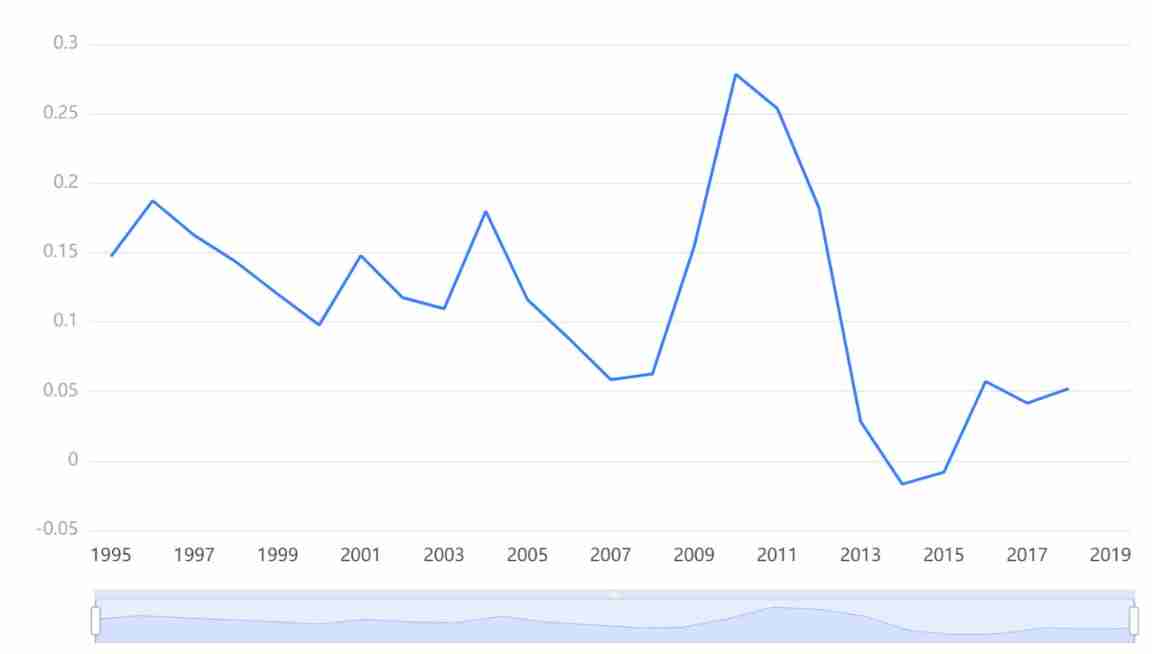
Chart description : The figure above shows the result of the first-order difference . When the time intervals are equal , Use the next value , Subtract the previous value , Get the first-order difference . Subjectively , The first-order difference sequence is numerically 1.5 Up and down , There is no obvious increasing and decreasing trend , It is preliminarily judged that the first-order difference sequence is a stationary sequence . In order to avoid artificial subjective judgment , Can pass ADF The unit root test is used to judge whether the first-order difference sequence is stable .
Output results 3: Second order difference graph

Chart description : The figure above shows the result of the second-order difference . Do the same action twice , That is, on the basis of the first-order difference, the latter value is subtracted by another value , Call “ Second order difference ”. For the stationary test of the second order difference sequence , Can pass ADF The unit root test is used to judge whether the second-order difference sequence is stable .
8、 matters needing attention
- In general, you can go through ADF Test to quantitatively evaluate the numerical difference , Whether there is stability
9、 Model theory


10、 reference
[1] Yao Zhipeng , He Dan , Cui Wei . Differential and integral calculus : Central China Normal University Press ,2015.05
边栏推荐
- The latest IT learning route in 2020
- 做自媒体视频需要怎么做才能年收入一百万?
- R language dplyr package summary_ The at function calculates the count number, mean and median of multiple data columns (specified by vectors) in the dataframe data, and specifies na RM parameter, spe
- Cesium building loading (with height)
- Mpai data science platform random forest classification \ explanation of regression parameter adjustment
- Use PHP script to view the opened extensions
- The R language cartools package divides data, the scale function scales data, and the NaiveBayes function of e1071 package constructs a naive Bayesian model
- How to use ARIMA model for prediction?
- R language uses the multinom function of NNET package to build an unordered multi classification logistic regression model, and uses the lrtest function of epidisplay package to perform multiple model
- RecyclerView滚动到指定位置
猜你喜欢

Old ou, a fox friend, has had a headache all day. The VFP format is always wrong when it is converted to JSON format. It is actually caused by disordered code

Oracle Spatial creating spatial tables

黑马畅购商城---3.商品管理

19、wpf之事件转命令实现MVVM架构

Uncover gaussdb (for redis): comprehensive comparison of CODIS

Explain factor analysis in simple terms, with case teaching (full)
揭秘GaussDB(for Redis):全面對比Codis
Black Horse Chang Shopping Mall - - - 3. Gestion des produits de base

The cloud native data lake has passed the evaluation and certification of the ICT Institute with its storage, computing, data management and other capabilities

A set of automated paperless office system (oa+ approval process) source code: with data dictionary
随机推荐
Arm immediate
20. MVVM command binding of WPF
VFP uses Kodak controls to control the scanner to solve the problem that the volume of exported files is too large
JS indexof() always returns -1
实现领域驱动设计 - 使用ABP框架 - 系列文章汇总
设置图片的透明度从左到右渐变
ROS notes (06) - definition and use of topic messages
R language dplyr package filter function filters the data rows in the specified list whose contents in the dataframe data are not (not equal to one of the specified vectors)
动态代理
The latest IT learning route in 2020
How far is it from the DBF of VFP to the web salary query system?
2020最新最全IT学习线路
devsecops与devops的理解与建设
Encapsulation of practical methods introduced by webrtc native M96 basic base module (MD5, Base64, time, random number)
[data midrange] what is the oneid of the data midrange? Isn't the master data fragrant?
The R language uses the follow up The plot function visualizes the longitudinal follow-up map of multiple ID (case) monitoring indicators, and uses stress The type parameter specifies the line type of
MYSQL中对复杂JSON的更新
Startups must survive
WebRTC Native M96 基础Base模块介绍之实用方法的封装(MD5、Base64、时间、随机数)
Kotlin基础