当前位置:网站首页>Database connection pool & dbutils
Database connection pool & dbutils
2022-07-24 00:35:00 【Qing】
Database connection pool
Connection pool Introduction
What is connection pooling
- In development “ Obtain a connection ” or “ Release resources ” They are two processes that consume system resources very much , To solve this kind of performance problem , Usually we use connection pooling technology , To share the connection Connection. So we don't have to create a connection every time 、 Release the connection , These operations are handed over to the connection pool .
The benefits of connection pooling
- Pool to manage Connection, It can be reused Connection. When used Connection after , call Connection Of close() Methods don't really close Connection, But the Connection“ The return ” Feed pool .
JDBC Mode and connection pool mode
- Ordinary JDBC The way

- Connection pool way

How to use database connection pool
Java Provides a common interface for the database connection pool :javax.sql.DataSource, Each manufacturer needs to make its own connection pool implement this interface . Such an application can easily switch the connection pools of different manufacturers .
Common connection pools are DBCP Connection pool ,C3P0 Connection pool ,Druid Connection pool
Data preparation
# Create database
create database db6 character set utf-8;

# Using a database
use db6;

# Create an employee table
create table employee(
         eid int PRIMARY KEY auto_increment,
		ename VARCHAR(20),   --  Employee name
		age int,      --  Age of employee
		sex VARCHAR(6),  --  Gender of employees
		salary DOUBLE,   --  salary
		empdate date     --  Date of entry
);

#  insert data
insert into employee(eid,ename,age,sex,salary,empdate)
VALUES(null,' Li qingzhao ',22,' Woman ',4000,'2018-11-12');
insert into employee(eid,ename,age,sex,salary,empdate)
VALUES(null,' Lin daiyu ',20,' Woman ',5000,'2019-03-14');
insert into employee(eid,ename,age,sex,salary,empdate)
VALUES(null,' Du Fu ',40,' male ',6000,'2020-01-01');
insert into employee(eid,ename,age,sex,salary,empdate)
VALUES(null,' Li Bai ',25,' male ',3000,'2017-10-01');
DBCP Connection pool
DBCP It's also an open source connection pool , yes Apache One of the members , It is also common in enterprise development ,tomcat Built in connection pool
Create project Import jar package
1) Put these two jar Package is added to the myjar In the folder  2) add to myjar Library to project dependencies

Write a tool class
- Tool class for connecting database tables , use DBCP Connection pool to complete
Java A rule interface for connection pooling is provided in :DataSource, It is java Connection pool provided in , As DriverManager An alternative to a tool
stay DBCP Provided in DataSource Implementation class of interface , The specific connection pool we're going to use BasicDataSource class
package com.utils;

import org.apache.commons.dbcp.BasicDataSource;

import java.sql.Connection;
import java.sql.ResultSet;
import java.sql.SQLException;
import java.sql.Statement;

public class DBCPUtils {

// 1. Define constants   Save information about the database connection
    public static final String DRIVERNAME = "com.mysql.jdbc.Driver" ;
    public static final String URL = "jdbc:mysql://localhost:3306/db6?characterEncoding=UTF-8" ;
    public static final String USERNAME = "root" ;
    public static final String PASSWORD = "123456" ;

// 2. Create connection pool object ( Yes DBCP Implementation class provided )
    public static BasicDataSource dataSource = new BasicDataSource();

// 3. Use static code blocks to configure
    static {

        dataSource.setDriverClassName(DRIVERNAME);
        dataSource.setUrl(URL);
        dataSource.setUsername(USERNAME);
        dataSource.setPassword(PASSWORD);
    }

// 4. How to get the connection
    public static Connection getConnection() throws SQLException {

//  Get from the connection pool
        Connection connection = dataSource.getConnection();
        return connection;
    }

//  Release resources
    public static void close(Connection connection, Statement statement, ResultSet resultSet){

        if (connection != null && statement != null && resultSet != null){

            try {

                resultSet.close();
                statement.close();
//  Return connection
                connection.close();
            } catch (SQLException throwables) {

                throwables.printStackTrace();
            }

        }
    }
}
Test class :
package com.utils.testpool;

import com.utils.DBCPUtils;

import java.sql.Connection;
import java.sql.ResultSet;
import java.sql.SQLException;
import java.sql.Statement;

public class TestDBCP {


    /** *  test DBCP Connection pool  * @param args */
    public static void main(String[] args) throws SQLException {


// 1. from DBCP Get the connection from the connection pool
        Connection connection = DBCPUtils.getConnection();

// 2. obtain Statement object
        Statement statement = connection.createStatement();

// 3. Check all employees
        String sql = "select ename from employee" ;
        ResultSet resultSet = statement.executeQuery(sql);

// 4. Processing result set
        while (resultSet.next()){

            String ename = resultSet.getString("ename") ;
            System.out.println(" Employee name :" + ename);
        }

// 5. Release resources
        DBCPUtils.close(connection,statement,resultSet);

    }
}
Common configuration items
| attribute | describe |
|---|---|
| driverClassName | Database driver name |
| url | Database address |
| username | user name |
| password | password |
| maxActive | Maximum number of connections |
| maxIdle | Maximum free connection |
| minIdle | Minimum free connection |
| initialSize | Initialize connection |
C3P0 Connection pool
C3P0 It's an open source JDBC Connection pool , Support JDBC3 Normative and JDBC2 Standard extension of . Which of its open source projects currently use Hibernate、Spring etc.
Import jar Packages and configuration files



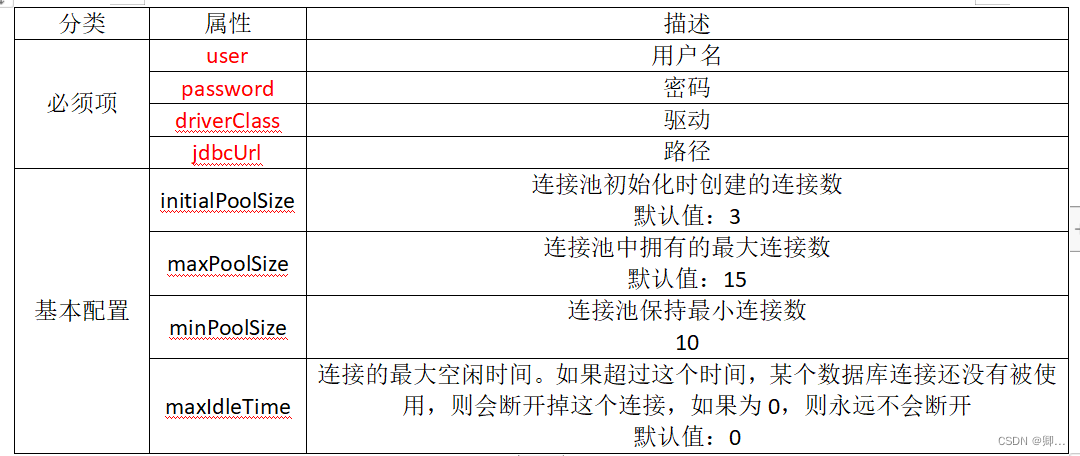
Common configuration
Druid Connection pool
Druid( Druid ) Is a database connection pool developed by alibaba that it claims was created for surveillance ,Druid Is the best database connection pool available ,Druid Is the best database connection pool available . In the functional 、 performance 、 extensibility , All over the other database connection pool , At the same time, log monitoring is added , It's a good monitor DB Pool connection and SQL Implementation of
Import jar Packages and configuration files
1) Import jar package 
2) Import profile
- yes properties Formal
- You can call it anything , It can be placed in any directory , We put it together resources Resource directory

To write Druid Tool class
- Get database connection pool object
Through the factory DruidDataSourceFactory Class createDataSource Method
createDataSource(Properties p) The method parameter can be an attribute set object
package com.utils;

import com.alibaba.druid.pool.DruidDataSourceFactory;

import javax.sql.*;
import java.io.InputStream;
import java.sql.Connection;
import java.sql.ResultSet;
import java.sql.SQLException;
import java.sql.Statement;
import java.util.Properties;

public class DruidUtils {


// 1. Define member variables
    public static DataSource dataSource;

// 2. Static code block
    static {

//  Create property set object
       try {

        Properties p = new Properties();
// Druid Connection pool cannot load configuration file actively , Need to execute documents
        InputStream inputStream = DruidUtils.class.getClassLoader().getResourceAsStream("druid.properties");

// Properties object   Of Load Method , Read configuration information from byte stream

        p.load(inputStream);

//  Get the connection pool object through the factory class
           dataSource=DruidDataSourceFactory.createDataSource(p);
       } catch (Exception e) {

        e.printStackTrace();
        }
   }

//  How to get the connection
    public static Connection getConnection(){


        try {

            return dataSource.getConnection();
        } catch (SQLException e) {

            e.printStackTrace();
            return null;
        }
    }

    //  Release resources
    public static void close(Connection connection, Statement statement, ResultSet resultSet){

        if (connection != null && statement != null && resultSet != null){

            try {

                resultSet.close();
                statement.close();
//  Return connection
                connection.close();
            } catch (SQLException throwables) {

                throwables.printStackTrace();
            }
        }
    }
}
package com.testpool;

import com.utils.DruidUtils;
import java.sql.Connection;
import java.sql.ResultSet;
import java.sql.SQLException;
import java.sql.Statement;

public class TestDruid {

//  demand   Query salary in 3000~5000 Between   Of employees

    public static void main(String[] args) throws SQLException {


// 1. Get the connection
        Connection connection = DruidUtils.getConnection();

// 2. obtain statement object
        Statement statement = connection.createStatement();

// 3. Execute the query
        ResultSet resultSet = statement.executeQuery("select ename from employee where salary between 3000 and 5000");

// 4. Processing result set
        while (resultSet.next()){

            String ename = resultSet.getString("ename");
            System.out.println(ename);
        }

// 5. Release resources
        DruidUtils.close(connection,statement,resultSet);
    }
}
DBUtils Tool class
DBUtils brief introduction
- Use JDBC We found too much redundant code , To simplify development , We choose to use DbUtils
- Commons DbUtils yes Apache The organization provides a solution to DBC Open source tool class library for simple encapsulation , Using it can simplify JDBC Application development , At the same time, it will not affect the performance of the program
- Usage mode :
DBUtils Namely JDBC A simplified development kit for . Project import required commons-dbutils-1.6.jar.
Dbutils Introduction to core functions
- QueryRunner Provided in pairs sql Statement operation API
- ResultSetHandler Interface , Used for definition select After the operation , How to encapsulate result sets
- DbUtils class , It's a tool class , It defines the methods of closing resources and transaction processing
Case related knowledge
The relationship between tables and classes
- The whole table can be seen as a class
- A row in a table , Corresponding to an instance of a class ( object )
- A column in the table , Corresponding to a member attribute in the class

JavaBean Components
1.JavaBean It's a class , It is usually used to encapsulate data in development , Has the following characteristics :;
1) Need to implement serialization interface ,Serializable( For the time being, you can omit )
2) Provide private fields :private type Variable name ;
3) Provide getter and setter
4) Provide Space parameter structure
2. establish Employee Objects and databases employee Table correspondence
package com.entity;


import java.util.Date;

/** * JavaBean class  *  Used to store data   Member variables are private   Provide get set  Provide empty parameters   implements Serializable  * * Employee class   It corresponds to employee surface  * * eid int PRIMARY KEY auto_increment, * ename VARCHAR(20), * age int, * sex VARCHAR(6), * salary DOUBLE, * empdate date */
public class Employee {


    private int eid ;

    private String ename ;

    private int age ;

    private String sex ;

    private double salary ;

    private Date empdate ;

    public Employee() {

    }

    public Employee(int eid, String ename, int age, String sex, double salary, Date empdate) {

        this.eid = eid;
        this.ename = ename;
        this.age = age;
        this.sex = sex;
        this.salary = salary;
        this.empdate = empdate;
    }

    public int getEid() {

        return eid;
    }

    public void setEid(int eid) {

        this.eid = eid;
    }

    public String getEname() {

        return ename;
    }

    public void setEname(String ename) {

        this.ename = ename;
    }

    public int getAge() {

        return age;
    }

    public void setAge(int age) {

        this.age = age;
    }

    public String getSex() {

        return sex;
    }

    public void setSex(String sex) {

        this.sex = sex;
    }

    public double getSalary() {

        return salary;
    }

    public void setSalary(double salary) {

        this.salary = salary;
    }

    public Date getEmpdate() {

        return empdate;
    }

    public void setEmpdate(Date empdate) {

        this.empdate = empdate;
    }

    @Override
    public String toString() {

        return "Employee{" +
                "eid=" + eid +
                ", ename='" + ename + '\'' +
                ", age=" + age +
                ", sex='" + sex + '\'' +
                ", salary=" + salary +
                ", empdate=" + empdate +
                '}';
    }
}
DBUtils complete CRUD
QueryRunner Core class
- Construction method
    QueryRunner()
    QuerRunner(DataSource ds), Provide data sources ( Connection pool ),DBUtils Bottom layer automatic maintenance connection Connection
- Common methods
update(Connection conn,String sql, Object ... params), Used to add table data 、 Delete 、 update operation
query(Connection conn,String sql, ResultSetHandler<T> rsh ,Object ... params), Used to complete the query operation of table data
QueryRunner The creation of
- Manual mode
//  Mode one : Manual mode
        QueryRunner qr = new QueryRunner() ;
- Automatic mode
//  Mode two : Automatic mode   Provide database connection pool object  DBUtils Will automatically maintain the connection
        QueryRunner qr2 = new QueryRunner(DruidUtils.getDataSource()) ;
- Automatic mode requires an incoming connection pool object
//  obtain Druid Connection pool method
    public static DataSource getDataSource(){

        return dataSource;
    }
QueryRunner Realize increase 、 Delete 、 Change operation
The core approach
update(Connection conn , String sql , Object… params)
| Parameters | explain |
|---|---|
| Connection conn | Database connection object , Automatic mode creation QueryRunner Can not pass , Manual mode must pass |
| String sql | In the form of a placeholder SQL, Use ? Place holder |
| Object… param | Object Type of Variable parameter , Used to set parameters on the placeholder |
- step
1. establish QueryRunner( Manual or automatic )
2. Placeholder method To write SQL
3. Set the placeholder parameter
4. perform
package com.testDBUtils;


import com.utils.DruidUtils;
import org.apache.commons.dbutils.DbUtils;
import org.apache.commons.dbutils.QueryRunner;
import org.junit.Test;

import java.sql.Connection;
import java.sql.SQLException;

/** *  Use QueryRunner  object   Complete the operation of adding, deleting and modifying  * update(Connection conn , String sql , Object... param) Method  */
public class DBUtilsDemo02 {


    @Test
    public void testInsert() throws SQLException {

// 1. establish QueryRunner  Manual mode creation
        QueryRunner qr = new QueryRunner();

// 2. How to write a place holder  SQL
        String sql = "insert into employee values(?,?,?,?,?,?)" ;

// 3. Set the parameters of the placeholder
        Object[] param = {
    null," Zhang wanwan " , 20 ," male ", 10000,"1990-12-26"};

// 4. perform update Method
        Connection connection = DruidUtils.getConnection();
        int i = qr.update(connection , sql , param) ;

// 5. Release resources
        DbUtils.close(connection);
    }


//  Modify the operating   Change the name to   The salary of Zhang million's employees is 15000
    @Test
    public void testUpdate() throws SQLException {


// 1. establish   Core class   Automatic mode   Delivery required   Database connection pool object
        QueryRunner qr = new QueryRunner(DruidUtils.getDataSource()) ;

// 2. To write  SQL
        String sql = "update employee set salary = ? where ename = ?" ;

// 3. Set the parameters of the placeholder
        Object[] param = {
    15000," Zhang wanwan "} ;

// 4. Perform modification operations   Automatic mode doesn't need to be passed in connection object
        qr.update(sql,param) ;
    }

//  Delete operation   Delete id by 1 The record of
    @Test
    public void testDelete() throws SQLException {


        QueryRunner qr = new QueryRunner(DruidUtils.getDataSource()) ;

        String sql = "delete from employee where eid = ?" ;

//  If there is only one parameter , There is no need to create arrays
        qr.update(sql,1);
    }
}
QueryRunner Implement query operation
ResultSetHandler Interface profile
- ResultSetHandler It can be used to check out the ResultSet The result set is processed , Meet some business needs
- QueryRunner The query method of
| Method | explain |
|---|---|
| query(String sql , handler , Object[] param) | Automatic mode creation QueryRunner, Execute the query |
| query(Connection con, string sql , Object[] param) | Manually create moss QueryRunner, Execute the query |
- query Methods return values that are generic , Specific return value types , Depending on how the result set is processed , change
ResultSetHandler Result set processing class
This example shows the use of ResultSetHandler Several common implementation classes of the interface realize the addition, deletion, modification and query of the database , Can greatly reduce the amount of code , The optimizer
Each implementation class represents a way to process the query result set
| ResultSetHandler Implementation class | explain |
|---|---|
| ArrayHandler | Encapsulate the first record in the result set into a Object[] Array , Each element in the array is the value of each field in the record |
| ArrayListHandler | Encapsulate every record in the result set into a Object[] Array , Encapsulate these arrays in List Collection |
| BeanListHandler | Encapsulates the first record in the result set into a specified JavaBean in |
| BeanListHandler | Encapsulate each record in the result set into a specified JavaBean in , And I'll put these JavaBean After packaging to List Collection |
| ColumnListHandler | Sets the field value of the specified column in the result set to , Package into a List Collection |
| KeyedHandler | Encapsulate each record in the result set into Map<String ,Object>, In the map Set as another Map Of value, the other one Map A collection of key Is the value of the specified field |
| MapHandler | Encapsulate the first record in the result set into Map<String ,Object> Collection ,key That's the field name ,value Is the field value |
| MapListHandler | Encapsulate every record in the result set into Map<String , Object> Collection ,key That's the field name ,value Is the field value , I'm putting these Map Package to List Collection |
| ScalaryHandler | It is used to encapsulate single data . for example select count(*) from Table operations |
ResultSetHandler Common implementation class testing
Create a test class , Yes ResultSetHandler Several common implementation classes of the interface are tested
Inquire about id by 5 The record of , Encapsulate in an array
Query all the data , Package to List Collection
Inquire about Id by 5 The record of , Encapsulate to the specified JavaBean in
Query salary greater than 3000 All employee information for , Package to JavaBean And then encapsulate it to List Collection
The query name is Zhang million's employee information , Encapsulate the results to Map Collection
Query the total salary of all employees
package com.testDBUtils;

import com.entity.Employee;
import com.sun.source.doctree.SeeTree;
import com.utils.DruidUtils;
import org.apache.commons.dbutils.QueryRunner;
import org.apache.commons.dbutils.handlers.*;
import org.junit.Test;

import java.sql.SQLException;
import java.util.Arrays;
import java.util.List;
import java.util.Map;
import java.util.Set;

public class DbUtilsDemo03 {


    /** * *  Inquire about id by 5 The record of , Encapsulate in an array  * ArrayHandler  Encapsulate the first data of the result set into an array  * */

    @Test
    public void testFindById() throws SQLException {


// 1. establish QueryRunner
        QueryRunner qr = new QueryRunner(DruidUtils.getDataSource()) ;

// 2. To write SQL
        String sql = "select * from employee where eid = ?" ;

// 3. Execute the query
        Object[] query = qr.query(sql, new ArrayHandler(), 5);

// 4. Get array
        System.out.println(Arrays.toString(query));

    }

    /** *  Inquire about id by 5 The record of , Encapsulate to a specified JavaBean in  * BeanHandler  Encapsulate the first data of the result set to JavaBean in  * */
    @Test
    public void testFindByIdJavaBean() throws SQLException {


        QueryRunner qr = new QueryRunner(DruidUtils.getDataSource());

        String sql = "select * from employee where eid = ?" ;
        Employee employee = qr.query(sql, new BeanHandler<Employee>(Employee.class), 3);

        System.out.println(employee);
    }

    /** *  Query salary greater than 3000 All employee information for , Package to JavaBean And then encapsulate it to List Collection  * BeanListHandler  Encapsulate every record and data of the result set into JavaBean in   then JavaBean  Put it in List Collection  * */
   @Test
    public void testFindBySalary() throws SQLException {


        QueryRunner qr = new QueryRunner(DruidUtils.getDataSource()) ;

        String sql = "select * from employee where salary > ?" ;

        List<Employee> list = qr.query(sql, new BeanListHandler<Employee>(Employee.class), 3000);

        for (Employee employee: list){

            System.out.println(employee);
        }
    }

    /** *  The query name is Zhang million's employee information , Encapsulate the results to Map Collection  * MapHandler  Encapsulate the first record of the result set to Map<String , Object> * key The corresponding is the column name  value  It corresponds to the value of the column  * */
    @Test
    public void testFindByName() throws SQLException {


        QueryRunner qr = new QueryRunner(DruidUtils.getDataSource()) ;

        String sql = "select * from employee where ename = ?" ;

        Map<String, Object> map = qr.query(sql, new MapHandler(), " Zhang wanwan ");

        Set<Map.Entry<String , Object>> entries = map.entrySet();

        for (Map.Entry<String , Object> entry : entries){


//  Print the results
            System.out.println(entry.getKey() + "=" + entry.getValue());
        }
    }

    /** *  Query the total salary of all employees  * ScalarHandler  Used to encapsulate individual data  * */
    @Test
    public void testGetSum() throws SQLException {


        QueryRunner  qr = new QueryRunner(DruidUtils.getDataSource()) ;

        String sql = "select sum(salary) from employee" ;

        double sum = (double) qr.query(sql, new ScalarHandler<>());

        System.out.println(" The total salary of employees : " + sum);
    }
}
establish BeanHandler You need to pass a parameter , The parameter is JavaBean Class class File object
Employee.class Create... By reflection Employee Object encapsulates the result set into an object And back to
Database batch processing
What is batch processing
- The batch (batch) Operating the database
 Batch processing refers to the execution of multiple SQL sentence , Batch processing is much more efficient than once at a time
 When you add a lot of data to a database , Batch processing is needed
- give an example : The delivery man's job :
- When batch processing is not used , The deliveryman can only deliver one piece of goods to the merchant at a time
- Using batch processing is to send the deliveryman all the goods to be transported , They all take the car to the distribution office and send it to customers
Implement batch processing
Statement and PreparedStatement Both support batch operations
PreparedStatement The batch method of
1) The method to be used
| Method | explain |
|---|---|
| void addBatch() | Will be given SQL Add the command to this Statement In the current command list of the object . By calling a method executeBatch You can batch execute the commands in this list |
| int[] executeBatch() | Each time a batch of commands are submitted, they are executed in the database , If all the commands are executed successfully , So return an array , This array describes the number of rows affected by each command |
2)mysql Batch processing is turned off by default , So you need to add a parameter to open mysql Database batch processing , stay url Add
package com.testbatch;

import com.utils.DruidUtils;

import java.sql.Connection;
import java.sql.PreparedStatement;
import java.sql.SQLException;

public class BatchInsert {

// Use batch processing to add  10000  Data
    public static void main(String[] args) throws SQLException {


//1. Get the connection
        Connection connection = DruidUtils.getConnection() ;

// 2. Get preprocessing object
        PreparedStatement ps = connection.prepareStatement(" insert into testBatch(uname) values(?)");

// 3. Perform a batch insert operation
        for (int i= 0 ; i < 10000 ; i++){

            ps.setString(1," cockroach " + i );

//  take SqL Add to batch list
            ps.addBatch();
        }

//  Add time stamp   Test execution efficiency
        long start = System.currentTimeMillis();

// 4. Unified execution   Bulk insert operation
        ps.executeBatch();

        long end = System.currentTimeMillis();

        System.out.println(" Insert 10000 Pieces of data need to use : " + (end - start) + " millisecond ");
// 5. Close the connection
        DruidUtils.close(connection , ps);
    }
}
MySQL Metadata
What is metadata
- Data other than tables is metadata , It can be divided into three categories :
Query result information :Update or Delete sentence Number of records affected
Database and table information : Contains the database as well as Data sheet Structure information of
MySQL server information : Contains the current state of the database server , Version number, etc
Common commands
--- Introduction to metadata related commands
1. View the current status of the server

show status;

2. see MySQL Version information for

select version();

3. Look up the details in the table

show columns from  Table name ;

4. Display detailed index information of table data

show index from  Table name ;

5. List all databases

show databases ;

6. Displays all tables in the current database

show tables;

7. Get the current database name

select database();
Use JDBC Fetch metadata
adopt JDBC You can also get metadata , For example, the relevant information of the database , Or when we use a program to query an unfamiliar table , We can get metadata information by , Understand how many fields are in the table , Name of field and Type of field
Common class introduction
JDBC Metadata classes described in
| metadata class | effect |
|---|---|
| DatabaseMetaDate | Describe the metadata object of the database |
| ResultSetMetaData | Metadata object that describes the result set |
- Methods to get metadata objects :getMetaData()
connection Connection object , call getMetaData() Method , What you get is DatabaseMetaData Database metadata object
PreparedStatement Preprocessing object calls getMetaData() , What you get is ResultSetMetaData, Result set metadata object
- DatabaseMetaData The common method of
| Method statement |
|---|
| getURL(): Get the URL |
| getUserName() : Get the user name of the current database |
| getDatabaseProductName(): Get the product name of the database |
| getDatabaseProductVersion(): Get the version number of the database |
| getDriverName(): Returns the name of the driver |
| isReadOnly(): Determine whether the database is only allowed to be read-only true Read only |
- ResultSetMetaData The common method of
| Method statement |
|---|
| getColumnCount(): How many columns are there in the current result set |
| getColumnName(int i): Gets the column name of the specified column number , The parameter is an integer from 1 Start |
| getColumnTypeName(int i): Gets the type of the specified column number , The parameter is an integer from 1 Start |
package com.testmetadata;

import com.utils.DruidUtils;
import org.junit.Test;

import java.sql.*;
import java.util.Properties;

public class TestMetaData {

// 1. Get the metadata information related to the database   Use DatabaseMetaData
    @Test
    public void testDataBaseMetaData() throws SQLException {


// 1. Get database connection object  connection
        Connection connection = DruidUtils.getConnection();

// 2. Get metadata information related to the representative database
        DatabaseMetaData metaData = connection.getMetaData();

        String url = metaData.getURL() ;
        System.out.println(" database URL:" + url);

        String userName = metaData.getUserName();
        System.out.println(" The current user : " + userName);

        String databaseProductName = metaData.getDatabaseProductName();
        System.out.println(" Database product name : " + databaseProductName);

        String databaseProductVersion = metaData.getDatabaseProductVersion();
        System.out.println(" Database version : " + databaseProductVersion);

        String driverName = metaData.getDriverName();
        System.out.println(" Database driver name : " +driverName);

        boolean readOnly = metaData.isReadOnly();
        System.out.println(" Whether the database is read-only : " + readOnly);

        connection.close();

    }

//  Get the metadata information in the result set

    @Test
    public void restResultSetMetaData() throws SQLException {

// 1. Get the connection
        Connection connection = DruidUtils.getConnection();

// 2. Get preprocessing object
        PreparedStatement ps = connection.prepareStatement("select * from employee") ;
        ResultSet resultSet = ps.executeQuery();

// 3. Get the result set metadata object
        ResultSetMetaData metaData = ps.getMetaData();

//  Get the current result set   How many columns are there in total
        int count = metaData.getColumnCount();
        System.out.println(" In the current result set : " + count + " Column ");


        for (int i = 1 ; i <= count ; i++){

            //  Get the name of the specified column number   and   type , The parameter is an integer
            String catalogName = metaData.getColumnName(i);
            System.out.println(" Name : " +catalogName);

            String columnTypeName = metaData.getColumnTypeName(i);
            System.out.println(" type : " + columnTypeName);
        }


//  Release resources
        DruidUtils.close(connection,ps,resultSet);

    }
}
边栏推荐
- MySQL client to server character set conversion
- Classic examples of C language - use 4 × The matrix displays all integers from 1 to 16 and calculates the sum of each row, column, and diagonal
- Difference between data index and label system of data warehouse
- GBase 8c 二进制字符串操作符
- Semaphore
- sed 深入理解与使用
- 北峰通信亮相中国(厦门)应急展|智能化通信手段强势吸睛!
- Redis distributed lock to be continued
- English语法_指示代词 - So
- Bean Validation自定义容器验证篇----06
猜你喜欢

Classic examples of C language - adding two scores

inode、软链接、硬链接
Development of main applet for business card traffic near the map

English grammar_ Demonstrative pronoun - so

MySQL client to server character set conversion

win10下基于anaconda的detectron2安装

Classic example of C language - convert the input two digits into English

High number_ Chapter 1 space analytic geometry and vector algebra__ Two point distance

Mobile terminal H5 - a lifeline timeline

Flutter | specifies the type of page return value
随机推荐
Summary of pit websocket
数仓数据标准详解-2022
EFCore高级Saas系统下单DbContext如何支持不同数据库的迁移
Distributed cap principle
Don't let Fujin Yibo see this
High number_ Chapter 2 differential calculus of multivariate functions__ Geometric application of partial derivatives_ Tangent and normal plane of space curve
《天幕红尘》笔记与思考(五)强势文化与弱势文化
Mobile terminal H5 - a lifeline timeline
GBase 8c 会话信息函数(一)
数据标准详细概述-2022
北峰通信亮相中国(厦门)应急展|智能化通信手段强势吸睛!
C language: deep analysis of const keyword
Educational Codeforces Round 132 (Rated for Div. 2)(A-D)
Redis cluster hash sharding algorithm (slot location algorithm)
Customize an object
Summary of polynomial commitment schemes
Flutter | firstwhere error reporting
GBase 8c 访问权限访问函数(四)
Redis分布式锁待续
JS determines whether the element scrolls to the top