当前位置:网站首页>Yolox backbone -- implementation of cspparknet
Yolox backbone -- implementation of cspparknet
2022-06-24 09:05:00 【Said the Shepherdess】
YOLOX The backbone feature extraction network used is CSPDarknet, As shown in the box on the left of the following figure .

picture source : Pytorch Build your own YoloX Target detection platform (Bubbliiiing Deep learning course )_ Bili, Bili _bilibili
CSPDarknet The main points of the are summarized as follows .
1. Focus Network structure
Focus The specific operation of the structure is , The direction of rows and columns in an image is extracted every pixel , Form a new characteristic layer , Each image can be reorganized into 4 Characteristic layers , And then 4 Feature layers are stacked , Expand the input channel to 4 times . The stacked feature layer is relative to the original 3 The channel becomes 12 passageway , As shown in the figure below :

PyTorch The code implementation is as follows :
class Focus(nn.Module):
    """Focus width and height information into channel space."""

    def __init__(self, in_channels, out_channels, ksize=1, stride=1, act="silu"):
        super().__init__()
        self.conv = BaseConv(in_channels * 4, out_channels, ksize, stride, act=act)

    def forward(self, x):
        # shape of x (b,c,w,h) -> y(b,4c,w/2,h/2)
        patch_top_left = x[..., ::2, ::2]
        patch_top_right = x[..., ::2, 1::2]
        patch_bot_left = x[..., 1::2, ::2]
        patch_bot_right = x[..., 1::2, 1::2]
        x = torch.cat(
            (
                patch_top_left,
                patch_bot_left,
                patch_top_right,
                patch_bot_right,
            ),
            dim=1,
        )
        return self.conv(x)
2. Residual network Residual
CSPDarknet The residual network in is divided into two branches , Do a trunk branch 1x1 Convolution sum once 3x3 Convolution , The residual edge part is not processed , It is equivalent to directly combining the input and output of the trunk .
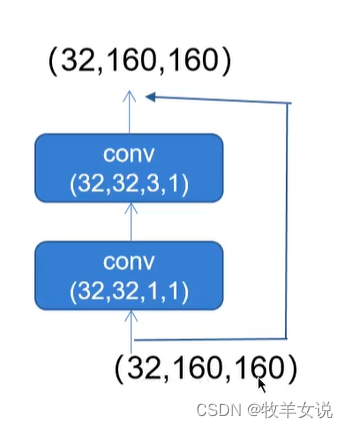
The code is as follows ,
class Bottleneck(nn.Module):
    # Standard bottleneck
    def __init__(
        self,
        in_channels,
        out_channels,
        shortcut=True,
        expansion=0.5,
        depthwise=False,
        act="silu",
    ):
        super().__init__()
        hidden_channels = int(out_channels * expansion)
        Conv = DWConv if depthwise else BaseConv
        self.conv1 = BaseConv(in_channels, hidden_channels, 1, stride=1, act=act)
        self.conv2 = Conv(hidden_channels, out_channels, 3, stride=1, act=act)
        self.use_add = shortcut and in_channels == out_channels

    def forward(self, x):
        y = self.conv2(self.conv1(x))
        if self.use_add:
            y = y + x
        return y
Among them DWConv refer to Depthwise Convolution, In lightweight networks such as YOLOX-Nano and YOLOX-Tiny use .
DWConv and BaseConv Is defined as follows :
class DWConv(nn.Module):
    """Depthwise Conv + Conv"""

    def __init__(self, in_channels, out_channels, ksize, stride=1, act="silu"):
        super().__init__()
        self.dconv = BaseConv(
            in_channels,
            in_channels,
            ksize=ksize,
            stride=stride,
            groups=in_channels,
            act=act,
        )
        self.pconv = BaseConv(
            in_channels, out_channels, ksize=1, stride=1, groups=1, act=act
        )

    def forward(self, x):
        x = self.dconv(x)
        return self.pconv(x)
class BaseConv(nn.Module):
    """A Conv2d -> Batchnorm -> silu/leaky relu block"""

    def __init__(
        self, in_channels, out_channels, ksize, stride, groups=1, bias=False, act="silu"
    ):
        super().__init__()
        # same padding
        pad = (ksize - 1) // 2
        self.conv = nn.Conv2d(
            in_channels,
            out_channels,
            kernel_size=ksize,
            stride=stride,
            padding=pad,
            groups=groups,
            bias=bias,
        )
        self.bn = nn.BatchNorm2d(out_channels)
        self.act = get_activation(act, inplace=True)

    def forward(self, x):
        return self.act(self.bn(self.conv(x)))

    def fuseforward(self, x):
        return self.act(self.conv(x))
3. CSPNet Network structure
CSPNet Structure and Residual It's kind of like , It is also divided into two parts , The trunk part is used to stack the residual blocks , The other part is like the residual edge , After a small amount of processing, it is connected to the last part of the trunk . Here is the following :

This is from the Internet .
The rightmost part of the figure above is CSPNet Decomposition structure of , among ,Bottleneck The number of can be configured according to different layers . The code implementation of this structure is as follows :
class CSPLayer(nn.Module):
    """C3 in yolov5, CSP Bottleneck with 3 convolutions"""

    def __init__(
        self,
        in_channels,
        out_channels,
        n=1,
        shortcut=True,
        expansion=0.5,
        depthwise=False,
        act="silu",
    ):
        """
        Args:
            in_channels (int): input channels.
            out_channels (int): output channels.
            n (int): number of Bottlenecks. Default value: 1.
        """
        # ch_in, ch_out, number, shortcut, groups, expansion
        super().__init__()
        hidden_channels = int(out_channels * expansion)  # hidden channels
        #  The trunk part is convoluted for the first time
        self.conv1 = BaseConv(in_channels, hidden_channels, 1, stride=1, act=act)
        #  The first convolution of the large residual edge part
        self.conv2 = BaseConv(in_channels, hidden_channels, 1, stride=1, act=act)
        #  Convolute the stacked results , Note after stacking , Input channels Doubled
        self.conv3 = BaseConv(2 * hidden_channels, out_channels, 1, stride=1, act=act)

        #  Build... According to the number of cycles Bottleneck Residual structure
        module_list = [
            Bottleneck(
                hidden_channels, hidden_channels, shortcut, 1.0, depthwise, act=act
            )
            for _ in range(n)
        ]
        self.m = nn.Sequential(*module_list)

    def forward(self, x):
        # X_1 It is the trunk part
        x_1 = self.conv1(x)
        # x_2 Is the large residual side part
        x_2 = self.conv2(x)
        #  In the main part, the residual structure stack is used for feature extraction
        x_1 = self.m(x_1)
        #  The trunk part and the large residual side part are stacked
        x = torch.cat((x_1, x_2), dim=1)
        #  Convolute the stacking results
        return self.conv3(x)
4. SiLU Activation function
SiLU The activation function is Signoid and ReLU Improved version , Having a lower bound and no upper bound 、 smooth 、 Nonmonotonic properties , The effect on the deep model is better than ReLU. Something like this :

The implementation code is as follows :
class SiLU(nn.Module):
    """export-friendly version of nn.SiLU()"""

    @staticmethod
    def forward(x):
        return x * torch.sigmoid(x)
5. SPP structure
SPP yes Spatial Pyramid Pooling Abbreviation . stay CSPDarknet in , Different pooled core sizes are used MaxPool Feature extraction , To improve the feeling of the network . And in YOLOv4 Lieutenant general SPP Use in FPN It's different inside , stay YOLOX in ,SPP The module is used in the backbone feature extraction network . The schematic diagram is as follows :

The implementation code is as follows :
class SPPBottleneck(nn.Module):
    """Spatial pyramid pooling layer used in YOLOv3-SPP"""

    def __init__(
        self, in_channels, out_channels, kernel_sizes=(5, 9, 13), activation="silu"
    ):
        super().__init__()
        hidden_channels = in_channels // 2
        self.conv1 = BaseConv(in_channels, hidden_channels, 1, stride=1, act=activation)
        self.m = nn.ModuleList(
            [
                nn.MaxPool2d(kernel_size=ks, stride=1, padding=ks // 2)
                for ks in kernel_sizes
            ]
        )
        conv2_channels = hidden_channels * (len(kernel_sizes) + 1)
        self.conv2 = BaseConv(conv2_channels, out_channels, 1, stride=1, act=activation)

    def forward(self, x):
        x = self.conv1(x)
        x = torch.cat([x] + [m(x) for m in self.m], dim=1)
        x = self.conv2(x)
        return x
6. CSPDarknet Complete implementation
Okay ,CSPDarknet That's all , Next , The above sub modules need to be assembled into the final CSPDarknet. The code is as follows :
class CSPDarknet(nn.Module):
    def __init__(
        self,
        dep_mul,
        wid_mul,
        out_features=("dark3", "dark4", "dark5"),
        depthwise=False,
        act="silu",
    ):
        super().__init__()
        assert out_features, "please provide output features of Darknet"
        self.out_features = out_features
        Conv = DWConv if depthwise else BaseConv

        #  The input image size is 640x640x3
        #  The initial basic channel is 64
        base_channels = int(wid_mul * 64)  # 64
        base_depth = max(round(dep_mul * 3), 1)  # 3

        #  utilize focus Network structure for feature extraction
        # 640x640x3 -> 320x320x12 -> 320x320x64
        self.stem = Focus(3, base_channels, ksize=3, act=act)

        # dark2
        # Conv: 320x320x64 -> 160x160x128
        # CSPLayer: 160x160x128 -> 160x160x128
        self.dark2 = nn.Sequential(
            Conv(base_channels, base_channels * 2, 3, 2, act=act),
            CSPLayer(
                base_channels * 2,
                base_channels * 2,
                n=base_depth,
                depthwise=depthwise,
                act=act,
            ),
        )

        # dark3
        # Conv: 160x160x128 -> 80x80x256
        # CSPLayer: 80x80x256 -> 80x80x256
        self.dark3 = nn.Sequential(
            Conv(base_channels * 2, base_channels * 4, 3, 2, act=act),
            CSPLayer(
                base_channels * 4,
                base_channels * 4,
                n=base_depth * 3,
                depthwise=depthwise,
                act=act,
            ),
        )

        # dark4
        # Conv: 80x80x256 -> 40x40x512
        # CSPLayer: 40x40x512 -> 40x40x512
        self.dark4 = nn.Sequential(
            Conv(base_channels * 4, base_channels * 8, 3, 2, act=act),
            CSPLayer(
                base_channels * 8,
                base_channels * 8,
                n=base_depth * 3,
                depthwise=depthwise,
                act=act,
            ),
        )

        # dark5
        # Conv: 40x40x512 -> 20x20x1024
        # SPPConv: 20x20x1024 -> 20x20x1024
        # CSPLayer: 20x20x1024 -> 20x20x1024
        self.dark5 = nn.Sequential(
            Conv(base_channels * 8, base_channels * 16, 3, 2, act=act),
            SPPBottleneck(base_channels * 16, base_channels * 16, activation=act),
            CSPLayer(
                base_channels * 16,
                base_channels * 16,
                n=base_depth,
                shortcut=False,
                depthwise=depthwise,
                act=act,
            ),
        )

    def forward(self, x):
        outputs = {}
        x = self.stem(x)
        outputs["stem"] = x
        x = self.dark2(x)
        outputs["dark2"] = x

        # dark3 The output of is 80x80x256 Effective feature layer
        x = self.dark3(x)
        outputs["dark3"] = x

        # dark4 The output of is 40x40x512 Effective feature layer
        x = self.dark4(x)
        outputs["dark4"] = x

        # dark5 The output of is 20x20x1024 Effective feature layer
        x = self.dark5(x)
        outputs["dark5"] = x
return {k: v for k, v in outputs.items() if k in self.out_features}边栏推荐
- PM2 deploy nuxt3 JS project
- 【LeetCode】415. String addition
- Jenkins is deployed automatically and cannot connect to the dependent service [solved]
- 十二、所有功能实现效果演示
- [MySQL from introduction to mastery] [advanced part] (I) character set modification and underlying principle
- 数组相向指针系列
- 双指针模拟
- A tip to read on Medium for free
- [Niuke] length of the last word of HJ1 string
- MySQL - SQL statement
猜你喜欢

Prompt code when MySQL inserts Chinese data due to character set problems: 1366

110. balanced binary tree recursive method

Mysql数据(Liunx环境)定时备份
MySQL data (Linux Environment) scheduled backup

4274. suffix expression

A tip to read on Medium for free

Data midrange: detailed explanation of the technical stack of data acquisition and extraction

OpenCV每日函数 结构分析和形状描述符(7) 寻找多边形(轮廓)/旋转矩形交集

Ebanb B1 Bracelet brush firmware abnormal interrupt handling
![[noi Simulation Competition] send (tree DP)](/img/5b/3beb9f5fdad00b6d5dc789e88c6e98.png)
[noi Simulation Competition] send (tree DP)
随机推荐
JS to find and update the specified value in the object through the key
Transplantation of xuantie e906 -- fanwai 0: Construction of xuantie c906 simulation environment
every()、map()、forEarch()方法。数组里面有对象的情况
IDEA另起一行快捷键
Linux (centos7.9) installation and deployment of MySQL Cluster 7.6
Qingcloud based R & D cloud solution for geographic information enterprises
One article explains in detail | those things about growth
1528. rearrange strings
Digital cloud released the 2022 white paper on digital operation of global consumers in the beauty industry: global growth solves marketing problems
数据中台:数据中台全栈技术架构解析,附带行业解决方案
【Pytorch基础教程31】YoutubeDNN模型解析
【NOI模拟赛】给国与时光鸡(构造)
Qingcloud based "real estate integration" cloud solution
uniapp 开发多端项目如何配置环境变量以及区分环境打包
华为路由器:GRE技术
Camera projection matrix calculation
Huawei Router: GRE Technology
KaFormer个人笔记整理
数组相向指针系列
Jenkins is deployed automatically and cannot connect to the dependent service [solved]